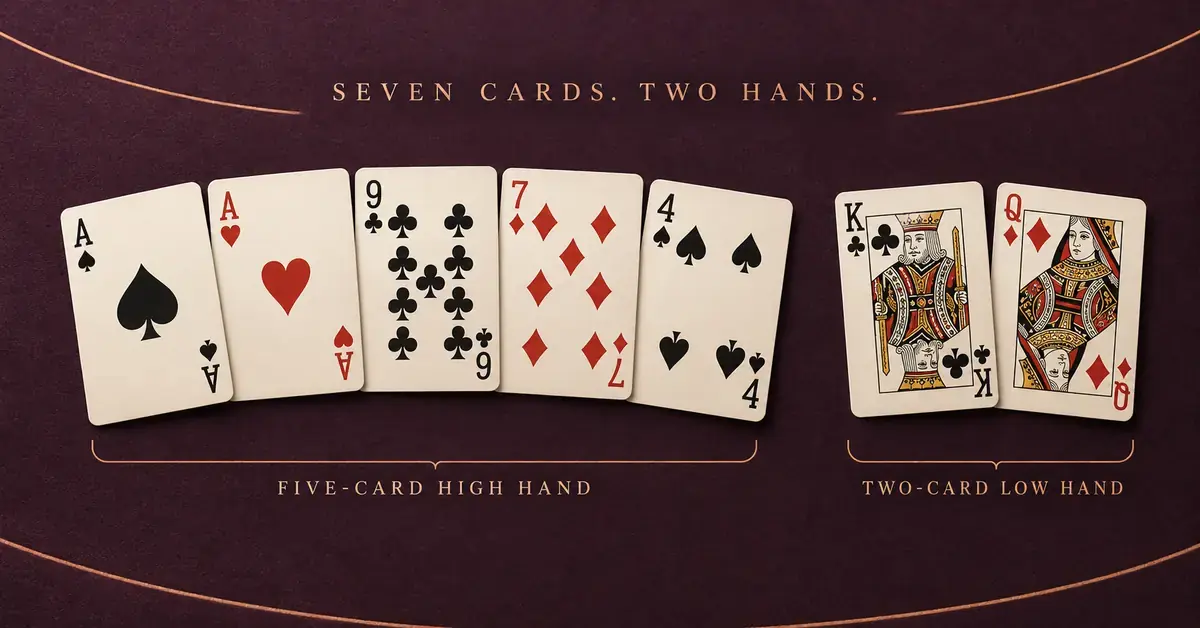
Pai gow poker is a casino card game in which you are dealt seven cards and split them into two separate poker hands — a five-card hand and a two-card hand — that both have to beat the dealer for you to win. It is played with a 53-card deck (a standard pack plus one joker), moves slowly, and produces a lot of tied rounds, which makes it one of the gentler games on a casino floor for a beginner. This guide explains the rules, how to set your hands, the odds and house edge, a simple setting strategy and the mistakes new players make most often.
Key Points
- You are dealt seven cards and split them into a five-card high hand and a two-card low hand; the five-card hand must outrank the two-card hand.
- Both of your hands must beat the dealer’s to win; win one and lose one and the round is a push (about 40% of hands).
- Played with 53 cards — a standard deck plus one semi-wild joker that only completes straights and flushes, otherwise counting as an ace.
- Ties (“copies”) go to the banker, and winning bets pay even money minus a 5% commission.
- House edge is about 2.5% with optimal setting (~2.7% following the house way); it drops to near zero if you bank.
What is pai gow poker?
Pai gow poker is a banking card game where every player competes only against the dealer (or whoever is acting as banker), not against each other. The name borrows from pai gow, an old Chinese gambling game played with domino-style tiles; the poker version swaps the tiles for a deck of cards and standard poker hand rankings.
The modern game was created in 1985 by Sam Torosian, owner of the Bell Card Club in California, who adapted the idea from an Asian card game a customer described to him. California card rooms at the time were restricted in which games they could legally spread, so a new game was a practical way around those limits. Torosian never patented it, which is a large part of why it spread so quickly — any casino could offer it without paying a licence fee. It reached Las Vegas within about a year and is now a fixture in casinos across North America, including regulated Canadian online and land-based venues.
Because each round is settled on two hands at once, pai gow poker ties (“pushes”) far more often than most casino games. That slow, low-swing rhythm is the game’s signature: your bankroll tends to drift rather than lurch, which is why it appeals to players who want table time without big volatility.
What you need to know before the deal
Two things set pai gow poker apart from standard poker before a single card is dealt: the deck and the layout of the hands.
The 53-card deck and the joker
Pai gow poker uses a standard 52-card deck plus one joker, for 53 cards in total. The joker is semi-wild (dealers call it a “bug”): it can only be used to complete a straight, a flush, a straight flush or a royal flush. In any other situation it simply counts as an ace. This is a common point of confusion — in standard pai gow poker the joker is not a fully wild card that can stand in for anything. Because the joker can act as a fifth ace, the single best possible hand is five aces (four natural aces plus the joker), which outranks even a royal flush.
Two hands, not one
You are dealt seven cards and must split them into:
- The five-card hand — called the high hand, back hand or “big” hand. It uses standard five-card poker rankings.
- The two-card hand — called the low hand, front hand or “small” hand. It can only be a pair or two unmatched high cards.
The one rule you must never break: the five-card hand has to outrank the two-card hand. If your two-card hand is higher — for example, a pair of kings in front while the back holds no pair — the hand is “fouled” and automatically loses (in some casinos it is reset to the house way). Everything about setting hands flows from this single constraint. If you are new to five-card hand strength, our poker hand rankings guide lists every hand from royal flush down to high card.
How to play pai gow poker, step by step
A round follows the same sequence every time, whether you are at a felt table or playing a digital version online.
- Place your bet. You make one wager on the main game before the deal.
- Receive seven cards. Everyone, including the dealer, is dealt seven cards face down.
- Set your two hands. Arrange five cards as your high hand and two cards as your low hand, keeping the five-card hand stronger than the two-card hand.
- The dealer reveals and sets. The dealer turns over their seven cards and arranges them according to a fixed, posted set of rules called the “house way.”
- Compare both hands. Your high hand is compared with the dealer’s high hand, and your low hand with the dealer’s low hand.
- Settle the bet. The result depends on how many of your two hands beat the dealer’s — explained in the next section.
Quick Facts
| Game type | Casino-banked card game |
|---|---|
| Deck | 53 cards (52 + one joker) |
| Cards per player | 7, set as a 5-card and a 2-card hand |
| Players vs | The dealer/banker only |
| Payout | Even money (1:1) minus 5% commission on wins |
| Ties | Won by the banker (“copies”) |
| Push rate | ~40% of hands |
| House edge | ~2.5% optimal / ~2.7% house way (dealer banking) |
| Volatility | Low — slow pace, frequent pushes |
| Origin | Created 1985 by Sam Torosian, Bell Card Club, California |
How do you win, lose or push?
Pai gow poker has three possible outcomes per round, decided by comparing both of your hands against the dealer’s.
- Win: Both of your hands beat both of the dealer’s hands. You are paid even money (1:1) on your bet, minus a commission (below).
- Loss: Both of your hands lose to the dealer’s. You lose your bet.
- Push (tie): You win one hand and lose the other. Your bet is returned — nobody wins. This split result is the reason pushes are so common.
What happens on a tie: “copies” go to the banker
If one of your hands exactly ties the dealer’s corresponding hand — for example you both hold ace-king in the two-card hand — that is a “copy,” and the banker (normally the dealer) wins it. This small edge matters: it means an exact match counts against you, so a round where you copy one hand and win the other becomes a push rather than a win.
The 5% commission
When you win the round, the casino takes a 5% commission on the winning payout. A $10 win therefore returns $9.50 in profit rather than $10. The commission is the house’s main source of revenue in this game and is built into the odds below. Some jurisdictions run commission-free versions with slightly different rules, but the standard game charges the 5%.
What are the odds and the house edge?
The house edge in standard pai gow poker is about 2.5% when you set every hand optimally, rising to roughly 2.7% if you simply copy the dealer’s house way, in games where the dealer banks. The house edge is the casino’s long-run average take on each bet — our house edge explainer covers how that figure works across games.
The defining statistic, though, is how often rounds push. Because a round is decided on two hands, roughly four in ten hands end in a tie:
| Outcome | Approximate frequency | Effect on your bet |
|---|---|---|
| Win both hands | ~29% | Paid even money, minus 5% |
| Lose both hands | ~30% | Bet lost |
| Push (win one, lose one) | ~40% | Bet returned |
That high push rate makes pai gow poker a low-volatility game: your money lasts longer and swings less than in faster games, but the frequent ties also mean long stretches where nothing much changes. Compared with the ~1.06% banker edge in baccarat, pai gow’s ~2.5% is higher per decision, but far fewer of your bets actually resolve into a win or loss.
How to set your hands: a simple strategy
Setting hands well is the only decision that affects your odds, and most hands set themselves. The guiding principle is to make your two-card low hand as strong as it can be without ever letting it outrank your five-card high hand. Casino rules let you ask the dealer to set your hand “the house way” if you are unsure, and following that costs only a fraction of a percent versus perfect play. Here is a sound starting framework:
- No pair: Put your highest card in the back (five-card) hand and your next two highest cards in the front (two-card) hand.
- One pair: Keep the pair in the back hand and place your two highest remaining cards in the front hand.
- Two pair: This is the key decision. As a rule of thumb, split them — keep the higher pair in the back and move the lower pair to the front — unless your pairs are small and you also hold an ace or king to keep up front. Keeping two low pairs together in the back leaves a weak front hand that pushes or loses too often.
- Three of a kind: Keep all three together in the back hand — except three aces, where you play a pair of aces in the back and one ace in the front.
- Straight or flush: Keep the five-card straight or flush in the back and put your two highest other cards in front, unless you can play a pair in front without breaking the straight or flush.
- Full house: Split it — three of a kind in the back, the pair in the front. A pair up front is a strong two-card hand, and trips alone usually still win the back.
One ranking quirk to remember: A-2-3-4-5 is treated as the second-highest straight in most casinos, not the lowest, which occasionally changes how you set a borderline hand.
Should you be the banker?
In pai gow poker, the banker role can rotate, and players are sometimes offered the chance to bank. This matters because the banker wins all copies (ties), which is where much of the edge lives. When a player banks with optimal setting, the house edge shrinks to almost nothing — close to break-even — though a 5% commission still applies to the banker’s net winnings and you must have enough money to cover every other player’s bet. Most casual players let the dealer bank every hand; that convenience is exactly what gives up the better odds. If your table allows player banking and you can afford the exposure, it is the single biggest lever on the game’s math.
Common mistakes to avoid
- Fouling the hand. Accidentally making the two-card hand stronger than the five-card hand means an automatic loss. Always double-check that the back beats the front before you commit.
- Loading up the back hand. New players often stack all their strength into the five-card hand and leave two weak cards in front. A monster back hand is wasted if the front hand loses every time — balance matters.
- Keeping two pair together. Holding both pairs in the back usually leaves a feeble front hand. Splitting two pair is right far more often than not.
- Assuming the joker is fully wild. It only completes straights and flushes; otherwise it is just an ace. Planning a hand around a wild joker leads to misreads.
- Declining to bank when you could. Passing on the banker role gives away the best odds the game offers.
- Chasing the side bets. Optional bonus wagers (for example “Fortune” or envy bonuses) carry a much higher house edge than the base game and should be treated as entertainment, not value.
How pai gow poker compares to other casino poker games
Pai gow poker sits in the same family as other casino-banked poker games, but its two-hand structure and push rate make it distinct. The table below compares it with games covered elsewhere on this site.
| Game | You play against | Approx. house edge | Pace / volatility |
|---|---|---|---|
| Pai gow poker | Dealer/banker, two hands | ~2.5% (optimal) | Slow, very low — frequent pushes |
| Three Card Poker | Dealer, one three-card hand | ~3.37% (ante-play) | Fast, moderate |
| Video poker | A paytable (no dealer) | Varies by paytable (~0.5%–5%) | Fast, higher |
For a broader overview of how the main felt games work and which carry the best odds, see our guide to casino table games.
Who is pai gow poker for?
Pai gow poker suits players who want a relaxed, drawn-out session rather than fast action. The low volatility and high push rate mean a fixed budget tends to last a long time, and the only skill involved — setting hands — is easy to learn and forgiving thanks to the house-way safety net. It is less suited to players chasing big, quick swings, since the frequent ties flatten the highs and lows. As with every casino game, the house keeps a long-run edge, so it is best approached as paid entertainment rather than a way to make money.
Disclaimer
This article is for information and education only. It is not betting advice and makes no promise of winnings — pai gow poker, like every casino game, keeps a long-term mathematical edge for the house, and no strategy removes it. You must be of legal gambling age in your province (18 or 19 depending on where you live). If gambling stops being fun or starts to cause harm, free, confidential help is available in Canada: call ConnexOntario at 1-866-531-2600 (available 24/7) or read our guide to problem gambling help in Canada and responsible gambling tools.
Sources
Vanliga frågor (FAQ)
Is pai gow poker hard to learn?
No. The rules are simple: split seven cards into a five-card hand and a two-card hand, keep the five-card hand stronger, and beat the dealer on both. Most hands set themselves, and you can always ask the dealer to arrange your cards the house way if you are unsure.
What is the joker used for in pai gow poker?
The joker is semi-wild. It can only be used to complete a straight, a flush, a straight flush or a royal flush. In every other case it simply counts as an ace — it is not a fully wild card that can stand in for anything.
Why do so many hands end in a tie?
Because each round is decided on two separate hands. If you win one hand and lose the other, the round is a push and your bet is returned. That split result happens on roughly four in ten hands, which is why pushes are so frequent.
What is the house edge in pai gow poker?
About 2.5% with optimal hand setting, rising to roughly 2.7% if you follow the dealer’s house way, in games where the dealer banks. If you take the banker role yourself and set hands well, the edge drops to nearly zero.
Why does the casino take 5% of my winnings?
The 5% commission on winning bets is how the house earns its revenue in pai gow poker. A $10 win returns $9.50 in profit. It is already factored into the house-edge figures above.
