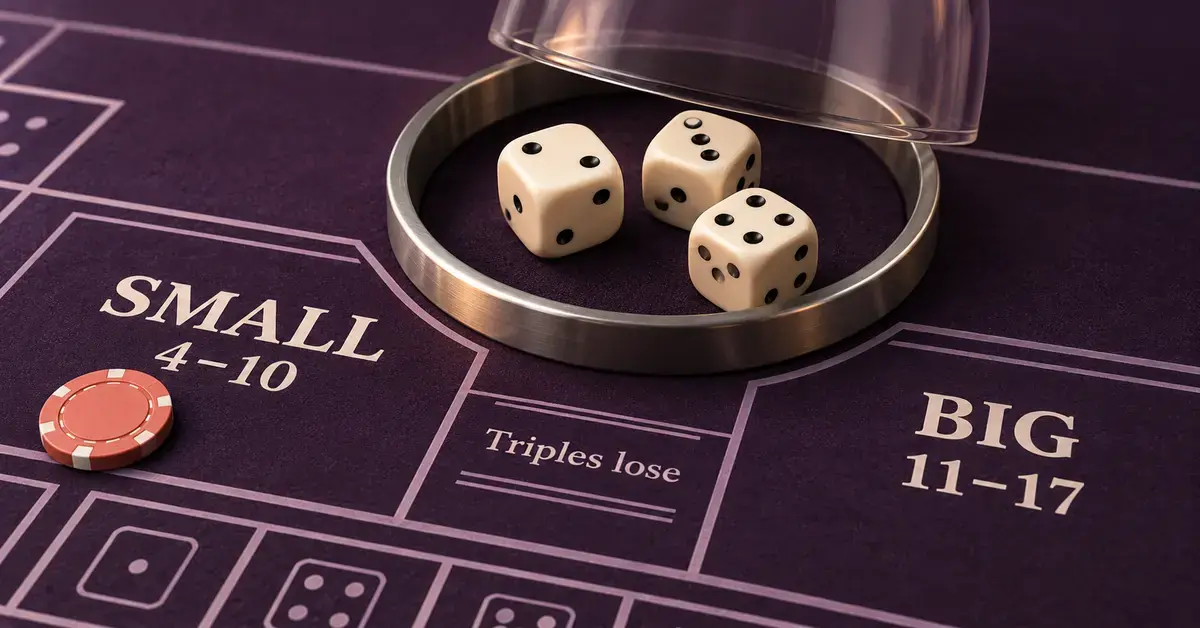
Sic bo is a casino dice game in which you bet on the outcome of three dice shaken in a covered cage or cup. Its name means “precious dice” in Chinese, and you may also see it called dai siu, tai sai, big and small, or hi-lo. There is nothing to learn about hitting, standing or drawing cards: every bet is a wager on what the three dice will show, the dealer reveals them, and winning bets are paid. This guide explains how a round works, walks through every bet on the table, and gives the house edge for each one so you can see exactly which bets are cheap and which are long shots.
Key Points
- Game type: a pure-chance casino game played with three dice; 216 possible combinations.
- How it works: bet on the outcome, the dealer shakes and reveals the dice, winning bets are paid — players never roll.
- Best bets: Small (4–10) and Big (11–17) pay 1:1 at a 2.78% house edge; both lose on any triple.
- Long shots: a specific triple pays up to 180:1 but hits only once in 216 rolls and keeps a 16.20% edge.
- Key tip: payouts vary by casino — always check the posted paytable, since the same bet can carry a very different edge.
What is sic bo?
Sic bo is a game of pure chance played with three standard six-sided dice. Because three dice can land in 6 × 6 × 6 = 216 equally likely combinations, every possible result and its probability can be worked out exactly — which is why the payouts and the house’s advantage on each bet are fixed and known in advance.
The game originated in ancient China and spread through Chinese diaspora communities across Southeast Asia, where it is still widely played; in Macau it is one of the most popular table games. Western casinos adopted close relatives of it: grand hazard and chuck-a-luck are English three-dice variants. Today you will find sic bo in many land-based casinos with a large Asian clientele and in most online and live-dealer casino lobbies.
Unlike craps, where the shooter rolls the dice, sic bo players never touch them. A dealer shakes the dice in a mechanical shaker or transparent dome, and the result is simply revealed. That makes sic bo one of the easiest casino games to join: you only have to place chips on the outcomes you want to back.
How to play sic bo step by step
A round of sic bo follows the same simple loop every time. Here is the sequence from start to finish:
- Buy chips and find the layout. The sic bo table is a large printed grid showing every available bet. In a live casino you place physical chips; online you click a bet area and your stake is placed there.
- Place one or more bets. You can back a single outcome or spread chips across several areas in the same round — for example a Big bet plus a specific total. Each bet is settled independently.
- Betting closes. The dealer calls “no more bets,” or the online timer runs out, and the layout locks.
- The dice are shaken and revealed. All three dice are shaken in the cage or shaker and uncovered. Many electronic tables light up the winning areas automatically.
- Winning bets are paid. The dealer clears losing chips and pays winners at the posted odds. A new round then begins.
That is the entire game. There are no decisions after the dice are shaken and no way to influence the result — your only choices are which bets to make and how much to stake.
The sic bo table layout
The sic bo table looks busy, but it is just a map of the bets. Each box shows the outcome it covers and the payout odds next to it. The main regions are the two large even-money areas (Small and Big) usually at the top corners, a row of specific totals (4 through 17) across the middle, the single-number boxes (one die showing a 1, a 2, and so on), the two-dice combination squares, and the double and triple boxes.
The payout printed in a box is always expressed as “to 1.” A bet marked 1:1 returns your stake plus the same amount again; a bet marked 180:1 returns 180 times your stake plus your original chip. Those printed numbers are exactly where the house edge lives, because they pay out slightly less than the true odds of the event.
Sic bo bets and payouts explained
Sic bo offers a wide range of bets, from near-even-money wagers to long shots that pay up to 180:1. The figures below use the common North American paytable. Payouts vary from casino to casino and between Macau, Atlantic City and Australian rules, so always check the odds printed on the table or screen before you bet — the same bet can carry a very different house edge depending on what it pays.
Sic Bo Bets and House Edge
| Bet | Typical payout | Chance to win | House edge |
|---|---|---|---|
| Small (4–10) / Big (11–17) | 1:1 | 48.61% | 2.78% |
| Odd / Even (where offered) | 1:1 | 48.61% | 2.78% |
| Single number (1 / 2 / 3 dice) | 1:1 / 2:1 / 3:1 | 34.72% (one die) | ~7.87% |
| Two-dice combination | 5:1 | 13.89% | 16.67% |
| Specific double | 10:1 | 7.41% | 18.52% |
| Any triple | 30:1 | 2.78% | 13.89% |
| Specific triple | 180:1 | 0.46% | 16.20% |
| Total 7 or 14 | 12:1 | 6.94% | 9.72% |
| Total 8 or 13 | 8:1 | 9.72% | 12.50% |
| Total 9 or 12 | 6:1 | 11.57% | 18.98% |
| Total 10 or 11 | 6:1 | 12.50% | 12.50% |
| Total 4 or 17 | 60:1 | 1.39% | 15.28% |
Small and Big (and Odd/Even)
The Small and Big bets are the cornerstone of sic bo and carry the lowest house edge. Small wins if the three dice total 4 to 10; Big wins if they total 11 to 17. Both pay 1:1 (even money). The catch is that both bets lose if the dice come up as any triple (three of a kind), even when that triple’s total would otherwise fall in your range. Each bet wins on 105 of the 216 combinations — a 48.61% chance — which produces a house edge of 2.78%. Some tables, mainly in Macau, also offer Odd and Even bets on the same 1:1 terms and 2.78% edge, again losing on any triple.
Single-number bets
A single-number bet (sometimes called a “lucky number”) backs one face, say 5, to appear on at least one of the three dice. The payout scales with how many dice show it: 1:1 if one die matches, 2:1 if two match, and 3:1 if all three match. You win on about 34.72% of rolls for a single match, 6.94% for two and 0.46% for all three. Despite feeling like a safe, intuitive bet, it carries a house edge of around 7.87% — noticeably worse than Big or Small.
Two-dice combination bets
A combination bet (also called a domino bet) backs two specific different faces — for example a 2 and a 5 — to both appear among the three dice. There are 15 such pairings on the table. The bet typically pays 5:1 and wins on 13.89% of rolls, for a steep house edge of 16.67%. Where a casino pays 6:1 instead, the edge drops dramatically to 2.78%, which is why the paytable matters so much.
Double and triple bets
These are the high-risk, high-reward wagers:
- Specific double: bets that a chosen number (e.g. two 4s) appears on at least two dice. It wins about 7.41% of the time and commonly pays 10:1, for a house edge near 18.52%.
- Any triple: wins if all three dice match, regardless of the number. The chance is 6/216 (2.78%); it usually pays 30:1 for a 13.89% edge.
- Specific triple: bets on one exact triple, such as three 6s. The chance is just 1/216 (0.46%), and it pays the game’s top prize of 180:1, which still leaves a 16.20% house edge.
Total (sum) bets
You can bet on the exact total of the three dice, from 4 to 17 (3 and 18 are covered by the specific-triple bets). Totals in the middle of the range are far more likely than the extremes, so the payouts rise toward the edges. A 7 or 14 occurs on 6.94% of rolls; a 4 or 17 on just 1.39%. Using the common North American paytable, the house edge ranges from about 9.72% on a total of 7 or 14 up to roughly 18.98% on a 9 or 12, with the rare 4 and 17 paying 60:1.
Sic bo house edge: which bets are best and worst?
The best bets in sic bo are Small and Big (and Odd/Even where offered) at a 2.78% house edge — competitive with the better wagers in other table games and far cheaper than everything else on the layout. After that, the edge climbs quickly: single-number bets cost about 7.87%, and most totals, doubles, triples and combinations sit between roughly 12% and 19%.
For context, a 2.78% edge means that for every CA$100 wagered on Big or Small over the long run, the house expects to keep about CA$2.78; a bet with an 18% edge expects to lose CA$18 of every CA$100 staked. That is why the long-shot bets drain a bankroll so much faster, even though their big payouts are tempting. If low cost is your priority, sic bo’s Small and Big bets are reasonable, though games like blackjack and baccarat still carry a lower house edge.
Is there a sic bo strategy?
No betting pattern or system can improve your odds in sic bo, because every roll is independent and the house edge is built into each payout. The dice have no memory, so a number that has not appeared in many rounds is no more “due” than any other — a point worth understanding about odds and probability in any casino game.
The only genuinely meaningful decision is bet selection. Sticking to the Small and Big bets keeps you on the 2.78% edge and makes your money last longer than scattering chips on triples and totals. Staking plans such as doubling after a loss do not change the long-run edge; they only change how quickly your results swing. Treat sic bo as entertainment with a known cost, not as a game you can beat.
Common sic bo mistakes to avoid
Beginners tend to lose money faster than they need to for a handful of avoidable reasons:
- Chasing the big payouts. The 180:1 specific triple and 60:1 totals are exciting, but they carry some of the worst edges on the table and hit extremely rarely.
- Assuming single-number bets are safe. Backing one face feels low-risk, but at a 7.87% edge it costs nearly three times as much as Big or Small.
- Ignoring the paytable. A combination bet at 6:1 is a 2.78% edge; the same bet at 5:1 is 16.67%. Always read the posted odds before betting.
- Believing in “due” numbers or hot streaks. Past rolls never influence the next shake.
- Betting more to “win it back.” Chasing losses is how a session gets out of control; set a budget first.
Sic bo vs craps and other dice games
Sic bo and craps both use dice, but they play very differently. In craps, players roll the dice themselves, bets resolve over a sequence of rolls tied to a “point,” and the best wagers (pass line with odds) can get the house edge down toward 1% or lower. In sic bo, you never roll, every bet is decided on a single shake, and the best available edge is 2.78%. Sic bo is simpler to pick up — there is no come-out roll or point to track — but it offers nothing as cheap as the craps pass line.
Compared with other pure-chance games, sic bo’s Small and Big bets are far kinder than keno or most slot machines, while its long-shot bets are as expensive as the worst bets anywhere on the floor. If you enjoy the spectacle of dice but want the lowest cost, learning the casino table games with better odds is worth the effort.
Who is sic bo for?
Sic bo suits players who want a fast, social dice game with no decisions to agonise over and a clear menu of bets at every risk level. If you like backing a near-even-money outcome, the Small and Big bets give you close to a coin-flip with a modest edge; if you enjoy the occasional long shot, the totals and triples are there — just at a much higher cost. It is a poor fit for anyone hoping to apply skill or a winning system, because sic bo rewards neither. As with every casino game, it favours the house over time, so it is best approached as paid entertainment.
Responsible gambling
Sic bo is a game of chance with a built-in house edge on every bet, so over time the math favours the casino and no bet or system changes that. This guide is for information only and is not betting advice. You must be of legal gambling age in your province or territory — 19 in most of Canada, and 18 in Alberta, Manitoba and Quebec — and play only at operators licensed for your region.
Set a budget before you start, treat any losses as the cost of entertainment, and never bet money you cannot afford to lose or try to win back losses by betting more. If gambling is affecting you or someone you know, free, confidential help is available in Canada through ConnexOntario at 1-866-531-2600 and the Responsible Gambling Council. You can also learn more about staying in control on our responsible gambling page.
Sources
Frequently Asked Questions (FAQ)
What is the best bet in sic bo?
The Small and Big bets are the best value. Both pay even money, win on nearly half of all rolls, and carry a house edge of just 2.78% — by far the lowest on the table. Every other bet costs more, so if you want your bankroll to last, stick to these.
How many dice are used in sic bo?
Sic bo is played with three six-sided dice, which gives 216 possible combinations. Bets are settled on the total of the three dice, on individual numbers appearing, and on doubles and triples.
Why do the Small and Big bets lose on a triple?
Any triple (three of a kind) is treated as a special outcome, so Small and Big both lose even if the triple’s total falls in your range. Those 6 triple outcomes out of 216 are exactly what creates the 2.78% house edge on these otherwise even-money bets.
Is sic bo a game of skill or luck?
Sic bo is pure luck. The dice are shaken by the dealer or the machine, every roll is independent, and no decision you make after betting can change the result. The only choice that matters is which bets you place.
Can you win consistently at sic bo?
No. Because every bet carries a house edge and each roll is independent, there is no strategy or system that produces a long-term profit. You can win in the short term through luck, but over time the house advantage will apply.
