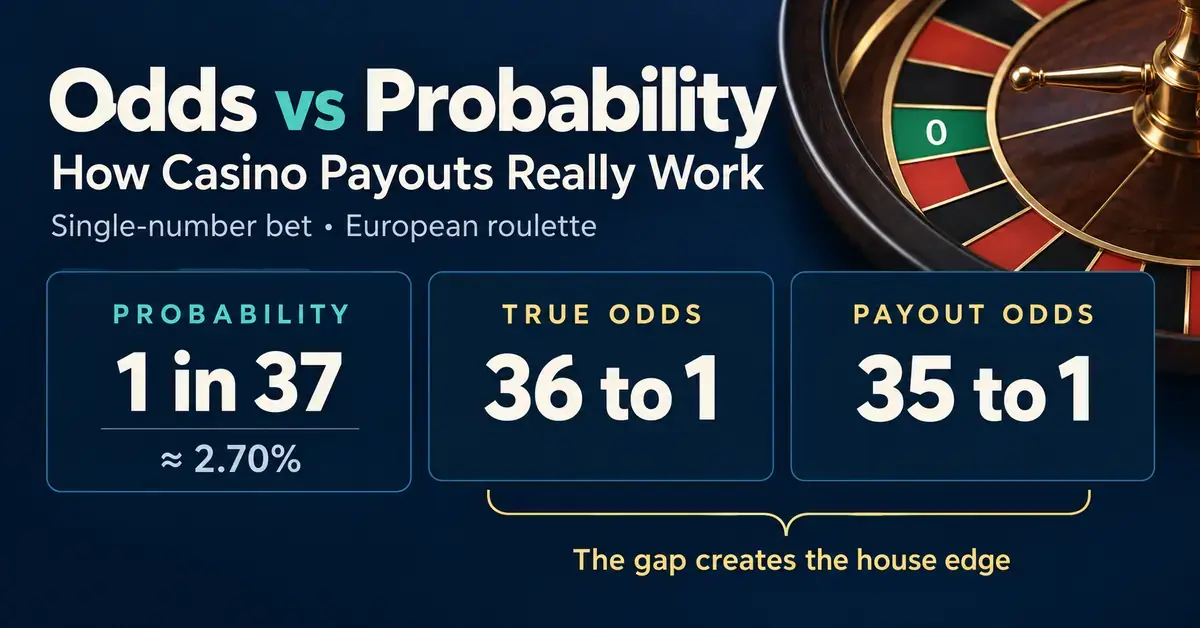
“Odds” and “probability” sound like the same thing, but in a casino they are two different measurements — and a third idea, the payout, hides inside the word “odds” as well. Probability tells you how likely an outcome is. True odds describe that same likelihood as a ratio of losing to winning. Payout odds are what the casino actually hands you when you win. The quiet gap between the last two is where the house edge lives. This guide separates the three ideas in plain language, then shows exactly how a single number on a roulette wheel turns a 36-to-1 chance into a 35-to-1 payout.
Key Points
- Probability measures how likely an outcome is, on a scale from 0 (never) to 1 (certain), often shown as a percentage such as 2.70%.
- True odds state the same thing as a ratio of ways-to-lose to ways-to-win (for example 36 to 1); they are fixed by the game.
- Payout odds are what the casino actually pays a winning bet (for example 35 to 1) — almost always a little short of the true odds.
- The house edge is the gap between true odds and payout odds. On European roulette a single number has true odds of 36 to 1 but pays 35 to 1, and that one-unit gap is the 2.70% edge.
- No bet, system or demo mode changes these fixed payouts; over the long run every standard casino game returns less than the true odds.
What is probability?
Probability measures how likely an outcome is on a fixed scale from 0 to 1. A probability of 0 means something can never happen; a probability of 1 means it is certain. Everything in a casino sits between those two extremes.
You calculate it by dividing the number of ways an event can happen by the total number of equally likely outcomes. On a European roulette wheel there are 37 pockets (the numbers 1 to 36 plus a single zero), so the probability of the ball landing on any one chosen number is 1 divided by 37, which is about 0.027, or 2.70%.
Probability is often written three ways that mean the same thing: a decimal (0.027), a percentage (2.70%), or a “1 in” fraction (1 in 37). None of these is a payout — they only describe how often the event should occur over a very long run of trials.
What are odds, and why are there two kinds?
Odds express the same information as probability, but as a ratio rather than a single number. The confusion starts because the word “odds” is used for two completely different ratios in gambling: true odds and payout odds.
True odds
True odds compare the number of ways to lose against the number of ways to win. They are a fact of the game’s mathematics and cannot be changed. On a European wheel, one number wins and 36 numbers lose, so the true odds against hitting your number are 36 to 1. Read that as “36 ways to lose for every 1 way to win.”
True odds and probability are just two views of the same reality. A 1-in-37 probability is the same event as 36-to-1 true odds — one counts the winning pocket, the other counts the losing ones.
Payout odds
Payout odds are what the casino pays on a winning bet, written the same way (for example 35 to 1). They are set by the house, printed on the felt, and are almost always a little short of the true odds. That shortfall is not an accident or a fee you can see — it is the entire business model.
How do you convert between probability and odds?
Converting between the two is simple arithmetic, and doing it yourself is the fastest way to spot a bad bet.
- Probability to true odds against: if the probability of winning is 1 in 37, subtract the 1 winning outcome from the 37 total to get 36 losing outcomes, giving true odds of 36 to 1.
- Odds to probability: for odds of 36 to 1, add both sides (36 + 1 = 37) and the probability of winning is 1 divided by 37.
- Odds to a percentage: 36-to-1 odds mean 1 chance in 37, or about 2.70%.
Notice that a bet quoted at “35 to 1” is a payout figure, while “36 to 1” is the true-odds figure for the same bet. They look almost identical, which is precisely why so many players never notice the difference.
What are casino payouts, and how are they written?
A casino payout is the profit you receive on a winning bet, stated as a ratio of winnings to stake. The notation matters, because two common formats look alike but mean different amounts.
- “To” odds (for example 35 to 1): you win 35 units plus your original 1-unit stake back. A winning \$10 straight-up roulette bet returns \$350 in winnings and your \$10 stake, for \$360 in your hand.
- “For” odds (for example 35 for 1): the total return is 35 units and your stake is not returned on top. This is mostly seen on some machine and video-poker pay tables, and it is worth one unit less than the “to” version.
Whenever a pay table uses “for” instead of “to,” the real payout is one unit smaller than it first appears. Reading the small print here is a genuine, legal way to avoid overpaying for a bet.
Where does the house edge come from?
The house edge is the gap between true odds and payout odds, expressed as a percentage of each bet the casino keeps over time. When the payout is smaller than the true odds, every winning bet is underpaid by a sliver, and that sliver — multiplied across millions of bets — is the casino’s guaranteed long-run profit.
The cleanest example is a straight-up bet on a single number in European roulette:
- The true odds of winning are 36 to 1 (1 winning pocket, 36 losing pockets).
- The casino pays only 35 to 1.
- A “fair” game with no edge would pay 36 to 1, so the house keeps the difference of one unit out of 37.
- One divided by 37 is 2.70% — exactly the house edge on European roulette.
American roulette shows how a tiny rule change moves the edge. Adding a second zero (the “00”) makes 38 pockets instead of 37. The true odds become 37 to 1, but the payout stays at 35 to 1. Now the house keeps two units out of 38, which is 5.26% — nearly double the edge for the same-looking bet. The payout did not change; the true odds did, and that is where the extra cost sits. You can see the full breakdown of both wheels in our guide to how to play roulette, and the broader picture in how casino games work.
True Odds vs Payout Odds
| Bet | Chance to win | True odds against | Casino pays | House edge |
|---|---|---|---|---|
| European roulette — single number | 1 in 37 (2.70%) | 36 to 1 | 35 to 1 | 2.70% |
| American roulette — single number | 1 in 38 (2.63%) | 37 to 1 | 35 to 1 | 5.26% |
| Craps — Place 6 or 8 | 5 in 11 (45.5%) | 6 to 5 | 7 to 6 | 1.52% |
| Craps — Big 6 or 8 | 5 in 11 (45.5%) | 6 to 5 | 1 to 1 (even) | 9.09% |
Does this pattern show up in other games?
Yes — the same true-odds-minus-payout gap drives the edge in every casino game, just with different numbers. Two craps bets make the point especially well because they pay on the identical event.
A 6 (or an 8) can be rolled in 5 ways out of the 36 dice combinations, while a 7 can be rolled in 6 ways. So the true odds of rolling a 6 before a 7 are 6 to 5 against. Two different bets cover exactly that outcome:
- Place 6 or 8 pays 7 to 6. That is close to the true 6-to-5 odds, so the house edge is only about 1.52%.
- Big 6 or Big 8 pays even money (1 to 1) on the same event. That is far short of 6 to 5, so the house edge balloons to about 9.09%.
Same dice, same chance of winning, wildly different cost — purely because the payout odds differ. The lesson generalises: when you compare two bets on the same outcome, the one whose payout is closest to the true odds is the cheaper bet.
Blackjack adds a twist, because the payout on a natural (an ace plus a ten-value card) is part of what sets the edge. A natural traditionally pays 3 to 2 — \$15 on a \$10 bet. Many tables now pay only 6 to 5 — \$12 on the same \$10 bet. Blackjacks occur on roughly 4.8% of hands, and that single downgrade adds about 1.4 percentage points to the house edge, turning a game you might play at around 0.5% into one closer to 2%. Our guide to how to play blackjack covers the 3:2 payout and other rules in detail, and you can compare edges across games in our overview of casino table games.
Why “even money” is not actually even
“Even money” means a 1-to-1 payout — win \$10 on a \$10 bet — and it sounds like a coin flip with no catch. It usually is not. A red/black bet in European roulette pays even money, but it does not win half the time, because the zero belongs to neither red nor black.
There are 18 red numbers, 18 black numbers, and 1 green zero, so your chance of winning a red bet is 18 in 37, or about 48.6% — not 50%. The payout is calculated as if you had a true 50/50 shot, but you do not, and the missing 1.4% of the time is the house edge showing up again. Any time a bet is quoted at even money, check whether the real chance of winning is genuinely one-half.
What are the common mistakes players make?
Most confusion around odds and probability comes down to a handful of repeated errors.
- Reading a payout as a probability. A 35-to-1 payout does not mean you win 1 time in 35; the true chance is 1 in 37 (European) or 1 in 38 (American). The payout is always set a notch below the real odds.
- Thinking a bigger payout means a better bet. Big 6/8 and Place 6/8 pay out on the same roll, yet the higher-sounding structure can be the worse deal. Always compare the payout to the true odds, not to another payout.
- Believing streaks change the odds. Independent events have no memory. After ten reds in a row, the next European spin is still 18 in 37 for red. Expecting black to be “due” is the gambler’s fallacy, and it changes nothing about the math.
- Treating “even money” as a true 50/50. As above, the zero (or zeros) quietly tilt the result.
- Assuming a system or demo mode improves your chances. Betting patterns, stop-losses and free-play sessions do not alter fixed payouts or the built-in edge. Over time, every bet still returns less than the true odds.
What does all this mean for a player?
The practical takeaway is that the house edge is a fixed, published cost, and understanding it lets you see what a game really charges rather than what it advertises. A 2.70% edge on European roulette means that, averaged over a very long run, the game keeps about \$2.70 of every \$100 wagered — not of every \$100 you bring, but of every \$100 that passes through your bets.
Lower-edge bets let your money last longer for the same amount of play, but no bet has a zero or negative edge in a standard casino game, and no amount of skill at reading odds turns a negative-edge bet into a winning one over time. Knowing how probability, true odds and payout odds fit together will not beat the house. It will, however, let you choose the cheaper bet, avoid the worst traps, and treat the money you spend as the price of entertainment rather than an investment.
A quick note on responsible play
This article is educational and explains casino math only; it is not betting advice and does not suggest any bet, system or demo play can overcome the house edge, because none can. In Canada the legal gambling age is 18 or 19 depending on your province. If gambling stops being fun or starts costing more than you can comfortably lose, free, confidential help is available — see our responsible gambling in Canada page for tools, limits and help-line contacts.
Sources
Vanliga frågor (FAQ)
What is the difference between odds and probability?
Probability is a single number from 0 to 1 (often shown as a percentage) describing how likely an outcome is. Odds express the same likelihood as a ratio. “True odds” compare ways to lose against ways to win, while “payout odds” are what the casino pays a winning bet — and the payout is almost always set lower than the true odds.
Why does roulette pay 35 to 1 when there are 37 numbers?
Because a game with no house edge would pay 36 to 1 on a single European number — matching the true odds of 36 ways to lose for 1 way to win. The casino pays 35 to 1 instead, keeping one unit out of 37. That one-unit shortfall is the 2.70% house edge on European roulette.
What are true odds versus payout odds?
True odds are the real mathematical chance of a bet winning, fixed by the game. Payout odds are what the house pays when you win. Casinos keep the gap between them, so payout odds are consistently a little shorter than true odds — that difference, as a percentage, is the house edge.
Does a higher payout always mean a better bet?
No. A higher-sounding payout can still be a worse deal if it is further from the true odds. In craps, Place 6 (pays 7 to 6, about 1.52% edge) and Big 6 (pays even money, about 9.09% edge) win on the same roll, yet the even-money bet costs far more. Always compare the payout to the true odds.
Can understanding odds help me beat the casino?
Not over the long run. Every standard casino bet pays less than its true odds, so the house keeps an edge no matter how well you read the numbers. Understanding odds helps you pick cheaper bets and avoid the worst ones, but it cannot turn a negative-edge game into a winning one.
