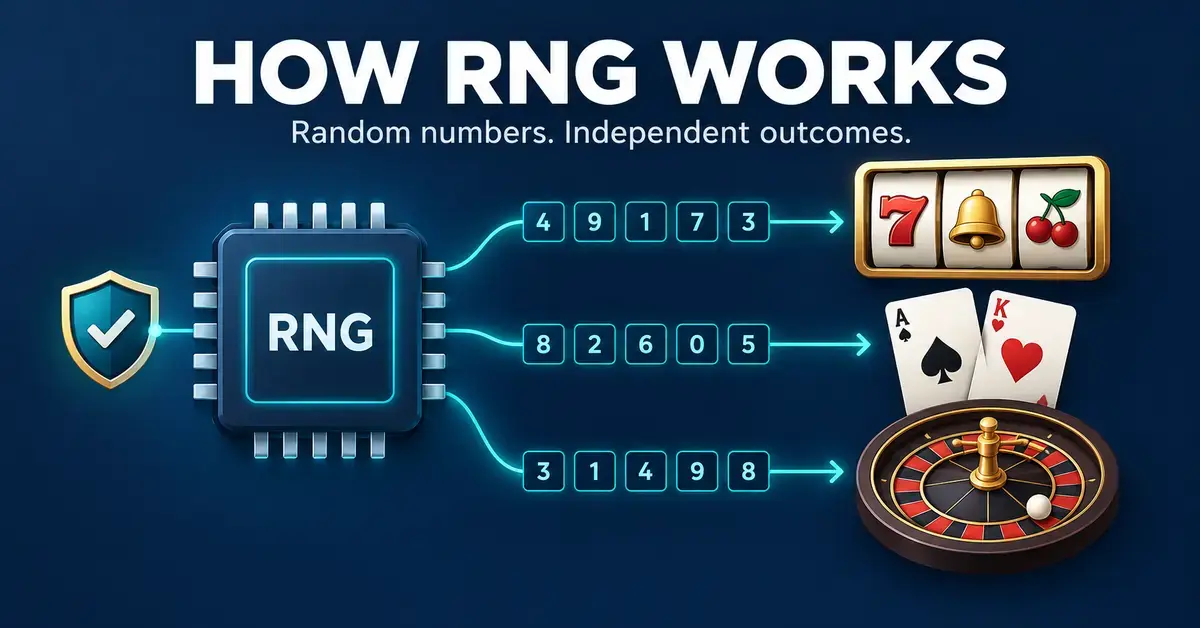
A random number generator (RNG) is the piece of software that decides the outcome of nearly every modern casino game — the symbols a slot lands on, the card a virtual blackjack shoe deals, the pocket a software roulette ball drops into. Instead of physical reels or a croupier, a program picks numbers thousands of times per second, and each number is translated into a game result. This guide explains, in plain language, what an RNG is, how it actually works, how regulators and independent labs test it, and why popular beliefs like a machine being “due” to pay are mathematically false.
Key Points
- A casino RNG is software that continuously generates unpredictable numbers; the game maps each number onto an outcome such as a slot symbol or a card.
- Almost all games use a pseudo-RNG (PRNG) seeded from a fast-changing source, not a physical “true” RNG.
- Every result is independent — the RNG has no memory of past wins, losses or jackpots.
- In regulated markets, RNGs must be tested and certified by independent labs before launch and monitored afterward.
- Certification confirms fair odds and the published RTP over the long run; it does not remove the house edge or guarantee a winning session.
- “Due”, “hot” and “cold” machines are a myth — the gambler’s fallacy — because outcomes do not influence one another.
What is a random number generator in a casino?
A random number generator is an algorithm that produces a continuous stream of numbers with no predictable pattern, which the game engine then maps onto an outcome. The RNG does not know or care whether you are winning or losing; its only job is to output the next number. Everything a player sees — spinning reels, flipping cards, a bouncing ball — is an animation layered on top of a number that has, in effect, already been chosen.
This matters because it separates the look of a game from the mechanism. A slot’s reels are a display. The real event is a number drawn by the RNG at the exact moment you press the button. Understanding this is the foundation for everything else on this page, and it sits at the heart of how casino games work more broadly.
How does an RNG work in a casino game?
Most casino RNGs work by starting from a seed and running it through a mathematical formula to produce a long, unpredictable-looking sequence of numbers. A few core properties define the behaviour:
- The seed. The generator starts from a seed value — a starting number often derived from a fast-changing source such as the system clock down to the millisecond and hardware entropy. Because the seed is hard to predict, the resulting sequence is hard to predict too.
- It runs constantly. The generator keeps cycling even when nobody is playing, producing new numbers continuously. The outcome you get is simply whichever number the generator holds at the instant you commit to the spin or deal.
- It has no memory. Each result is independent. The RNG keeps no record of past wins, losses or jackpots, so nothing “carries over” from one round to the next.
- It is deterministic but practically unpredictable. Software generators are technically repeatable if you know the exact algorithm and seed, and their sequences eventually repeat. Modern generators use cycles so astronomically long that repetition is irrelevant in practice, and the seed is kept out of players’ reach.
From a number to a symbol on the reel
The RNG outputs a number, not a cherry or a seven. The game engine maps each number onto a position on a virtual reel using a weighted table, so some symbols are programmed to appear more often than others. That weighting is how a game sets its hit frequency and its payout structure. Once the symbols land, the engine checks the result against the paytable and pays any win. The same idea applies to a digital card deck or a software roulette wheel: a number comes out, and a lookup table turns it into a card or a pocket.
True RNG vs pseudo-RNG: what casinos actually use
Almost all casino games use a pseudo-random number generator (PRNG) rather than a “true” RNG, and the distinction is worth understanding:
- True RNG (TRNG). Draws randomness from a physical, unpredictable source such as electronic noise or radioactive decay. It is genuinely non-repeatable but slower and harder to deploy at scale.
- Pseudo-RNG (PRNG). An algorithm that generates numbers that pass statistical tests for randomness but are produced from a seed. It is fast, cheap and easy to test, which is why it dominates gaming.
A well-designed, properly seeded PRNG is “random enough” that its output is indistinguishable from true randomness for gameplay purposes, which is exactly what testing labs set out to confirm. The word “pseudo” does not mean rigged — it means the randomness comes from mathematics rather than physics.
Are casino games fair? How RNGs are tested and certified
In regulated markets, RNGs must be independently tested and certified before a game can go live, and they are monitored afterward. An operator cannot simply claim a game is fair; a qualified laboratory has to demonstrate it. This independent review is the single most important reason a licensed game can be trusted more than an unlicensed one.
What the testing covers
A typical RNG evaluation combines several layers:
- Statistical randomness tests. Labs run the number output through recognised test suites — commonly including NIST SP 800-22, the DIEHARD battery, and tests such as chi-square and Kolmogorov-Smirnov — to look for bias, patterns or predictability.
- Source-code and implementation review. Reviewers check how the generator is seeded and used, so the maths is not undermined by a weak or predictable seed.
- Return-to-player (RTP) verification. The lab simulates or audits very large numbers of rounds to confirm that real results match the declared RTP — the share of total stakes a game is designed to pay back over the long run. You can read more about RTP and the house edge in our overview of how slot machines work.
- Ongoing monitoring. Certification is not one-and-done; games and systems are re-checked over time.
Who certifies casino games in Canada?
In Ontario’s regulated igaming market, the Alcohol and Gaming Commission of Ontario (AGCO) requires games and RNGs to be certified by an AGCO-registered Independent Testing Lab (ITL) before they are offered. Under the AGCO’s amended Standard 4.08 — in force since April 4, 2023 — games, RNGs and the system components that determine outcomes must be approved by the Registrar or certified by a registered ITL before deployment. Importantly, the AGCO does not test these products in its own laboratory; it relies on registered independent labs. Labs the AGCO has registered for the Ontario market include BMM, eCOGRA, Gaming Associates and Gaming Laboratories International (GLI). The specific list of accepted labs differs by regulator and changes over time, so the regulator’s current list is always the authoritative source.
Testing Labs Compared
| Independent lab | Based in | Notes |
|---|---|---|
| Gaming Laboratories International (GLI) | United States | Widely used across many jurisdictions; registered for Ontario’s igaming market. |
| eCOGRA | United Kingdom | Founded in 2003 for the online-gaming sector; registered for Ontario. |
| BMM Testlabs | United States | Long-established gaming test house; registered for Ontario. |
| Gaming Associates | Australia | Registered for Ontario’s igaming market. |
| iTech Labs | Australia | Accredited by numerous regulators internationally; accepted in several markets. |
Are slots rigged? What certification proves (and what it does not)
Licensed, certified slots are not rigged in the sense players usually mean — the result is not secretly switched to stop you winning, and the game cannot “see” how much you have lost and punish you. A certified RNG produces independent outcomes at the mathematically declared odds. That is what the testing described above confirms.
Certification does, however, have limits worth stating plainly:
- It confirms the RNG is statistically sound and that the game matches its published RTP over the long run — it does not promise any particular result in your session.
- It does not remove the house edge. A fair game can still be designed to return, say, 96% of stakes over millions of spins, which means it is built to keep the rest.
- It applies to the licensed version of the game. An unlicensed site running software with no certification offers none of these guarantees — which is the real “rigged” risk to avoid.
Why “due”, “hot” and “cold” machines are a myth
A machine is never “due” to pay out, because the RNG has no memory and each spin is an independent event. This belief — that a long losing streak makes a win more likely, or that a recent jackpot makes another one less likely — is the classic gambler’s fallacy (also called the Monte Carlo fallacy, after a 1913 roulette table where the ball landed on black 26 times in a row and bettors lost fortunes piling onto red).
The coin-flip analogy makes it concrete: a fair coin that just landed heads five times still has a 50% chance of heads on the next flip. The coin has no record to “balance out,” and neither does a slot. Long dry spells and quick jackpots are both normal features of randomness — one player can spin for weeks without a big hit while another wins in the first few minutes. Outcomes being independent is also why no betting pattern or “system” can shift the odds in games like roulette, where every spin is a fresh event.
RNGs in different casino games
The same engine sits behind most games you will meet, with small differences:
- Slots. The RNG picks numbers that map to weighted virtual-reel positions; animations then show the reels stopping.
- Video poker and digital card games. The RNG shuffles a virtual deck so each card dealt is independent and unpredictable; strategy still matters because you make decisions, as explained in our guide to how to play blackjack.
- Software roulette and keno. Numbers map directly to pockets or drawn balls.
- Live-dealer games. These are the exception: outcomes come from a real wheel, cards or dice streamed on camera, not an RNG — though the surrounding platform is still certified.
Common mistakes players make about RNGs
- Chasing a “cold” machine. Believing a slot that hasn’t paid is closer to a win. It isn’t — every spin resets to the same odds.
- Thinking a near miss means anything. Two jackpot symbols plus a “so close” third is just a mapped outcome, not a sign a win is coming.
- Assuming stake size or timing changes the odds. Playing faster, slower, at midnight, or after a big win does not alter the RNG’s output.
- Believing a “system” beats the RNG. Because outcomes are independent, no betting progression can overcome the built-in house edge.
- Trusting an uncertified game. The protection comes from certification and licensing, not from the word “random” on a marketing page.
How to check a game’s RNG and fairness yourself
You can do a few quick checks before trusting a game:
- Confirm the licence. Play only on sites licensed for your province or market, where certification is mandatory.
- Find the RTP. Reputable games publish their return-to-player percentage in the info or paytable screen. Missing or hidden RTP is a red flag.
- Look for a testing seal. Game or site footers often name the lab that certified them, such as GLI or eCOGRA.
- Be sceptical of guarantees. Any site promising a way to beat the RNG is misleading you — certification guarantees fair odds, not winning sessions.
Responsible gambling note
This article explains how RNGs work; it is information, not betting advice. Knowing that outcomes are random does not create a way to overcome the house edge — over time, every casino game is designed to pay back less than it takes in. If gambling stops feeling like entertainment, free and confidential help is available in Canada through ConnexOntario at 1-866-531-2600. For deposit and time limits, self-exclusion and more support, see our guide to responsible gambling in Canada.
Sources
- AGCO — Independent Testing Labs Registered for igaming in Ontario
- AGCO — Requirements for Certification of Technology by a Registered ITL
- CDC Gaming — RNGs: What Are They and Are They Random?
- eCOGRA — Testing and certification services
- Gaming Laboratories International (GLI)
- NIST SP 800-22 — Statistical Test Suite for Random and Pseudorandom Number Generators
- Duke University — The Gambler’s Fallacy
Frequently asked questions (FAQ)
What is an RNG in a casino?
An RNG, or random number generator, is the software that decides the outcome of a casino game. It continuously produces unpredictable numbers, and the game maps each number onto a result such as a slot symbol, a card or a roulette pocket.
Are online slots rigged?
Licensed, certified online slots are not rigged. Their RNG is tested by an independent lab to produce fair, independent outcomes at the game’s published odds. The real risk is unlicensed sites running uncertified software, which carry none of these protections.
Can you predict or beat an RNG?
No. A properly seeded, certified RNG is designed so the next number cannot be predicted from past results, and because outcomes are independent, no betting system can overcome the built-in house edge.
Is a slot machine ever “due” to pay out?
No. The RNG has no memory, so a machine that has not paid for a long time is no more likely to hit on the next spin. Believing otherwise is the gambler’s fallacy; every spin carries the same odds.
Who checks that casino RNGs are fair?
Independent testing laboratories such as GLI, eCOGRA, BMM and Gaming Associates certify RNGs and RTP against regulators’ standards. In Ontario, the AGCO requires this certification by a registered lab before a game can go live, and it does not test games in-house.
