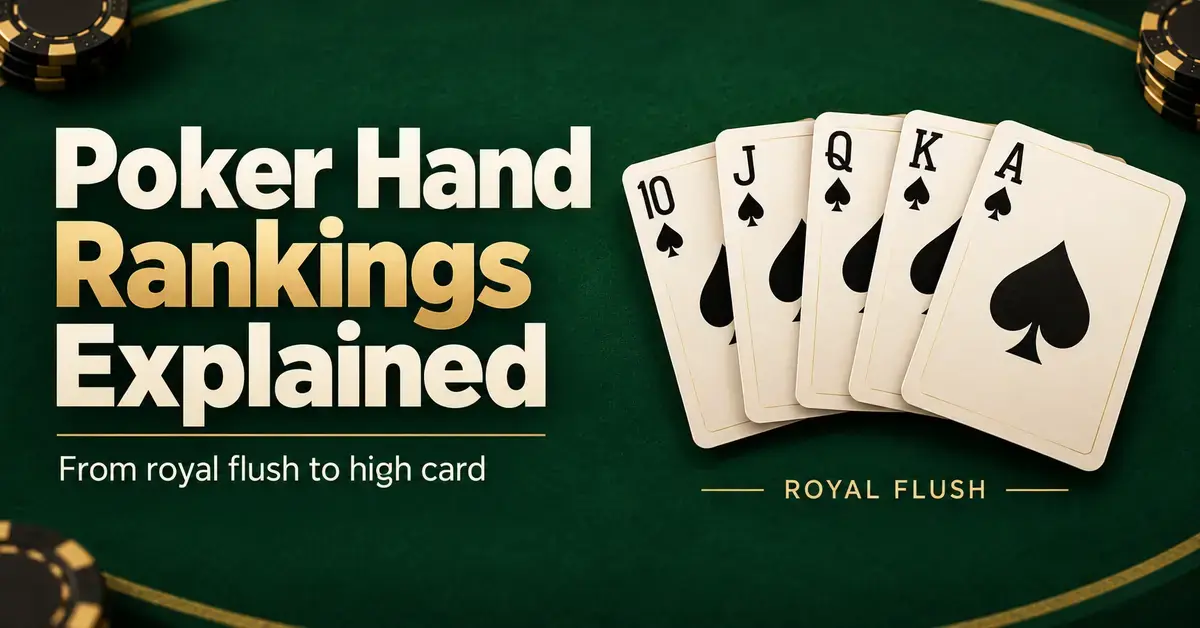
Poker hand rankings are the fixed order that decides which five-card hand wins when more than one player reaches a showdown. There are ten possible hand categories, from the unbeatable royal flush down to a plain high card. The same hierarchy is used in Texas Hold’em, video poker and most casino poker variants, so learning it once lets you read almost any poker game at a glance. This guide lists every hand in order, shows how close calls are settled, and explains where the ranking quietly changes.
Key Points
- There are ten poker hand categories, ranked by rarity from royal flush (best) down to high card (worst).
- The same order applies in Texas Hold’em, video poker and most casino poker games.
- Kickers — side cards — break ties when two hands share the same category.
- An ace is high or low in a straight, but it cannot wrap around (Q-K-A-2-3 is not a straight).
- Three Card Poker is the exception: a straight beats a flush because hands use only three cards.
- Suits carry no ranking value in standard poker; identical hands split the pot.
What are poker hand rankings?
Poker hand rankings rank every possible five-card hand from strongest to weakest, and the stronger hand always wins the pot. The order is built on rarity: the harder a hand is to make from a shuffled deck, the higher it ranks. A royal flush sits at the top because only four of them exist in a 52-card deck, while a high card sits at the bottom because roughly half of all random five-card hands are nothing better than that.
Every ranking is based on the best five cards. In games where you have access to more than five cards — such as Texas Hold’em, where you combine two hole cards with five community cards — you simply pick the best five-card combination you can form, and everyone at the table is measured by the same ten-tier scale. Suits have no ranking value in standard poker: a flush in spades does not beat a flush in hearts of equal height.
The 10 poker hands in order, from best to worst
Below are all ten hands ranked from highest to lowest. Each one beats every hand listed beneath it and loses to every hand above it.
1. Royal flush
A royal flush is the ace-high straight flush: ten, jack, queen, king and ace, all of the same suit (for example 10♥ J♥ Q♥ K♥ A♥). It is the best possible hand in standard poker and cannot be beaten, only tied. There is exactly one royal flush per suit, so just four exist in the whole deck.
2. Straight flush
A straight flush is five cards of consecutive rank, all in the same suit — for example 5♠ 6♠ 7♠ 8♠ 9♠. If two players both hold a straight flush, the one with the higher top card wins. The lowest straight flush is the “steel wheel”, A-2-3-4-5 suited, which counts as five-high.
3. Four of a kind
Four of a kind (also called “quads”) is all four cards of one rank plus any fifth card — for example four queens. Higher quads beat lower quads. If two hands somehow share the same quads (possible in community-card games), the higher fifth card, or kicker, decides the winner.
4. Full house
A full house is three cards of one rank plus a pair of another — for example three kings and two fours (“kings full of fours”). When two players both have a full house, the rank of the three-of-a-kind is compared first. Aces full of twos beats kings full of aces, because the trip aces outrank the trip kings; the pair only matters if the trips are identical.
5. Flush
A flush is any five cards of the same suit that are not in sequence — for example A♦ J♦ 8♦ 5♦ 2♦. Flushes are compared from the top card down: highest card first, then the second-highest, and so on, until one hand is higher.
6. Straight
A straight is five cards of consecutive rank in mixed suits — for example 7♣ 8♦ 9♣ 10♥ J♠. The highest top card wins. An ace can play high (10-J-Q-K-A, the top straight, nicknamed “Broadway”) or low (A-2-3-4-5, the “wheel”), but it cannot wrap around the corner, so Q-K-A-2-3 is not a straight.
7. Three of a kind
Three of a kind (“trips” or a “set”) is three cards of the same rank plus two unrelated cards — for example three eights. Higher trips win; if they match, the higher of the two remaining kicker cards breaks the tie, then the second kicker.
8. Two pair
Two pair is two cards of one rank, two of another, and a fifth unrelated card — for example two tens and two threes. The higher pair is compared first, then the lower pair, then the fifth card. So tens-and-threes beats nines-and-eights, and when the pairs match, the kicker decides.
9. One pair
One pair is two cards of the same rank plus three unrelated cards — for example two jacks. Higher pairs win. When two players hold the same pair, the kickers are compared one by one from highest to lowest until one hand pulls ahead.
10. High card
High card is a hand that misses every category above — no pair, no straight, no flush. The hand is judged by its highest card, then the next, and so on. “Ace-high” beats “king-high”, and if the top cards tie, you keep comparing down the line. This is the most common outcome of a random five-card deal.
Poker hand chart
The chart below is a quick reference you can keep beside you, listing each hand with an example and how often it appears in a single random five-card deal. Save or screenshot it while the order is still fresh.
Poker Hand Chart
| Rank | Hand | Example | What it is | Chance in a 5-card deal |
|---|---|---|---|---|
| 1 | Royal flush | 10-J-Q-K-A, one suit | Ace-high straight flush | 0.00015% (about 1 in 649,740) |
| 2 | Straight flush | 5-6-7-8-9, one suit | Five in sequence, one suit | 0.0014% (about 1 in 72,193) |
| 3 | Four of a kind | Q-Q-Q-Q-7 | All four of one rank | 0.024% (about 1 in 4,165) |
| 4 | Full house | K-K-K-4-4 | Three of a kind plus a pair | 0.14% (about 1 in 694) |
| 5 | Flush | A-J-8-5-2, one suit | Five of one suit, not in sequence | 0.20% (about 1 in 509) |
| 6 | Straight | 7-8-9-10-J, mixed suits | Five in sequence, mixed suits | 0.39% (about 1 in 255) |
| 7 | Three of a kind | 8-8-8-K-4 | Three of one rank | 2.1% (about 1 in 47) |
| 8 | Two pair | 10-10-3-3-A | Two pairs of different ranks | 4.8% (about 1 in 21) |
| 9 | One pair | J-J-9-6-2 | Two cards of one rank | 42% (about 1 in 2.4) |
| 10 | High card | A-Q-9-5-3 | None of the above | 50% (about 1 in 2) |
The probabilities above describe being dealt that hand directly in five cards. They are a fair guide to relative rarity, but they are not the odds of ending up with the hand in every game — more on that below.
How ties and kickers are settled
When two hands fall in the same category, poker uses a strict, card-by-card comparison to find a winner. Understanding this is what separates knowing the list from actually reading a showdown.
What is a kicker?
A kicker is a side card that is not part of your main hand but is used to break ties. If two players each hold a pair of kings, the hand with the higher kicker wins — A-K beats Q-K because the ace outranks the queen. Kickers are compared in order of rank until the tie is broken or all five cards match.
How flushes and straights are compared
Flushes are ranked by their cards from the top down, exactly like high-card hands, since the suit itself carries no value. Straights are ranked only by their highest card, so a nine-high straight beats a seven-high straight. Two straights with the same top card are equal.
When the pot is split
If two hands are identical in rank all the way through five cards, the pot is split evenly. This is common in community-card games where the shared board plays a large role — for instance, when the best five-card hand for everyone is the straight on the board and no one can beat it.
How hand rankings work across poker variants
The ten-hand order is the backbone of nearly every mainstream poker game, but how you build your five cards differs by format. Here is how the same rankings apply to the games you are most likely to meet, and you can see where each sits in our overview of casino table games.
Texas Hold’em and other community-card games
In Texas Hold’em you are dealt two private cards and share five community cards, then make the best five-card hand from any combination of the seven. Omaha works similarly but with four hole cards (of which you must use exactly two). The ranking chart is unchanged; you simply have more cards to choose from, which makes stronger hands easier to reach.
Video poker
Video poker is a machine game based on five-card draw: you are dealt five cards, choose which to keep, and the rest are replaced. Payouts follow the same hand hierarchy, with a royal flush paying the most. The pay table printed on the machine tells you exactly what each ranking pays, so the rankings double as a payout guide.
Casino poker variants
Table games such as Caribbean Stud and Let It Ride use the standard five-card rankings, where you play against the house rather than other players. Three Card Poker is the important exception: because hands use only three cards, the order changes (see below). Casino poker is a fixed-odds house game, not a game of skill against opponents.
Do the odds of making each hand change by game?
Yes — the frequencies in the chart are for a straight five-card deal, and your real chances shift with the format. In Texas Hold’em you ultimately see seven cards, so the odds of completing a flush, straight or full house are noticeably better than in a one-shot five-card deal. In video poker, your chances depend on which cards you choose to hold. The ranking order never changes, but how often you reach each rung does. If you want the maths behind odds, payouts and the built-in margin, see our explainer on how casino games work.
The Three Card Poker exception
In Three Card Poker the ranking order is different because each hand has only three cards. A straight beats a flush here, which is the reverse of standard poker, because with three cards a straight is harder to make than a flush. The order, from highest to lowest, is: straight flush, three of a kind, straight, flush, pair, then high card. Always check the rules of the specific game you are playing before assuming the five-card order applies.
Common mistakes with poker hand rankings
A few errors trip up beginners again and again. Knowing them in advance saves confusion at the table.
- Thinking a flush beats a full house. A full house ranks above a flush in standard poker. Many newcomers assume the opposite because flushes look impressive.
- Forgetting the kicker. Two players can hold the same pair and still not tie — the side cards decide. Ignoring kickers leads to badly misread showdowns.
- Trying to wrap the ace around. An ace is high or low, never both at once. Q-K-A-2-3 is not a straight.
- Assuming suits rank. No suit outranks another in standard poker. Equal hands of different suits split the pot.
- Applying the five-card order to Three Card Poker. In that game a straight beats a flush — the sequence is genuinely different.
- Playing only part of the board. In Hold’em you must make the best five cards; sometimes the board itself is your best hand.
Who this guide is for
This reference suits anyone new to poker-style games — whether you are learning Texas Hold’em, trying a video poker machine, or sitting down at a casino poker table for the first time. Memorising the ten-hand order and the kicker rules is the single most useful thing a beginner can do, because every other decision in poker depends on knowing what beats what. If you are also exploring other card games, our guide to how to play blackjack covers a game with very different scoring.
Friskrivning: This article is an educational explainer about how poker hands are ranked. It is informational only and is not betting advice; knowing the rankings does not improve the odds of any gambling game and this guide makes no “how to win” promises. Outcomes in casino poker and video poker are governed by chance and a built-in house margin. If gambling stops being fun, support is available — see our page on responsible gambling in Canada. You must be of legal gambling age in your province (19+ in most of Canada, 18+ in Alberta, Manitoba and Quebec).
Sources
Vanliga frågor (FAQ)
What is the highest hand in poker?
The royal flush is the highest hand: ten, jack, queen, king and ace all of the same suit. It cannot be beaten, only matched by another royal flush, in which case the pot is split. There are only four possible royal flushes in a standard 52-card deck.
Does a flush beat a straight?
Yes, in standard five-card poker a flush beats a straight, because a flush is rarer. The one common exception is Three Card Poker, where hands use only three cards and a straight beats a flush. Always confirm the rules of the specific game you are playing.
What is a kicker in poker?
A kicker is a side card that is not part of your main hand but is used to break ties between otherwise equal hands. For example, if two players each hold a pair of kings, the player with the higher remaining card wins. Kickers are compared from highest to lowest until the tie is resolved.
Is an ace high or low in a straight?
An ace can be either the highest card (10-J-Q-K-A) or the lowest (A-2-3-4-5), but it cannot do both in the same straight. That means a run such as Q-K-A-2-3 does not count as a straight, because the ace cannot wrap around the corner.
Are poker hand rankings the same in video poker and Texas Hold’em?
The ranking order is the same in both: royal flush down to high card. What differs is how you build your five cards and how often you reach each hand. Video poker is a five-card draw against a pay table, while Texas Hold’em lets you use the best five of seven cards, which makes stronger hands easier to make.
