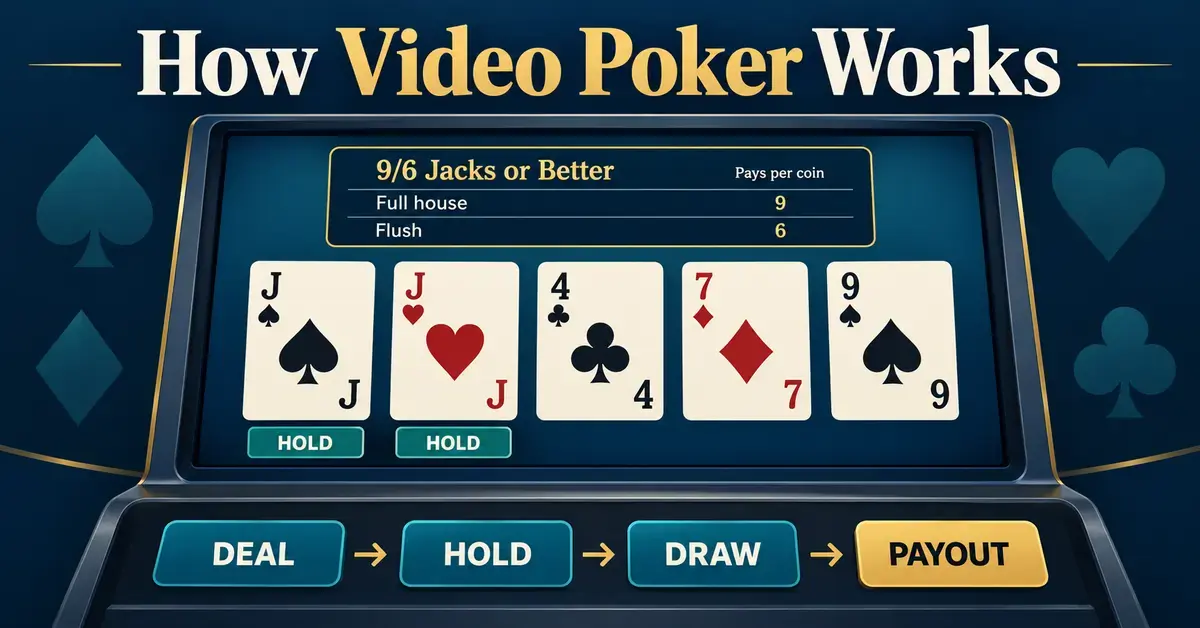
Video poker is a casino machine game that plays like a single hand of five-card draw poker against a fixed payout schedule, rather than against a dealer or other players. You are dealt five cards on a screen, choose which ones to keep, draw replacements for the rest, and are paid according to the poker rank of your final hand. This guide explains how a hand works step by step, how to read the 9/6 Jacks or Better paytable, why the pay schedule — not luck alone — sets the long-run return (RTP), and how the game uses the standard poker hand rankings.
Key Points
- What it is: a solo machine game based on five-card draw poker, scored against a fixed paytable.
- Core loop: bet up to five coins, get five cards, hold the ones you want, draw once, and get paid on the final poker hand.
- Hand rankings: standard poker rankings, from a pair of Jacks (in Jacks or Better) up to a royal flush.
- The paytable is everything: “9/6” means a full house pays 9 and a flush pays 6 per coin; full-pay 9/6 Jacks or Better returns about 99.54% with perfect play.
- Bet max: five coins unlock the royal-flush bonus of 4,000 coins, so smaller bets cut the long-run return.
- No memory: a random number generator deals every hand independently — there is no hot or cold machine.
What is video poker?
Video poker is a solo, machine-based game built on five-card draw poker. There is no dealer to beat, no other players at the screen and no bluffing — you simply try to build the best-ranking poker hand you can and are paid a fixed amount for each qualifying hand. Because the payouts are printed on the machine and the odds come from a 52-card deck, video poker is one of the few casino games where the long-run return can be worked out exactly.
The game grew out of mechanical poker machines — Brooklyn firm Sittman and Pitt built a five-drum poker device as far back as 1891. Electronic versions arrived in the early 1970s (Dale Electronics’ “Poker-Matic”), but it was SIRCOMA’s “Draw Poker” in 1979, from the company that later became industry giant IGT, that turned video poker into a mainstream casino fixture. Many players find it less intimidating than a live table, which is part of why it sits alongside the other casino table games in most venues.
How a hand of video poker works
A standard hand of Jacks or Better follows the same short loop every time. There is a single draw — you get one chance to swap cards.
- Choose your bet. You set a coin value and then bet one to five coins (credits) per hand. Betting the maximum five coins matters, as explained below.
- Deal. Press “Deal” and the machine shows five cards from a standard 52-card deck.
- Hold. Decide which cards to keep by tapping “Hold” under each one. You can hold anywhere from zero to all five.
- Draw. Press “Draw” and the cards you did not hold are replaced once, in a single draw, from the remaining cards in the deck.
- Get paid. The machine reads your final five-card hand, compares it to the paytable and pays out if the hand qualifies.
That is the whole game in Jacks or Better. Some variants add extra steps — a second draw, a double-or-nothing gamble, or wild cards — but the deal-hold-draw core stays the same.
Does video poker use real poker hands?
Yes — video poker uses the standard poker hand rankings, so if you know how poker hands are ranked, you already know how the game is scored. From strongest to weakest, the paying hands in Jacks or Better are:
- Royal flush — A, K, Q, J, 10 all of the same suit.
- Straight flush — five cards in sequence, all the same suit.
- Four of a kind — four cards of the same rank.
- Full house — three of a kind plus a pair.
- Flush — five cards of the same suit, not in sequence.
- Straight — five cards in sequence, mixed suits.
- Three of a kind — three cards of the same rank.
- Two pair — two separate pairs.
- Jacks or better — one pair of Jacks, Queens, Kings or Aces.
The name “Jacks or Better” tells you the minimum paying hand: a pair of tens or lower pays nothing. Other games set a different floor — in Bonus Poker the floor is still Jacks, while in Deuces Wild the minimum paying hand is three of a kind — so always read the specific game’s paytable before you play.
Reading the paytable: what “9/6” means
The “9/6” in 9/6 Jacks or Better refers to two per-coin payouts: a full house pays 9 coins and a flush pays 6 coins for every coin wagered. These two numbers are the quickest way to tell a generous machine from a stingy one, because every other payout in Jacks or Better is usually identical from game to game. A machine labelled 8/5 pays only 8 for a full house and 5 for a flush — same game, worse odds.
9/6 Jacks or Better Paytable
| Hand | 1 coin | 5 coins |
|---|---|---|
| Royal flush | 250 | 4,000 |
| Straight flush | 50 | 250 |
| Four of a kind | 25 | 125 |
| Full house | 9 | 45 |
| Flush | 6 | 30 |
| Straight | 4 | 20 |
| Three of a kind | 3 | 15 |
| Two pair | 2 | 10 |
| Jacks or better | 1 | 5 |
Notice the royal flush. On bets of one to four coins it pays a flat 250 coins per coin, but on a five-coin bet it jumps to 4,000 coins — that is 800 per coin instead of 250. This single bonus is why strategy guides insist you always bet the maximum five coins: dropping to fewer coins throws away part of the game’s return. If five coins is more than you want to risk, it is better to lower the coin value than to bet fewer coins.
How RTP depends on the paytable
A video poker game’s RTP — return to player, the share of all money wagered that the game pays back over the long run — is set almost entirely by its paytable. Full-pay 9/6 Jacks or Better returns about 99.54% with perfect play, a house edge of roughly 0.46%. That is one of the lowest house edges in any casino, which is why video poker has a devoted following. To understand how RTP and house edge fit together across every game, see our explainer on how casino games work.
Change the paytable and the return falls fast, even though the game keeps the same name and look. Reported returns for common Jacks or Better pay schedules, with optimal play, are:
- 9/6 — about 99.54%
- 9/5 — about 98.45%
- 8/6 — about 98.39%
- 8/5 — about 97.30%
- 7/5 — about 96.15%
- 6/5 — about 95.00%
Two things decide whether you ever see that return. First, the figure assumes optimal strategy — holding the mathematically correct cards on every hand; loose play gives back a chunk of it. Second, RTP is a long-run average measured across millions of hands, not a promise for your session. Short-term swings are large, and a single payout change can move the return by more than a full percentage point, so the habit that matters most is simple: read the paytable on the actual machine before you play.
Jacks or Better versus other video poker variants
Jacks or Better is the baseline, but the game comes in many variants that share the deal-hold-draw mechanics while changing the payouts and sometimes adding wild cards:
- Bonus Poker pays more for certain four-of-a-kind hands but trims lower payouts to compensate.
- Double Bonus and Double Double Bonus boost four-of-a-kind payouts further, with the Double Double version rewarding specific “kicker” cards; full-pay versions can approach or even exceed 100% but demand very precise play.
- Deuces Wild makes all four 2s wild, which raises the minimum paying hand to three of a kind. The rare full-pay version returns about 100.76% with perfect strategy, but such machines are hard to find and most versions offered return less.
Wild-card and bonus games change the correct strategy completely, so a strategy chart built for Jacks or Better will cost you money on a Deuces Wild machine. Treat each variant as its own game.
Where the cards come from: the RNG
Every card in video poker is chosen by a random number generator (RNG), a program that shuffles a virtual 52-card deck continuously between hands. When you press “Deal” it locks in your five cards; when you draw, your replacements come from the 47 cards left in that deck after your dealt hand is removed. The cards you hold are taken out of the pool, which is exactly why holding the right cards changes your odds on the draw.
Because each hand is dealt independently, there is no such thing as a “hot” or “cold” machine, and a game is never “due” for a royal flush. This is the same engine that drives modern slots — if you want the mechanics in depth, see how slot machines work. The key difference is that in video poker your hold decisions genuinely affect the outcome, which is why it rewards skill in a way slots do not.
Common mistakes beginners make
Most of the value in video poker is lost to a handful of avoidable errors:
- Betting fewer than five coins. This forfeits the royal-flush bonus and is the single most expensive habit in the game.
- Not checking the paytable. An 8/5 machine sitting next to a 9/6 one looks identical but returns over two percentage points less.
- Playing by instinct instead of strategy. Keeping a “nice-looking” card or chasing a flush over a sure pair quietly erodes the return.
- Using the wrong strategy for the variant. Deuces Wild and the bonus games need their own charts.
- Believing in streaks. The RNG has no memory, so a machine that just paid is no less likely to pay again — and no more.
Who video poker suits
Video poker suits players who enjoy making decisions and want a game with a published, verifiable paytable and a low house edge. On a full-pay machine played well it offers one of the best long-run returns on the casino floor, better than almost any slot and competitive with low-edge table games. It is less suited to players who want a purely passive game, or who will not take the time to learn a strategy chart — without correct play, the advertised RTP simply does not apply.
One honest point remains: apart from a few rare full-pay machines played perfectly, video poker still carries a house edge, so over time the game is expected to cost money, not make it. It is entertainment with unusually good odds, not an income. For how its house edge stacks up against the rest of the floor, compare it with the other table and card games covered on this site.
Responsible gambling
This article is educational and explains how video poker works; it is not betting advice and does not suggest any way to win. No strategy, paytable choice or coin-size trick changes the fact that the game is built to favour the house over time, and outcomes are decided by a random number generator. In Canada the minimum gambling age is 18 or 19 depending on the province. If gambling stops being fun, set deposit and time limits, use self-exclusion tools, or reach free, confidential help — see our guide to responsible gambling in Canada for tools and help lines.
Sources
Frequently Asked Questions (FAQ)
What is the best video poker game for the player?
Among common games, full-pay 9/6 Jacks or Better is the easiest high-return game to find, giving back about 99.54% with perfect play. A few rarer machines, such as full-pay Deuces Wild, can return slightly over 100% with flawless strategy, but they are hard to locate and demand near-perfect play.
What does 9/6 mean in Jacks or Better?
It describes the per-coin payouts for two hands: a full house pays 9 coins and a flush pays 6 coins for each coin bet. Lower-paying versions such as 8/5 pay less for those hands and therefore return a smaller percentage over time.
Do I have to bet the maximum five coins?
You do not have to, but it is almost always the right choice. The royal flush pays a disproportionately large 4,000 coins only on a five-coin bet, so betting fewer coins lowers the game’s overall return. If the stake feels too high, reduce the coin value rather than the number of coins.
Is video poker a game of skill or luck?
Both. The cards are dealt randomly, but which cards you hold affects your result, so skilled play meaningfully improves your long-run return. That mix of luck and decision-making is what separates video poker from slot machines.
Can a video poker machine be hot or cold?
No. Each hand is dealt by a random number generator independently of every hand before it, so a machine is never “due” to pay and recent results do not predict future ones.
