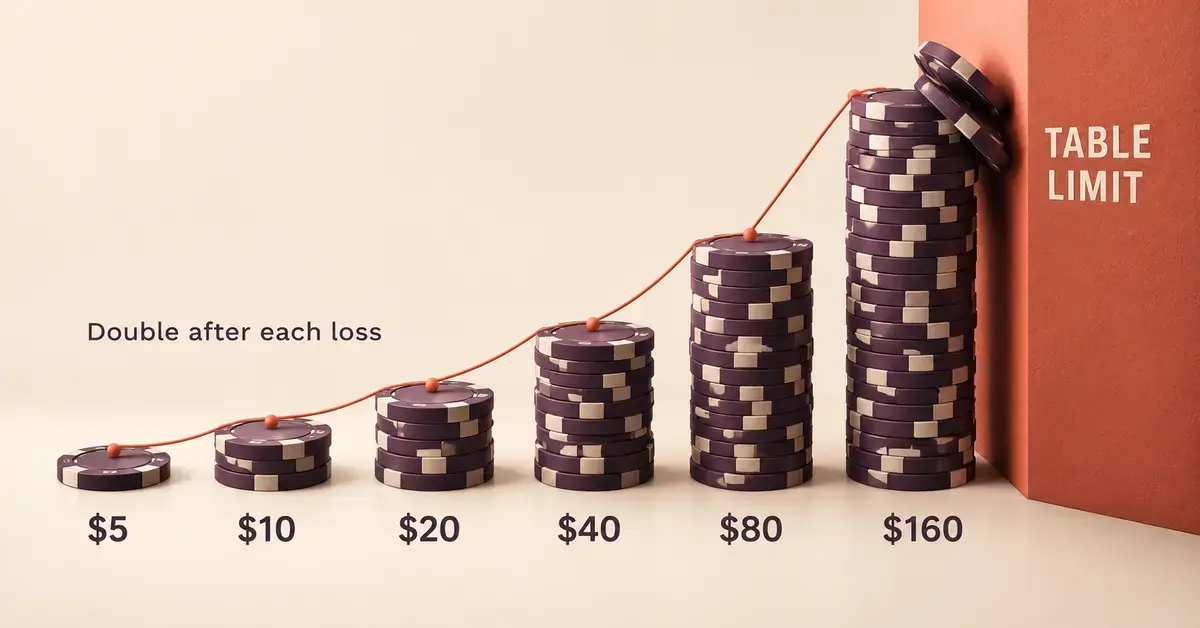
The Martingale is the best-known betting system in gambling: after every losing bet you double your next stake, so that a single win recovers everything you have lost and leaves you one base unit ahead. It sounds like a guaranteed way to grind out a profit, and for short stretches it often appears to work. In reality it is a mathematical trap. This guide explains exactly how the Martingale works, walks through the numbers with a worked example, and shows why casino table limits, a finite bankroll and the built-in house edge mean it reliably loses money over time.
Key Points
- What it is: an even-money betting system where you double your stake after every loss, aiming to win back all losses plus one base unit.
- Why it feels safe: it produces many small, frequent wins — the losses are rare but large.
- Why it fails: three independent limits beat it — casino table maximums, your finite bankroll, and the house edge, which no bet size can change.
- The hidden cost: a run of 7-8 losses can demand thousands of dollars in bets to win back a few dollars.
- Bottom line: the Martingale changes the shape of your results, not the odds. It is a way to lose money faster and in bigger chunks, not a way to beat the casino.
What is the Martingale betting system?
The Martingale is a negative-progression betting system: you increase your stake after a loss rather than after a win. It is used on even-money bets — wagers that pay 1:1, meaning a winning bet returns your stake plus the same amount again. Classic examples are red or black, odd or even, and high or low on a roulette wheel, the Pass line in craps, or the Player/Banker bets in baccarat.
The idea is simple. You pick a base stake, say $10. Every time you lose, you double the next bet. The moment you win, you have recovered all the losses from that run and gained one base unit of profit, so you reset to $10 and start again. Because a win is bound to come eventually, the system feels like it cannot fail. The flaw is hidden in the word “eventually” — and in the size of the bets you need to place to get there.
How does the Martingale system work?
The Martingale works by making each winning bet large enough to cancel out every losing bet before it. Here is the step-by-step cycle:
- Choose a base stake (your one unit) and place it on an even-money bet.
- If you win, keep the one-unit profit and bet the base stake again.
- If you lose, double your stake for the next bet.
- Keep doubling after every loss until you win.
- When you finally win, you recover all previous losses plus one base unit. Reset to the base stake and repeat.
The maths behind the recovery is exact. If your base unit is $10 and you lose four bets in a row before winning the fifth, you have staked $10 + $20 + $40 + $80 = $150 in losses, then won $160 on the fifth bet. Your net result for the whole cycle is +$10 — one base unit — no matter how long the losing run was. That is the seductive part: every completed cycle, long or short, nets exactly one unit of profit.
A worked example: how fast the bets grow
The problem is how quickly the stakes escalate. Doubling is exponential, so each additional loss roughly doubles both the next bet and the total you have put at risk. The table below starts from a $10 base and shows a single unbroken losing streak.
| Loss number | This bet | Total wagered so far | Net if this bet wins |
|---|---|---|---|
| 1 | $10 | $10 | +$10 |
| 2 | $20 | $30 | +$10 |
| 3 | $40 | $70 | +$10 |
| 4 | $80 | $150 | +$10 |
| 5 | $160 | $310 | +$10 |
| 6 | $320 | $630 | +$10 |
| 7 | $640 | $1,270 | +$10 |
| 8 | $1,280 | $2,550 | +$10 |
Read the right-hand column carefully. By the eighth bet in a losing run you are risking a $1,280 stake, and you have already put $2,550 on the table in total — all to win back a single $10 unit. A ninth loss would demand a $2,560 bet. The reward never grows; only the risk does. You are repeatedly staking large sums to win small ones, which is the exact opposite of a sound risk-to-reward ratio.
Where does the Martingale come from?
The Martingale dates back to 18th-century France, where it described a family of staking strategies popular with gamblers betting on coin-flip-style games. The simplest and most famous version — double after every loss — is the one that still carries the name today. The term was later adopted in probability theory: mathematician Jean Ville used “martingale” in a 1939 treatise, and in modern mathematics a martingale is a formal model of a fair game. One of the key results in that field, the optional stopping theorem, is essentially a proof that you cannot gain an edge over a fair game by cleverly choosing when to stop — which is exactly what the betting system tries to do.
Why does the Martingale system feel like it works?
The Martingale feels reliable because it wins small amounts very often and loses large amounts only rarely. On an even-money bet you have roughly a coin-flip chance of winning each spin, so most cycles end after one or two bets with a quick one-unit profit. You can sit down, win a string of small amounts, and walk away ahead on many sessions. Those frequent small wins create a powerful illusion that the system has “beaten” the game.
What the short sessions hide is the shape of the risk. The Martingale trades a high probability of a small win for a low probability of a catastrophic loss. Over enough cycles, that rare long losing streak is not a freak event — it is a mathematical certainty waiting to happen, and when it does it wipes out all the small wins you banked before it and then some. This is closely tied to the gambler’s fallacy: the mistaken belief that after several losses a win is somehow “due”. It is not. Each spin is independent, and a long losing run is always possible from any starting point.
Why does the Martingale system fail?
The Martingale fails for three independent reasons, any one of which is enough to sink it: casino table limits, finite bankrolls, and the house edge. Together they turn a system that looks unbeatable on paper into a reliable way to lose money.
Casino table limits stop the doubling
Every casino table has a maximum bet, and that cap is what breaks the Martingale first. A roulette table with a $10 minimum and a typical $500 maximum on even-money (outside) bets lets you double only to $320. The next required bet in a losing streak would be $640 — over the limit — so you cannot place it. The chain is broken before you can recover, and you are forced to accept the full accumulated loss. Table limits exist partly for exactly this reason: they make progression systems unworkable.
No bankroll is big enough
Even without a table limit, your money runs out. Because the stakes double, the bankroll needed to survive a losing streak also grows exponentially. Surviving 8 losses from a $10 base needs more than $2,550; surviving 10 needs over $10,000 — all staked to protect a $10 profit target. A player with enough money to make those bets has no reason to risk thousands to win ten dollars, and a player without that money simply busts out. Sensible bankroll management and the Martingale are fundamentally incompatible.
The house edge makes every bet a losing bet
The deepest reason the Martingale fails is that it never touches the house edge. On a European roulette wheel the single zero means an even-money bet wins 18 times out of 37 — about 48.65% of spins, not 50%. On an American wheel with two zeros it is 18 out of 38, or 47.37%. Every bet you place, big or small, carries a negative expected value, and changing the size of a losing bet does not turn it into a winning one. As the Wizard of Odds puts it, over the long run the ratio of money lost to money wagered converges on the house edge no matter what staking system you use. The Martingale does not reduce that edge; it just reaches it faster and in bigger chunks.
Past spins don’t make a win ‘due’
The Martingale quietly assumes that a long losing streak becomes less likely the longer it runs, so that a win is increasingly “overdue”. Roulette wheels, dice and cards have no memory. After six reds in a row, the chance of red again is exactly what it always was. Any individual losing streak is improbable, but you are not betting on it from the start — you are already several losses deep and asking the next independent spin to save you, which it is under no obligation to do. For even-money bets specifically, see our guide to roulette odds on European and American wheels.
How likely is a losing streak that breaks the system?
A streak long enough to bankrupt a Martingale player is rarer than a single loss but far more common than people expect. On a fair 50/50 bet, the chance of losing a given number of bets in a row is 0.5 multiplied by itself that many times:
- 4 losses in a row: about 6.25%, or 1 in 16
- 6 losses in a row: about 1.56%, or 1 in 64
- 8 losses in a row: about 0.39%, or 1 in 256
- 10 losses in a row: about 0.10%, or 1 in 1,024
Those look like comforting odds until you remember two things. First, real even-money roulette is worse than a coin flip: because the zero counts as a loss, a European wheel loses about 51.35% of the time, so an eight-loss streak is closer to 1 in 207. Second, you are not flipping once — a steady player makes hundreds of spins per session, so streaks that are 1 in 200 or 1 in 1,000 turn up regularly over weeks of play. You only need one to hit when your bet is capped or your bankroll is spent to lose far more than every small win combined.
Martingale vs other betting systems
The Martingale is one of a family of staking systems. Some double down on losses, others chase winning streaks, but they share one trait: none of them changes the odds of the next bet or the house edge. The table below compares the most common ones.
Betting Systems Compared
| System | Type | How it works | Core weakness |
|---|---|---|---|
| Martingale | Negative progression | Double the bet after every loss; reset after a win | Stakes explode; table limit and bankroll break it |
| Grand Martingale | Negative progression | Double after a loss and add an extra base unit | Even faster escalation and larger losses than the Martingale |
| Anti-Martingale (Paroli) | Positive progression | Double after a win; reset after a loss | One loss surrenders a whole winning streak |
| D’Alembert | Negative progression | Raise the bet by one unit after a loss, lower it by one after a win | Slower, but still loses to the house edge |
| Fibonacci | Negative progression | Move up the Fibonacci sequence after a loss, back two steps after a win | Stakes still grow large in long losing runs |
| Labouchere | Negative progression | Bet the sum of the outer numbers of a target list; cross them off on a win | A bad run lengthens the list and the bets |
The Grand Martingale is simply a more aggressive — and more dangerous — Martingale, adding an extra unit to each doubled bet so the stakes climb even faster. The Anti-Martingale (also called the Paroli) flips the logic and raises bets after wins instead of losses, which limits your downside but means one loss gives back a whole winning run. Gentler systems like the D’Alembert and Fibonacci grow stakes more slowly, so they take longer to hit a wall, but they still lose to the house edge in the end. No staking pattern is a long-term winner.
What are the common mistakes players make with the Martingale?
The most common and most expensive mistake is believing the small, frequent wins prove the system works. They do not; they are the bait. Other recurring errors include:
- Starting with too high a base stake. A $25 base reaches the table limit after only three or four losses, giving the system almost no room to recover.
- Ignoring the table maximum. Players plan the doubling chain without checking the cap, then discover mid-streak that they cannot place the bet they need.
- Underestimating how normal a long streak is. Eight losses in a row over a long session is not bad luck; it is expected to happen eventually.
- Treating zero as a near-miss. On an even-money roulette bet the zero is a straight loss, and it is the reason the odds are below 50%.
- Chasing losses. The whole system is a formalised version of loss-chasing, which is one of the clearest warning signs of risky gambling behaviour.
Does the Martingale have any legitimate use?
The Martingale has no use as a way to make money, because no betting system can overcome a negative expected value. The only honest way to describe it is as a way to change the shape of your results: it makes a winning session more likely on any given night, at the cost of making your rare losing sessions very large. If your goal is simply to extend a short session with a high chance of a small profit — and you fully accept that the occasional blow-up will erase all of it and more — it does that. It is best understood as entertainment with a known, unavoidable cost, not a strategy. If you want lower-cost entertainment, choosing games with a lower house edge does far more for your money than any staking system.
Responsible gambling
This article is educational and explains gambling mathematics; it is not betting advice and does not suggest the Martingale or any system can produce a profit. All casino games are designed so the house wins over time, and no staking pattern changes that. Gambling should only ever be done with money you can afford to lose, as a form of paid entertainment. The doubling logic of the Martingale is a structured form of chasing losses, which is a recognised risk factor for gambling harm.
In Canada, free and confidential help is available. ConnexOntario offers 24/7 support at 1-866-531-2600 (or text CONNEX to 247247), and the Responsible Gambling Council provides information and tools nationwide. Most provinces also run help lines and self-exclusion programs. For a fuller overview of limits, self-exclusion and support, see our responsible gambling in Canada guide. You must be of legal gambling age in your province (18 or 19) to gamble.
Sources
Vanliga frågor (FAQ)
Is the Martingale betting system illegal?
No. The Martingale is perfectly legal to use — it is just a way of sizing your bets, not cheating. Casinos make no effort to ban it because it does not work against them. Table maximum bets, which stop the doubling chain, exist for several reasons but have the side effect of neutralising the system entirely.
Can the Martingale guarantee a profit?
Only under impossible conditions: unlimited money, no table limit and unlimited time. In a real casino all three are capped, and every bet carries a house edge, so the Martingale cannot guarantee a profit. It produces frequent small wins and rare large losses that, on average, add up to a loss.
What happens when the Martingale hits the table limit?
The doubling chain breaks. Once the next bet you need would exceed the table maximum, you cannot place it, so you are stuck holding the full accumulated loss with no way to recover it within the system. From a $10 base against a common $500 even-money cap, this happens after about six consecutive losses.
Does the Martingale work better in roulette, blackjack or baccarat?
It works no better in any of them, because the house edge is present in all three. The Martingale needs an even-money bet, which roulette (red/black), baccarat (Player/Banker) and craps (Pass line) all offer. Lower-edge games like baccarat Banker simply let you reach the inevitable loss a little more slowly; none remove it.
Is there a betting system that actually beats the casino?
No staking or progression system beats the casino, because none of them changes the odds of the next bet or the built-in house edge. Choosing games with a lower house edge and managing your bankroll will reduce how much you expect to lose, but no pattern of bet sizes turns a negative-expectation game into a positive one.
