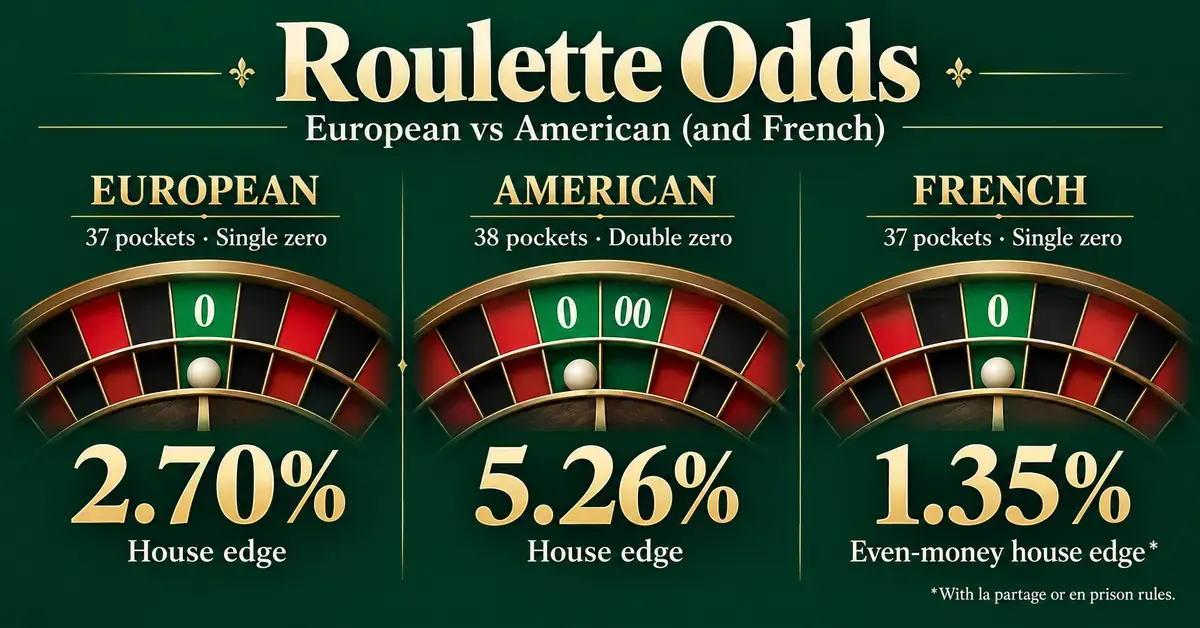
Roulette odds are set by one thing above all: how many pockets the ball can land in and how much the table pays when it lands in yours. Every bet on the layout has a fixed payout, but the chance of winning changes depending on whether you play a European wheel with a single zero, an American wheel with an extra double zero, or a French wheel that softens the loss when zero hits. That one design difference is why the same red/black bet can cost you 2.70%, 5.26% or about 1.35% of your stake over time. This guide explains what those numbers mean, lists the payout for every bet, and shows which version of the game gives you the better odds.
Key Facts
- European wheel: 37 pockets (single zero) — house edge 2.70%.
- American wheel: 38 pockets (0 and 00) — house edge 5.26%.
- French wheel: single zero plus la partage/en prison — even-money bets fall to about 1.35%.
- Top payout: straight-up (one number) pays 35:1.
- Worst bet: the American five-number bet (6:1) at a 7.89% edge.
- Key rule: every spin is independent — past results never change the next outcome.
What “roulette odds” actually means
Roulette odds describe two separate things that beginners often blur together: your chance of winning a bet, and what that bet pays. The chance of winning is simple probability — the number of pockets your bet covers divided by the total number of pockets on the wheel. The payout is a fixed ratio the casino advertises, written as “X:1”, meaning you keep your stake and receive X times it in winnings.
A straight-up bet on a single number is the clearest example. On a European wheel there are 37 pockets, so your chance of hitting one chosen number is 1 in 37, or about 2.70%. The bet pays 35:1. If the game were perfectly fair, a 1-in-37 shot would pay 36:1. The gap between the fair payout (36:1) and the real payout (35:1) is where the casino makes its money. For a fuller primer on how probability and payouts differ across games, see our explainer on how casino games work.
Why the house always has an edge in roulette
The house edge in roulette comes entirely from the zero (and, on American wheels, the double zero). Those green pockets are not covered by red/black, odd/even or high/low bets, yet the payouts are calculated as if they did not exist. The casino pays “true odds minus the zeros”, and that difference is the house edge — the average percentage of each bet the casino expects to keep over the long run.
You can see it in one line of arithmetic. On a European wheel, a 1-unit straight-up bet wins 35 units on 1 pocket and loses 1 unit on the other 36. The expected result is (1 × 35 − 36 × 1) ÷ 37 = −1÷37 ≈ −2.70%. Crucially, that same 2.70% applies to almost every bet on a single-zero wheel, not just straight-up bets — the math works out to the same edge whether you back one number or eighteen. That is why no single bet type is “smarter” than another in terms of the edge; they simply differ in how often they win and how much they pay. You can read more about this concept in our guide to the house edge and RTP.
European vs American roulette: the key difference
The difference between European and American roulette is a single extra pocket, and it doubles the cost of playing. European wheels have 37 pockets: numbers 1–36 plus a single zero. American wheels have 38: the same numbers plus both a 0 and a 00.
That extra 00 does not change any payout — a straight-up bet still pays 35:1 on both wheels — but it adds a pocket that beats every bet except the one that covers it. The result:
- European roulette (single zero): house edge of 2.70% on essentially every bet.
- American roulette (double zero): house edge of 5.26% on essentially every bet — nearly twice as expensive.
In plain terms, for every CAD 100 you wager over time, a European wheel is expected to cost about CAD 2.70 and an American wheel about CAD 5.26. If both are available, the single-zero wheel is the better-value game every time. There is also one bet that exists only on American wheels — the five-number bet covering 0, 00, 1, 2 and 3 — which pays 6:1 and carries a 7.89% edge, the worst bet on the table.
Comparison
| Version | Pockets | Zeros | House edge (most bets) | Even-money edge |
|---|---|---|---|---|
| European | 37 | 0 | 2.70% | 2.70% |
| American | 38 | 0 and 00 | 5.26% | 5.26% |
| French (with la partage/en prison) | 37 | 0 | 2.70% | ~1.35% |
How French roulette cuts the edge to about 1.35%
French roulette uses the same single-zero wheel as the European game but adds a rule that protects even-money bets when zero lands. Those even-money bets are red/black, odd/even and high/low (1–18 vs 19–36). The rule comes in two forms:
La partage
La partage (“the sharing”) means that if the ball lands in zero, you lose only half of any even-money bet instead of all of it; the other half is returned. Because the zero now costs you half a unit rather than a full one, the house edge on those bets falls to roughly half of 2.70% — about 1.35%.
En prison
En prison (“in prison”) applies when zero hits: your even-money bet is locked in place for one more spin instead of being lost. If it wins the next spin, you get your original stake back with no profit; if it loses, it is gone. The long-run effect is the same roughly 1.35% edge on even-money bets.
Two things matter here. First, these rules apply only to even-money bets — straight-up, split and other inside bets still carry the full 2.70% edge even on a French table. Second, the rules are not universal; many single-zero tables, especially outside Europe, do not offer them, in which case the edge stays at 2.70%. Always confirm which rule, if any, is in play before assuming the lower figure.
Roulette payouts and win chances for every bet
The payout for each bet is the same on European and American wheels — only the win probability changes, because the American wheel has one more pocket. Bets fall into two groups: inside bets placed on specific numbers (higher payouts, lower chance) and outside bets placed on large groups (lower payouts, higher chance). The table below lists every standard bet, its payout and your chance of winning on each wheel.
| Bet | Numbers covered | Payout | Win chance (European) | Win chance (American) |
|---|---|---|---|---|
| Straight up | 1 | 35:1 | 2.70% | 2.63% |
| Split | 2 | 17:1 | 5.41% | 5.26% |
| Street | 3 | 11:1 | 8.11% | 7.89% |
| Corner | 4 | 8:1 | 10.81% | 10.53% |
| Six line (double street) | 6 | 5:1 | 16.22% | 15.79% |
| Column | 12 | 2:1 | 32.43% | 31.58% |
| Dozen | 12 | 2:1 | 32.43% | 31.58% |
| Red/Black, Odd/Even, High/Low | 18 | 1:1 | 48.65% | 47.37% |
| Five-number (American only) | 5 | 6:1 | — | 13.16% |
Reading a payout: at 35:1, a winning CAD 1 straight-up bet returns your CAD 1 plus CAD 35. At 1:1, a winning CAD 10 red bet returns your CAD 10 plus CAD 10. Note that every inside bet on a single-zero wheel carries the identical 2.70% house edge — the only outlier is the American five-number bet at 7.89%. For a walkthrough of where these bets sit on the felt, see our guide on how to play roulette.
Which roulette has the best odds?
French roulette with la partage or en prison offers the best odds, but only on even-money bets. Ranked by house edge:
- French, even-money bets with la partage/en prison: ~1.35% — the best deal in the game.
- European (and French inside bets): 2.70%.
- American, most bets: 5.26%.
- American five-number bet: 7.89% — avoid it.
So if you prefer even-money bets, a French table is clearly best; if you play inside numbers, French and European are identical and both beat American. Among common casino table games, roulette’s edge sits higher than blackjack played with correct strategy but is competitive with many others — you can compare them in our overview of casino table games and their odds.
Common mistakes about roulette odds
Even players who know the payouts fall into a few predictable traps:
- Thinking outside bets are “safer” in terms of value. Red/black wins almost half the time, but its house edge is the same 2.70% (or 5.26%) as a straight-up bet. Higher win frequency does not mean a smaller edge.
- Believing past spins affect the next one. The wheel has no memory. After ten reds in a row, black is still 48.65% on a European wheel, not more likely. This is the gambler’s fallacy, and it underpins most losing “systems”.
- Assuming any single-zero table gives 1.35%. The ~1.35% figure requires la partage or en prison and applies only to even-money bets. Without those rules, a single-zero table is 2.70% across the board.
- Playing American when European is available. The games look nearly identical, but the American wheel quietly costs you almost double. Check for the 00 before you sit down.
- Chasing losses with progressive staking. Doubling after a loss (the Martingale and similar systems) does not change the house edge; it only changes how quickly you reach the table limit or run out of money.
Responsible Gambling Disclaimer
This article is for general information only. It explains how roulette odds and payouts work and is not betting advice or a promise of winnings. No bet, system or choice of wheel changes the fact that roulette has a built-in house edge, and the game is designed so the casino profits over time. In Canada you must be of legal gambling age — 19+ in most provinces and 18+ in Alberta, Manitoba and Quebec — to gamble.
If gambling is causing you stress or financial harm, set deposit and time limits, consider self-exclusion, and reach out for support. In Ontario, ConnexOntario offers free, confidential help 24/7 at 1-866-531-2600 (or text CONNEX to 247247); other provinces have their own help lines. The Responsible Gambling Council provides further resources. See our responsible gambling guide for Canada for tools, limits and where to get help.
Sources
Frequently Asked Questions (FAQ)
What are the odds of winning a single number in roulette?
On a European wheel (37 pockets) the chance of hitting one chosen number is 1 in 37, about 2.70%. On an American wheel (38 pockets) it is 1 in 38, about 2.63%. Both pay 35:1 regardless.
Why does American roulette have worse odds than European?
The American wheel adds a second green pocket, the double zero (00), giving 38 pockets instead of 37. Payouts stay the same, so the extra pocket raises the house edge from 2.70% to 5.26% — nearly double.
What does a 35:1 payout actually pay?
A 35:1 payout returns 35 units of profit plus your original stake. A winning CAD 1 straight-up bet gives you CAD 36 in total: your CAD 1 back plus CAD 35.
How does French roulette lower the house edge to 1.35%?
French tables use la partage or en prison, which return half (or keep in play) an even-money bet when zero lands. This roughly halves the 2.70% edge to about 1.35% — but only on even-money bets such as red/black, not on inside number bets.
Does betting on red or black give better odds?
Red/black wins close to half the time, but its house edge is identical to every other standard bet — 2.70% on a European wheel or 5.26% on an American one. Winning more often does not mean the bet is better value.
