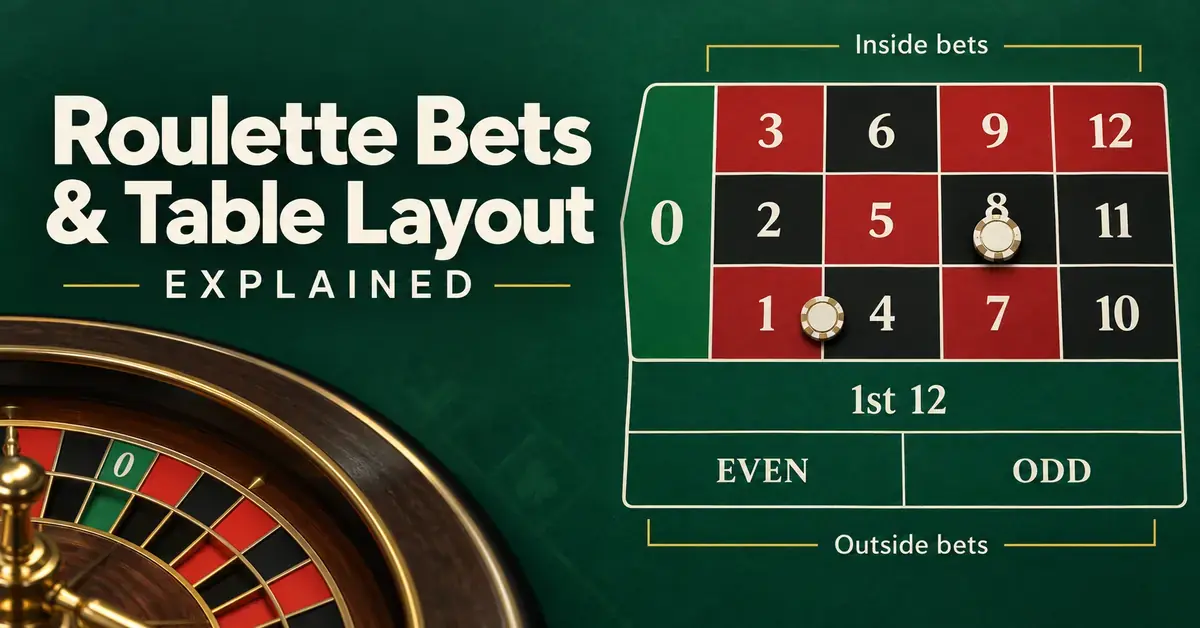
A roulette bet is simply a wager on where the ball will land — but the betting layout turns that one question into dozens of options, each with its own position on the table, its own payout and its own chance of winning. This guide maps every bet to its exact spot on the felt, from a single number to half the wheel, and explains the French “call bets” that cover sections of the wheel itself. It is a reference for reading the table, not a system for beating it: on every legal wheel the maths favours the casino, and no bet changes that. If you are new to the game, start with the basics in our guide to how to play roulette and then use this page to understand each bet in detail.
Key Points
- Two families: inside bets (1–6 numbers, high payouts) and outside bets (12–18 numbers, low payouts).
- Same cost: on a given wheel every bet has the same house edge — the payout just matches the odds.
- Top payouts: straight-up 35:1, split 17:1, street 11:1, corner 8:1, line 5:1; columns and dozens 2:1; red/black, odd/even, low/high 1:1.
- Wheel matters most: European 2.70% edge, American 5.26%, French even-money bets about 1.35% under La Partage.
- Call bets: Voisins du Zéro, Tiers du Cylindre, Orphelins and Jeu Zéro cover sections of the wheel on single-zero French tables.
- Avoid: the American five-number bet (7.89% edge) and any “system” — spins are independent.
What counts as a roulette bet?
Every roulette bet falls into one of two families: inside bets and outside bets. The names come from where the chips sit on the table. Inside bets are placed on or between the printed numbers in the main grid; they cover one to six numbers, win rarely and pay a lot. Outside bets are placed in the boxes around the grid; they cover twelve to eighteen numbers, win often and pay a little.
The single most important fact about these bets is that they do not change the house edge. On a given wheel, every bet carries the same long-run cost per dollar — the payout shrinks in exact proportion to how likely the bet is to win. Choosing an outside bet over an inside bet changes how often and how much you win on a single spin, not your expected result over time. For the maths behind that, see our explainer on how casino games work.
How the roulette table is laid out
The betting layout is a grid of the numbers 1 to 36 arranged in three columns and twelve rows, with the green zero (and the green double zero on American tables) sitting at the top. The numbers run 1, 2, 3 across the first row, 4, 5, 6 across the next, and so on down to 34, 35, 36. The three columns and the three blocks of twelve (the “dozens”) each have their own betting box at the edge of the grid, and the even-money boxes — red/black, odd/even, and low/high — run along one side.
Because the numbers are printed in a fixed pattern, each inside bet has a physical shape. You bet on a single number by placing a chip in its square; you bet on two numbers by placing a chip on the line between them; you bet on a whole row by placing a chip at the end of the row, and so on. Learning the shapes is the fastest way to read any roulette table at a glance.
One detail that trips up beginners
The order of numbers on the betting grid is not the order of pockets on the wheel. The grid is a tidy 1–36 layout for placing chips; the wheel scatters those same numbers around its rim so that colours and high/low numbers alternate. That gap between layout and wheel is exactly why the French call bets (covered below) exist — they let you bet on a section of the physical wheel, which the grid cannot do directly.
Inside bets explained
Inside bets cover small groups of numbers and carry the highest payouts. The payout multiples below are the same on European and American wheels; only the win probability and the house edge differ because the American wheel has an extra pocket.
Straight-up (one number)
A straight-up bet is a chip in a single number’s square and pays 35:1. On a European wheel it wins about 2.70% of the time (one pocket in 37). It is the highest-paying and lowest-probability bet on the table.
Split (two numbers)
A split is a chip on the line shared by two adjacent numbers — horizontally or vertically — and pays 17:1. It wins about 5.41% of the time on a European wheel.
Street (three numbers)
A street covers a full row of three numbers, such as 7-8-9, with a chip at the outer edge of the row. It pays 11:1 and wins about 8.11% of the time.
Corner (four numbers)
Also called a square, a corner bet sits where four numbers meet — for example 1, 2, 4 and 5 — with a chip on the central intersection. It pays 8:1 and wins about 10.81% of the time.
Line / six-line (six numbers)
A line bet (also called a double street or six-line) covers two adjacent rows — six numbers — with a chip at the shared outer corner. It pays 5:1 and wins about 16.22% of the time.
American-only inside bets
Tables with a double zero add two bets built on the green pockets. The trio covers three numbers using the 0 and/or 00 and pays 11:1. The five-number bet (also called the basket or top line) covers 0, 00, 1, 2 and 3, pays 6:1 — and is the single worst bet in roulette, carrying a 7.89% house edge against the 5.26% on every other American bet. Avoid it.
Outside bets explained
Outside bets cover large groups of numbers, win far more often and pay far less. None of them cover the zero (or double zero), which is how the house keeps its edge on even the biggest bets.
Columns
A column bet covers one of the three vertical columns of twelve numbers and pays 2:1. Each column wins about 32.43% of the time on a European wheel.
Dozens
A dozen bet covers the first (1–12), second (13–24) or third (25–36) block of twelve numbers and also pays 2:1, with the same roughly 32.43% win chance as a column.
Red or black
This bet covers all eighteen numbers of one colour and pays 1:1 (even money). It wins about 48.65% of the time on a European wheel — not 50%, because the green zero belongs to neither colour.
Odd or even
An even-money bet on all odd or all even numbers (the zero counts as neither), paying 1:1 with the same ~48.65% chance.
Low or high (1–18 / 19–36)
An even-money bet on the lower or upper half of the numbers, paying 1:1 with the same ~48.65% chance. Again, the zero is excluded.
Bet Payouts and Odds
| Bet | Numbers covered | Payout | European win chance |
|---|---|---|---|
| Straight-up | 1 | 35:1 | 2.70% |
| Split | 2 | 17:1 | 5.41% |
| Street | 3 | 11:1 | 8.11% |
| Corner (square) | 4 | 8:1 | 10.81% |
| Line (six-line) | 6 | 5:1 | 16.22% |
| Column | 12 | 2:1 | 32.43% |
| Dozen | 12 | 2:1 | 32.43% |
| Red/Black, Odd/Even, Low/High | 18 | 1:1 | 48.65% |
| Five-number (American only) | 5 | 6:1 | 13.16% (US wheel) |
Win chances use the 37-pocket European wheel except where noted. The American double-zero wheel lowers each chance slightly and raises the house edge to 5.26%.
French call bets (announced bets)
French call bets let you cover a section of the physical wheel rather than a shape on the grid, and they exist only on single-zero tables that offer a “racetrack” — an oval diagram of the wheel’s pocket order. You announce the bet by name and the dealer places the chips for you. Each one is a fixed pattern of inside bets, so the payouts are just the ordinary inside-bet payouts; the chip count below is the minimum number of units the bet needs.
Voisins du Zéro (neighbours of zero)
Voisins du Zéro covers the 17 numbers clustered around the zero on the wheel — 22, 18, 29, 7, 28, 12, 35, 3, 26, 0, 32, 15, 19, 4, 21, 2 and 25 — using nine chips. A standard layout places one chip each on the 4/7, 12/15, 18/21, 19/22 and 32/35 splits, two chips on the 25/26/28/29 corner and two on the 0/2/3 trio. It is the largest call bet, covering nearly half the wheel.
Tiers du Cylindre (thirds of the wheel)
Tiers du Cylindre covers the 12 numbers on the opposite side of the wheel from zero — 27, 13, 36, 11, 30, 8, 23, 10, 5, 24, 16 and 33 — using six chips, one on each of the 5/8, 10/11, 13/16, 23/24, 27/30 and 33/36 splits.
Orphelins (orphans)
Orphelins covers the eight numbers left over between the other two groups — 1, 6, 9, 14, 17, 20, 31 and 34 — using five chips: one straight-up on 1, and one each on the 6/9, 14/17, 17/20 and 31/34 splits. (The number 17 sits under two chips.)
Jeu Zéro (zero game)
Jeu Zéro is a smaller cousin of Voisins, covering the seven numbers closest to zero — 0, 3, 12, 15, 26, 32 and 35 — with four chips: one each on the 0/3, 12/15 and 32/35 splits and one straight-up on 26.
How the wheel type changes your odds
The bet shapes are identical across roulette variants, but the number of green pockets decides the house edge, so the wheel you choose matters more than the bet you pick.
- European roulette: one zero, 37 pockets, a 2.70% house edge on every bet.
- American roulette: a zero and a double zero, 38 pockets, a 5.26% house edge on nearly every bet (and 7.89% on the five-number bet). The extra pocket almost doubles the cost of playing.
- French roulette: a single-zero wheel with the La Partage or En Prison rule. When the ball lands on zero, La Partage returns half of any even-money stake, while En Prison holds the bet for the next spin. Either rule cuts the house edge on even-money bets to about 1.35% — the best odds in the game.
If you have the choice, a single-zero (European or French) table is always cheaper to play than a double-zero one. Roulette sits toward the higher-edge end of the floor; for how it compares with other games, see our overview of casino table games.
Common mistakes with roulette bets
- Thinking outside bets are safer in the long run. They win more often, but the house edge is identical to inside bets on the same wheel. “Safer” only means lower variance, not lower cost.
- Playing the five-number bet. On American tables it carries a 7.89% edge — worse than any other bet. If you must play a double-zero wheel, skip it.
- Betting on red and black at the same time. Covering both colours does not remove risk; the zero still loses both stakes, so you simply pay the house edge twice.
- Chasing “due” numbers. Each spin is independent. A colour that has not appeared in ten spins is no more likely on the next spin — the wheel has no memory.
- Ignoring the wheel type. Sitting at a double-zero table when a single-zero one is open nearly doubles your expected loss for the exact same bets.
- Trusting betting systems. Doubling after a loss (Martingale) or any other progression cannot overcome a negative edge; it only changes how your wins and losses are distributed.
Which bets suit which players
There is no bet that improves your odds, so the right choice is about the experience you want, not the result you expect. Even-money outside bets on a single-zero wheel give the most playing time per dollar and the lowest edge (especially under La Partage), which suits players who want their bankroll to last. Inside bets and straight-ups deliver rare, large payouts and big swings, which suits players chasing a thrill over a short session. Call bets appeal to players who think in terms of the wheel rather than the grid. Whatever you pick, decide the amount you are prepared to lose before you sit down and treat it as the price of entertainment.
Responsible gambling and Canadian rules
Roulette is a game of chance with a built-in house edge, so over time the wheel is designed to win. No bet, pattern or system changes that, and nothing on this page is betting advice. In Canada the legal gambling age is 19 in most provinces and 18 in Alberta, Manitoba and Quebec. Set a time and money limit before you play, never bet money you cannot afford to lose, and never chase losses. If gambling stops being fun or feels hard to control, free, confidential help is available — in Ontario you can reach ConnexOntario any time at 1-866-531-2600. For tools, limits and provincial support options, see our guide to responsible gambling in Canada.
Sources
Frequently Asked Questions (FAQ)
What is the difference between inside and outside bets?
Inside bets are placed on the numbered grid and cover one to six numbers, paying between 5:1 and 35:1. Outside bets are placed in the surrounding boxes and cover twelve to eighteen numbers, paying 2:1 or 1:1. Inside bets win rarely for big payouts; outside bets win often for small ones. On the same wheel both carry the identical house edge.
Which roulette bet has the best odds?
No bet beats the house, but even-money outside bets (red/black, odd/even, low/high) on a French single-zero wheel with La Partage have the lowest house edge, about 1.35%. On a standard European wheel every bet has a 2.70% edge; on an American double-zero wheel it is 5.26%.
What does a straight-up bet pay?
A straight-up bet on a single number pays 35:1, meaning you win 35 units plus your original stake returned. On a European wheel it wins about 2.70% of the time (one pocket in 37); on an American wheel, about 2.63% (one in 38).
What are call bets or announced bets?
Call bets are fixed groups of numbers that sit together on the physical wheel rather than on the grid, offered on single-zero French tables with a racetrack diagram. The main ones are Voisins du Zéro (17 numbers), Tiers du Cylindre (12 numbers), Orphelins (8 numbers) and Jeu Zéro (7 numbers). You announce them and the dealer places the chips.
Why is the five-number bet a bad bet?
The five-number bet (0, 00, 1, 2, 3) exists only on American wheels and pays 6:1. That payout is lower than the odds justify, giving it a 7.89% house edge — higher than the 5.26% on every other American bet and the worst wager on the table.
