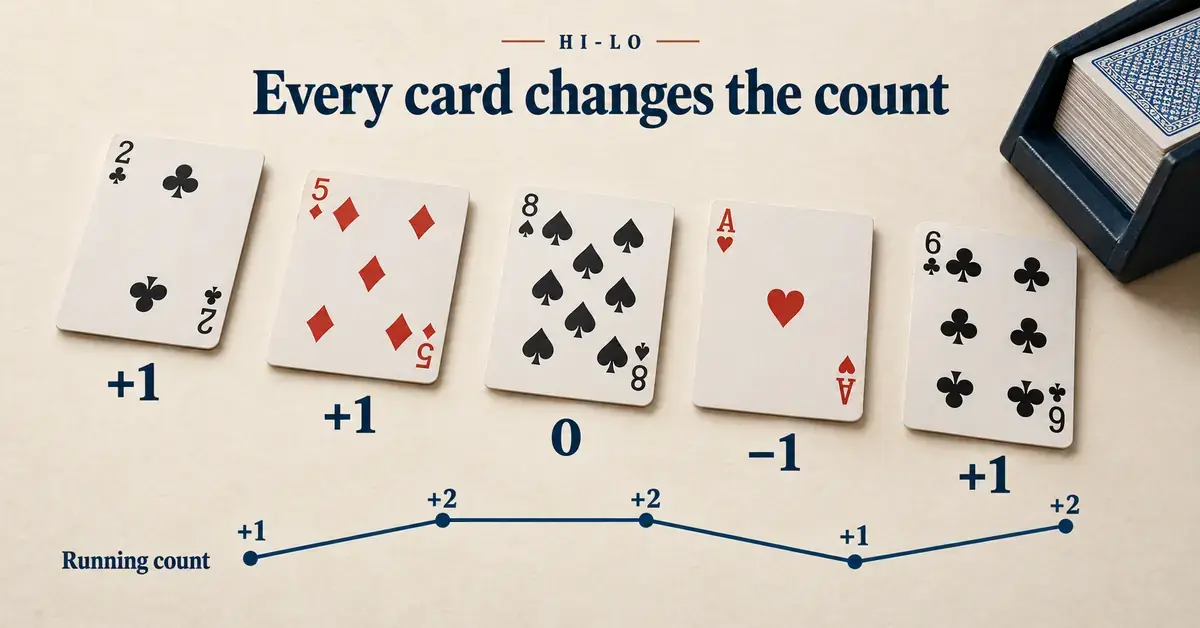
Card counting is a mental technique that tracks the ratio of high cards to low cards left in a blackjack shoe, so a player can bet more when the remaining cards favour them and less when they favour the dealer. It is not memorising every card, it is not illegal in Canada, and — contrary to films like Rain Man and 21 — it does not guarantee winnings. What it does, in the right conditions, is turn blackjack’s small house advantage into a small player advantage. This guide explains exactly how counting works, walks through the most common system step by step, and gives an honest answer to the question most readers really have: is it actually worth the effort?
Key Points
- What it is: a mental method of tracking the ratio of high to low cards left in the shoe, so you bet more when the odds favour you.
- Only works in blackjack, because dealt cards change the odds of the hands to come — unlike slots or roulette.
- Hi-Lo values: 2-6 = +1, 7-9 = 0, 10 through Ace = -1; true count = running count ÷ decks remaining.
- The edge is small: about 1% at best in a good six-deck game, with high variance and a bankroll of roughly 100× your top bet needed to ride it out.
- Legal in Canada when done in your head (no device or partner), but casinos can still refuse to let you play.
- Does not work online: RNG blackjack reshuffles every hand, and continuous shuffling machines kill counting at live tables.
What is card counting?
Card counting is a strategy for keeping a rough running tally of the cards that have already been dealt, in order to estimate whether the cards still to come favour the player or the dealer. It works only in blackjack, because blackjack is one of the few casino games where past cards change the odds of the next hand. Each card dealt from the shoe is gone until the next shuffle, so the make-up of what remains genuinely shifts as play continues.
This is the opposite of a game like roulette or a slot machine, where every spin is independent and nothing you have seen tells you anything about the next result. A counter is not predicting which card comes next. They are simply judging whether the deck as a whole has become richer or poorer in the cards that help the player.
How does card counting work?
Card counting works because high cards are good for the player and low cards are good for the dealer. When the undealt portion of the shoe holds more high cards than low ones, the player has a small edge on the next hands; when it holds more low cards, the house edge grows. A counter raises their bet in the first case and keeps it minimal in the second.
Why high cards favour the player
Several blackjack rules tilt in the player’s favour when tens and aces are plentiful:
- Blackjacks pay more. A natural (an ace plus a ten-value card) pays 3:2 at a fair table, better than an ordinary win. More tens and aces means more naturals — and the player collects the bonus payout, while the dealer’s blackjack only pushes against a player blackjack.
- The dealer busts more often. The dealer must hit on low totals by rule. With lots of high cards left, a dealer forced to draw to a stiff hand (12 through 16) is more likely to go over 21.
- Doubling down pays off. Players choose when to double; getting a ten on a double-down is far more valuable when tens are abundant.
- Insurance becomes worthwhile. The normally poor insurance bet turns profitable only when the remaining deck is rich in ten-value cards.
Because these advantages all point the same way, a shoe loaded with high cards is genuinely better for the player. Counting is just a way to notice when that has happened without tracking every individual card.
The Hi-Lo system explained
The Hi-Lo system is the most widely taught counting method, and it is the easiest to learn because it uses only three values. You assign each card a tag, add the tags up as cards appear, and watch whether the total drifts positive or negative. Hi-Lo is a “balanced” system, meaning a full deck counted all the way through nets exactly zero.
The card values are:
| Cards | Hi-Lo value | Meaning |
|---|---|---|
| 2, 3, 4, 5, 6 | +1 | Low cards — good to see them gone |
| 7, 8, 9 | 0 | Neutral — ignored |
| 10, J, Q, K, Ace | -1 | High cards — bad to see them gone |
The running count
The running count is the total you get by adding each card’s value as it is dealt, starting from zero after a shuffle. If the first few cards are 5, King, 3, 2, 10, you would count +1, 0, +1, +2, +1. A positive running count means more low cards have left the shoe than high cards, so the remaining cards lean high — in the player’s favour. A negative count means the opposite.
The true count
The true count adjusts the running count for how many cards are still left, and it is the number a counter actually bets on. In a shoe game the same running count means far less with six decks to go than with one. To convert, you divide the running count by the number of decks still unplayed:
- Running count of +6 with about three decks left: true count = +6 ÷ 3 = +2.
- Running count of +6 with about one deck left: true count = +6 ÷ 1 = +6 — a much stronger signal.
At the table you estimate the decks remaining by eye, usually by glancing at the discard tray. This estimation is one of the skills that separates a practised counter from a beginner.
Turning the count into bets
The whole point of the true count is to decide how much to bet. Each extra point of true count is worth roughly half a percent of edge to the player, so counters bet the table minimum when the count is flat or negative and scale their bet up as the true count climbs. The strongest hands come up rarely, which is why a counter spends most of the time betting small and wins the bulk of their money on a minority of hands.
Counting also slightly changes some playing decisions — most famously, taking insurance and standing on borderline hands when the count is very high — but the bulk of the edge comes from bet sizing, not from deviating from the basic strategy you would play anyway.
Counting Systems Compared
| System | Card values used | Level of difficulty | Notes |
|---|---|---|---|
| Hi-Lo | -1, 0, +1 (balanced) | Beginner | The most taught system; strong balance of simplicity and accuracy. |
| KO (Knock-Out) | -1, 0, +1 (unbalanced) | Beginner | Counts the 7 as +1 and skips the true-count division, trading a little accuracy for ease. |
| Hi-Opt I | -1, 0, +1 | Intermediate | Aces counted separately; slightly more accurate for playing decisions. |
| Hi-Opt II | -2 to +2 | Advanced | More card tags for higher accuracy, but much harder to keep at speed. |
| Omega II | -2 to +2 | Advanced | A multi-level count favoured by serious players; demanding to run accurately. |
How much of an edge does card counting give?
A skilled counter in a good six-deck game gains an edge of roughly 1% over the house — and that is the realistic ceiling, not a typical result. For context, perfect basic strategy alone can hold the house edge under about 0.5% at a favourable table. Counting flips that small deficit into a small surplus; it does not produce the huge swings people imagine.
The practical numbers are sobering:
- The edge is tiny. At a $100 average bet and a 1% edge, the long-run expectation is about $1 per hand — roughly $50 an hour at 50 hands per hour, before any losses to variance.
- You bet big only rarely. Counters raise their bets only about 10-35% of the time, depending on the rules and how deep the shoe is dealt. The rest of the time you are grinding at the minimum.
- Variance is brutal. A 1% edge is easily swamped by short-term swings. It can take hundreds of hours of play for the edge to reliably show up in results.
- You need a real bankroll. A common rule of thumb is a bankroll of at least 100 times your maximum bet to survive the downswings without going broke. Spread to a $100 top bet, that implies a four- or five-figure cushion.
In other words, counting is a slow, high-variance grind for a thin edge, not a shortcut to easy money. It changes blackjack from a negative-expectation game to a marginally positive one, and only for players willing to put in serious practice and bankroll.
A short history of card counting
Card counting grew out of mathematics, not casino folklore. In 1957 four U.S. Army mathematicians known as the “Four Horsemen” published the first accurate blackjack basic strategy along with a crude counting idea. The breakthrough came in 1962, when mathematician Edward O. Thorp published Beat the Dealer, having used an IBM computer to prove that tracking the cards could beat the house. It remains the foundation of modern counting.
Through the 1970s, professional player Ken Uston popularised “big player” team tactics, in which several counters feed signals to one player who swoops in to bet big only on favourable shoes. The most famous example was the MIT Blackjack Team, groups of students and ex-students who ran team play through the 1980s and 1990s and later inspired books and films. Casinos responded by studying counters as hard as counters studied the game — which is why the countermeasures below exist.
Is card counting legal in Canada?
Counting cards in your head is legal in Canada — it is skilful play, not cheating, because you are only using information openly available at the table and your own mental arithmetic. Canadian courts have treated purely mental counting as a legitimate exercise of skill rather than an offence, and the same view holds across the United States and the United Kingdom.
Two important caveats:
- Devices and confederates cross a line. Using a hidden device to track cards, or signals from a partner to gain an advantage, is treated very differently and has led to criminal charges — including well-known prosecutions tied to Casino Windsor in Ontario in the 1990s. Mental counting alone is the only clearly lawful version.
- Casinos can still refuse service. A casino is a private business. If staff suspect you of counting, they can ask you to stop playing blackjack, bar you from the table, require you to flat-bet, or ask you to leave entirely — and that is within their rights.
So the honest summary is: legal, but not protected. You will not be arrested for counting in your head, but you can absolutely be shown the door.
How casinos stop card counters
Modern casinos use a stack of countermeasures that have made counting far harder than it was in Thorp’s day. The key ones are:
- Continuous shuffling machines (CSMs). These reshuffle dealt cards back into the shoe almost every hand, so the count never gets a chance to build. A CSM effectively kills counting outright, and playing faster against one does not help.
- Poor penetration. “Penetration” is how deep into the shoe the dealer deals before reshuffling. Shuffling early — well before the shoe runs low — denies counters the rich end-of-shoe situations where the edge lives.
- More decks. Six- and eight-deck shoes dilute the effect of any single card and flatten the swings a counter relies on.
- 6:5 payouts. Paying blackjacks at 6:5 instead of 3:2 raises the house edge by roughly 1.4% on its own, enough to wipe out a counter’s advantage. Which rules a table uses matters enormously — see our guide to blackjack rule variations.
- Surveillance and heat. Pit staff and cameras watch for the tell-tale pattern of a player who suddenly ramps their bet when the count turns positive. A player flagged as a counter may be barred, flat-betted, or asked to leave.
- No mid-shoe entry. Preventing players from joining partway through a shoe blocks “back-counting”, where someone watches from the side and sits down only when the count is favourable.
Does card counting work online or on live dealer tables?
Card counting does not work in online blackjack, and it is impractical at nearly all live dealer tables. Online “RNG” blackjack is dealt by software: a random number generator effectively reshuffles the full deck before every single hand, so there is no running count to build. The cards you have seen tell you nothing about the next deal.
Live dealer blackjack — streamed from a studio with a real dealer and real cards — is theoretically countable, but studios shuffle frequently (often around halfway through the shoe or even every hand), the slow pace means very few hands per hour, and operators can simply restrict or close the account of anyone who appears to be spreading bets with the count. In practice, counting online is not a viable strategy.
Common mistakes and misconceptions
Most people who try counting give up, and usually for the same reasons:
- Thinking it predicts the next card. It does not. Counting only shifts the probabilities slightly in your favour; you will still lose plenty of individual hands.
- Forgetting to convert to the true count. Betting off the raw running count in a multi-deck shoe badly overstates your edge and leads to over-betting.
- Playing at a 6:5 table. No counting edge survives a 6:5 payout. If the table does not pay 3:2, the math is already lost before you start.
- Bet-spreading too obviously. Jumping from the minimum to a large bet the moment the count turns positive is the clearest signal to the pit that you are counting.
- Under-estimating the bankroll and variance. Players expect steady profit and instead hit a long losing streak that a thin 1% edge cannot quickly repair, then conclude counting “doesn’t work”.
- Ignoring basic strategy first. Counting is pointless without flawless basic-strategy play underneath it, since that is where most of the game’s value is recovered.
So, is card counting worth it?
For the vast majority of players, card counting is not worth it — and for a small, disciplined minority, it is a demanding part-time job rather than a windfall. The edge it offers is real but thin (around 1% at best), the variance is high, the bankroll required is large, and casinos have spread CSMs, 6:5 tables and early shuffling specifically to neutralise it. Online, it simply does not work.
Where counting is genuinely interesting is as a way to understand why blackjack is unusual: it is the rare casino game where skill and memory can, in principle, swing the math. Learning how it works makes you a sharper, better-informed player even if you never spread a bet. If you want to lower the house edge in practice, learning and sticking to basic strategy at a 3:2 table delivers most of the benefit with none of the heat — and understanding how blackjack works is the right starting point.
Who is card counting for?
Card counting suits a very specific person: someone who enjoys the math, has the patience to practise for months, can stay composed through long losing stretches, and can afford a bankroll they are fully prepared to lose. It is best understood as an advanced hobby for enthusiasts, not a money-making plan. Anyone drawn to it mainly to “beat the casino” and get rich will almost certainly be disappointed — and would be better served treating blackjack as entertainment with a budget, as covered across our wider casino table games guides.
Disclaimer
This article is for information and education only. It is not betting advice and does not suggest any method of improving your chances of winning money. Blackjack, like every casino game, favours the house over time, and card counting does not change that for the vast majority of players. Gambling is restricted to adults (18+ or 19+ depending on your province or territory in Canada). If gambling is affecting you or someone you know, free, confidential help is available — see our guide to responsible gambling in Canada or contact ConnexOntario any time at 1-866-531-2600.
Sources
Frequently Asked Questions (FAQ)
Is card counting illegal in Canada?
No. Counting cards in your head is legal in Canada because it uses only information openly available at the table — it is treated as skilful play, not cheating. However, using a device or a partner’s signals can lead to criminal charges, and casinos are private businesses that can still ask a suspected counter to stop playing or leave.
How much can you really win by counting cards?
Very little, slowly. A skilled counter in a good six-deck game gains roughly a 1% edge, which works out to around $1 per hand on a $100 average bet. High variance means it can take hundreds of hours for that edge to reliably show up, so counting is a thin, grinding return rather than a quick profit.
What is the easiest card counting system to learn?
The Hi-Lo system is the most popular and the easiest to start with. You assign +1 to cards 2 through 6, 0 to 7, 8 and 9, and -1 to tens, picture cards and aces, keep a running total, then divide by the decks remaining to get the true count you bet on.
Can you count cards in online blackjack?
No. Online RNG blackjack reshuffles the full deck before every hand, so no count can ever build. Live dealer tables shuffle frequently and are slow, and operators can restrict suspected counters, so counting is not practical online either.
What is the difference between the running count and the true count?
The running count is the raw total you keep as cards are dealt. The true count adjusts that figure for how many decks are still unplayed by dividing the running count by the decks remaining, which is the number that actually reflects your edge in a multi-deck shoe.
