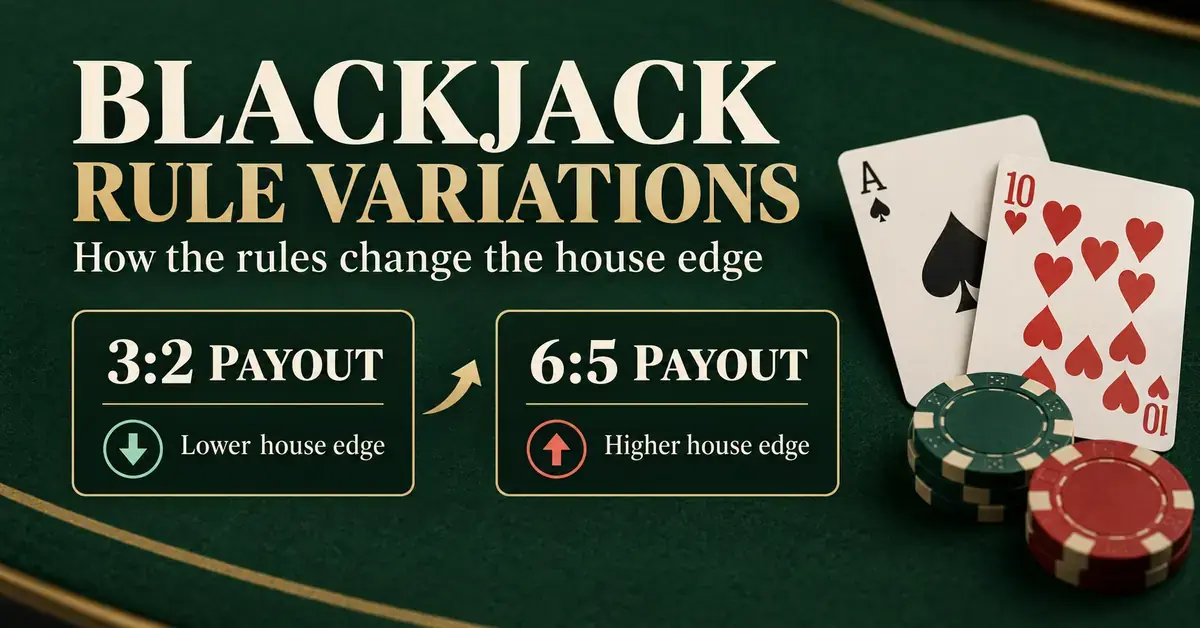
Not all blackjack tables are the same. Two tables can look identical — same green felt, same dealer, same basic deal — yet one gives you noticeably better odds than the other. The reason is the fine print: the payout on a natural, whether the dealer hits or stands on a soft 17, how many decks are in the shoe, and which doubling, splitting and surrender options you are allowed. Each of these rules nudges the house edge — the casino’s long-run mathematical advantage — up or down by a measurable amount. This guide explains the common blackjack rule variations, shows how much each one is worth, and gives you a single table of impacts so you can tell a good blackjack game from a bad one before you sit down.
Key Points
- The payout matters most: 3:2 is standard; a 6:5 payout adds about 1.4% to the house edge and can more than triple it.
- Soft 17: the dealer hitting soft 17 (H17) adds about 0.2%; a table where the dealer stands (S17) is better for you.
- Fewer decks help a little, and player-friendly options — double after split, re-split aces and surrender — each trim a small amount off the edge.
- Best case: with good rules and correct basic strategy, blackjack’s house edge is about 0.3–0.5%, among the lowest in the casino.
- Rules change the math, not your luck: no mainstream rule set makes blackjack a winning game for a basic-strategy player.
What “rule variations” means in blackjack
Blackjack rule variations are the small, table-specific differences in how a game is dealt and paid, and together they decide how big the casino’s edge is. The core objective never changes — beat the dealer’s hand without going over 21 — but casinos adjust the surrounding rules to make a game more or less generous. If you are new to the game, our guide on how to play blackjack covers card values, the deal and the basic player actions; this article assumes you already know those and focuses on how the rules move the odds.
The rules that matter most fall into a handful of groups: the payout for a natural blackjack, the dealer’s rule on a soft 17, the number of decks, the doubling options, the splitting options, and whether surrender is offered. Casinos publish these on a small placard at the table or in the rules panel of an online game.
Why rules change the house edge
Every blackjack rule either gives the player an extra option or takes one away, and the house edge simply totals those effects. The house edge is the share of each bet the casino expects to keep over the long run; in blackjack played with correct basic strategy (the mathematically best play for every hand) and a good rule set, it is around 0.5%, among the lowest of any casino game. Change the rules and that number moves. For the broader picture of how edge, odds and payouts fit together across games, see our explainer on how casino games work.
Two points are worth stating plainly. First, rule variations change the math over thousands of hands, not your luck on any single hand — a 6:5 table can still pay you a jackpot tonight. Second, no mainstream rule set turns blackjack into a positive-expectation game for a basic-strategy player; the best rules only shrink the house edge toward zero, they do not flip it.
The payout rule: 3:2 versus 6:5
The payout on a natural blackjack is the single most important rule at the table. A natural (also called a blackjack) is an ace plus any ten-value card dealt as your first two cards. The standard, player-friendly payout is 3:2, meaning a $10 bet returns $15 in winnings. Many newer tables — especially single-deck and lower-limit games — pay only 6:5, which returns just $12 on that same $10 natural.
That difference is costly. Switching a game from 3:2 to 6:5 adds roughly 1.39 percentage points to the house edge. Because the baseline edge with good rules is only about 0.5%, a 6:5 payout can more than triple the casino’s advantage on an otherwise identical game. A handful of tables go further and pay naturals at even money (1:1), which adds about 2.27 points — avoid these entirely. The rule of thumb is simple: look for “Blackjack pays 3:2” on the felt first, before you consider anything else.
Dealer hits or stands on soft 17 (H17 vs S17)
Whether the dealer must hit or stand on a soft 17 is the second-biggest common rule, and standing is better for you. A soft 17 is any hand totalling 17 that counts an ace as 11 — for example, ace-6. Under S17 the dealer stands on that hand; under H17 the dealer must take another card.
Letting the dealer hit a soft 17 (H17) gives the house an extra chance to improve a mediocre hand, which adds about 0.22 percentage points to the edge. Tables are often marked “Dealer stands on all 17s” or “Dealer hits soft 17.” All else equal, an S17 table is the better game.
Number of decks
Fewer decks lower the house edge, though the effect is smaller than most players assume. Using the common eight-deck shoe as the reference point, reducing the deck count trims the edge as follows:
- Single deck: about 0.48 points lower than eight decks
- Double deck: about 0.19 points lower
- Four decks: about 0.06 points lower
- Six decks: about 0.02 points lower
Fewer decks help because they make a natural slightly more likely and make doubling and standing decisions pay off a little more often. One important catch: casinos frequently “take back” the single-deck advantage by pairing it with a 6:5 payout. A single-deck 6:5 game is a worse bet than a six-deck 3:2 game, so never judge the deck count in isolation.
Doubling rules
Doubling rules decide how aggressively you can press your advantage, and the freer they are, the lower the edge. To double down is to double your bet after seeing your first two cards in exchange for exactly one more card. The most generous version lets you double on any two cards, and that is the baseline assumed by most published figures.
Restricting when you can double costs you:
- Doubling limited to totals of 9–11: adds about 0.09 points to the edge
- Doubling limited to 10–11: adds about 0.18 points
A separate and valuable rule is double after split (DAS) — being allowed to double on a hand you have just created by splitting a pair. Offering DAS is worth about 0.14 points in the player’s favour; a table that forbids it (no-DAS) hands that amount back to the house.
Splitting and re-splitting
Splitting rules affect how many hands you can build from pairs, and the more freedom you have, the better your odds. Splitting means turning a pair into two separate hands, each with its own bet. Most tables let you split to at least three or four hands, but the treatment of aces varies the most.
Normally, when you split aces you receive just one card on each and cannot draw again. Tables that allow re-splitting aces — splitting again if you draw a third ace — give back about 0.08 points to the player. Some tables also allow drawing more than one card to split aces, which helps a little more, but it is uncommon. These are small effects individually, yet they add up with the other player-friendly options.
Surrender
Surrender lets you fold a bad hand for half your bet, and having it available always lowers the house edge. There are two forms. Late surrender, the common one, is offered after the dealer checks for blackjack; it is worth roughly 0.07–0.08 points to the player. Early surrender, offered before the dealer checks, is far more valuable — about 0.63 points combined — but it is rare, especially online.
Surrender only helps if you use it correctly, on genuinely losing hands such as a hard 16 against a dealer’s 9, 10 or ace. Used carelessly it costs you money, which is one reason many players ignore it.
How the rules stack up: a table of impacts
The table below collects the common variations and the approximate amount each one moves the house edge, so you can weigh any table at a glance. Positive numbers favour the house (a worse game for you); negative numbers favour the player (a better game). The figures assume otherwise-standard rules and correct basic strategy, and they shift slightly depending on the full rule set.
House Edge Impact
| Rule variation | Approx. effect on house edge | Favours |
|---|---|---|
| Natural pays 6:5 instead of 3:2 | +1.39% | House |
| Natural pays even money (1:1) | +2.27% | House |
| Dealer hits soft 17 (H17) | +0.22% | House |
| Eight decks instead of one | +0.48% | House |
| Double deck instead of one | +0.19% | House |
| Doubling limited to 10–11 | +0.18% | House |
| No double after split (no DAS) | +0.14% | House |
| Double after split allowed (DAS) | −0.14% | Player |
| Re-splitting aces allowed | −0.08% | Player |
| Late surrender allowed | −0.08% | Player |
| Early surrender allowed | −0.63% | Player |
Read the table as a priority list: the payout dwarfs everything else, the soft-17 rule and deck count come next, and the doubling, splitting and surrender rules are smaller tie-breakers that matter most once the big rules are already good.
How to read a blackjack table’s rules
You can judge most blackjack games in about ten seconds if you know where to look. In a live casino the rules are printed on the felt or a placard; online they appear in the game’s information or rules panel. Check them in this order:
- Payout: confirm “Blackjack pays 3:2.” If it says 6:5 or even money, walk away.
- Soft 17: prefer “Dealer stands on all 17s” over “Dealer hits soft 17.”
- Decks: fewer is marginally better — but only if the payout is still 3:2.
- Doubling and DAS: look for “double on any two cards” and “double after split allowed.”
- Surrender and re-splits: nice extras if present, not deal-breakers if absent.
Blackjack is one of several casino table games, and it rewards this kind of comparison more than most because the rules are published up front and the differences are real money.
Common mistakes with rule variations
The most expensive mistake is ignoring the payout, and several smaller errors compound it. Watch for these:
- Chasing single-deck 6:5 tables. Players assume fewer decks means better odds and miss that the 6:5 payout more than cancels the single-deck advantage.
- Treating all tables as equal. Two tables side by side can differ by a full percentage point in house edge purely on rules.
- Taking “even money” on your own blackjack. This is really a 1:1 payout on a natural and is a poor deal at a 3:2 table.
- Not adjusting basic strategy to the rules. The correct play for some hands changes between H17 and S17, or with and without surrender; using a chart built for different rules leaks a little more edge.
- Overvaluing side bets. Side bets are not rule variations on the main game, and they carry much higher house edges than the base game regardless of the table rules.
Which rules matter most, and who should care
If you remember only one thing, make it the payout, because it outweighs every other rule combined. For a casual player, finding a 3:2 table with the dealer standing on soft 17 captures almost all of the available advantage; the remaining doubling, splitting and surrender rules refine a game that is already good. For a disciplined basic-strategy player, stacking every favourable rule — 3:2, S17, DAS, re-split aces and surrender — can pull the house edge down toward the 0.3–0.5% range, which is about as good as blackjack gets without card counting.
None of this changes the underlying truth: even the best blackjack game keeps a small edge for the casino, and results over any short session are dominated by chance. Rule knowledge helps you pay the lowest possible price to play; it is not a way to win.
Responsible Gambling
This article is educational and describes how blackjack rules affect the mathematical house edge; it is not betting advice and does not suggest any outcome can be guaranteed. Understanding rule variations can lower the cost of playing, but blackjack always favours the casino over time and no rule set or strategy makes it a reliable source of income.
In Canada you must be of legal gambling age — 19 in most provinces and 18 in Alberta, Manitoba and Quebec — to play. Set a budget before you play, treat any losses as the price of entertainment, and never bet money you cannot afford to lose. If gambling stops being fun or feels hard to control, free, confidential help is available: in Ontario, ConnexOntario at 1-866-531-2600 (or text CONNEX to 247247), and nationally through the Responsible Gambling Council. See our responsible gambling in Canada page for support lines, deposit and time limits, and self-exclusion tools.
Sources
Frequently Asked Questions (FAQ)
What is the single most important blackjack rule for the house edge?
The payout on a natural blackjack. A 3:2 payout is standard and player-friendly; switching to 6:5 adds roughly 1.4 percentage points to the house edge, which can more than triple the casino’s advantage on an otherwise identical game. Always confirm the table pays 3:2 before anything else.
Is 6:5 blackjack really that much worse than 3:2?
Yes. On a $10 natural, 3:2 pays $15 while 6:5 pays only $12. Across many hands that gap adds about 1.39 percentage points to the house edge, far more than any other common rule. A six-deck 3:2 table is a better bet than a single-deck 6:5 table.
Does the dealer hitting soft 17 help or hurt me?
It hurts you. When the dealer hits a soft 17 (H17) instead of standing (S17), the house edge rises by about 0.22 percentage points, because the dealer gets an extra chance to improve a weak hand. Given a choice, pick a table where the dealer stands on all 17s.
Do fewer decks always mean better odds?
Fewer decks lower the edge slightly — a single deck is about 0.48 points better than eight decks with the same other rules — but the effect is small and often cancelled out. Many single-deck tables pay 6:5, which erases the deck advantage several times over, so judge the deck count only after checking the payout.
What is the lowest house edge blackjack can have?
With the best common rules — 3:2 payout, dealer stands on soft 17, double on any two cards, double after split, re-split aces and surrender — and correct basic strategy, the house edge can drop to roughly 0.3–0.5%. That is among the lowest in the casino, but it is still an edge in the house’s favour.
