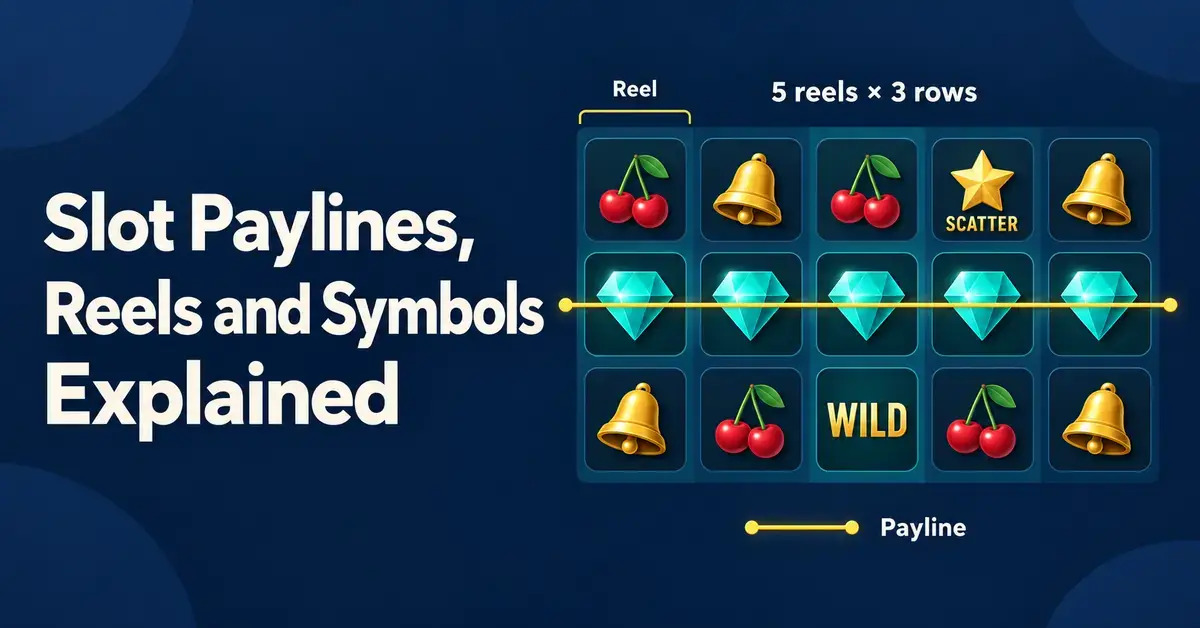
Slot paylines, reels and symbols are the three things that decide whether a spin counts as a win or a miss. A payline is a set path across the reels that the game checks for matching symbols; the reels and rows form the grid those symbols land on; and special symbols such as wilds and scatters change how combinations are scored. Understanding these terms will not change your odds, but it will help you read any slot correctly and know exactly what you are looking at. This guide explains each concept in plain English and shows you how to find the real rules in a game’s paytable.
For the bigger picture of spins, the random number generator and RTP, see our overview of how slot machines work.
Key Points
- Reels and rows form the grid; most video slots are 5 reels × 3 rows (15 positions).
- A payline is a fixed route; only symbols on an active line count, usually read left to right.
- Ways to win drop fixed lines and pay for matching symbols on adjacent reels in any row (e.g. 243 or 1,024 ways).
- Megaways vary the symbols per reel each spin, up to 117,649 ways; cluster pays reward groups of touching symbols.
- Wilds substitute for other symbols; scatters pay or trigger features by count, wherever they land.
- The paytable is the only reliable source for a specific game’s rules, symbol values and RTP.
What are reels and rows on a slot machine?
A reel is a vertical strip of symbols that spins and stops, and a row is a horizontal line of symbol positions across those reels. Most modern video slots use five reels and three rows, which creates a grid of 15 visible symbol positions. Older classic slots use three reels and one row.
Slots are usually described with a “reels × rows” shorthand. A 5×3 slot has five reels and three rows; a 6×4 slot has six reels and four rows. The grid below shows a typical 5×3 layout, where each cell is one symbol position:
| Reel 1 | Reel 2 | Reel 3 | Reel 4 | Reel 5 | |
|---|---|---|---|---|---|
| Row 1 (top) | 🍒 | A | 🔔 | K | 🍋 |
| Row 2 (middle) | 7 | 🍒 | 🍒 | 🍒 | Q |
| Row 3 (bottom) | 🔔 | J | 🍋 | 7 | 🍒 |
The number of reels and rows sets how many winning patterns are even possible, which is why layout is the first thing to check on any new game.
What is a payline in slots?
A payline is a fixed route across the reels that the game checks for matching symbols, and only symbols that land directly on an active payline can form a win. Lines can run straight across a row, diagonally, or in zig-zag shapes such as a V or a W. On a classic three-reel slot there is often just one payline through the centre row.
Two rules apply on almost every line-based slot:
- Position matters. A matching symbol that lands just above or below an active line pays nothing, even if three identical symbols are visible on screen. It only counts if it sits on the line.
- Direction matters. Most slots read paylines from the leftmost reel to the right, so a combination usually has to start on reel 1 and continue on each following reel without a gap.
So a slot with 20 paylines is checking 20 separate routes on every spin, and your stake is spread across all of them.
Fixed paylines vs adjustable paylines
Some slots have fixed paylines that are always all active, while others let you choose how many lines to play. On a fixed-line game you simply bet, and every line is live. On an adjustable game you set a number of active lines and a stake per line; your total bet is the stake per line multiplied by the number of active lines.
One point is often misunderstood: choosing fewer lines does not improve your expected return. The game’s long-run payout percentage, or RTP, is built into its design and does not change with your line selection. Playing fewer lines at a higher stake per line simply makes results more swingy — bigger but rarer wins. For how RTP and the house edge actually work across casino games, see our explainer on how casino games work.
Paylines vs “ways to win” — what is the difference?
The difference is that paylines pay along fixed routes, while “ways to win” slots pay for matching symbols on adjacent reels in any position. A ways-to-win game drops the idea of set lines entirely. Instead, if the same symbol lands anywhere on reel 1, reel 2, reel 3 and so on from left to right, that counts as a win — regardless of which row each symbol sits in.
The total number of ways is the symbol count on each reel multiplied together. On a five-reel, three-row grid that is 3 × 3 × 3 × 3 × 3 = 243 ways. Add a fourth row and it becomes 4 × 4 × 4 × 4 × 4 = 1,024 ways. This is why you will see games advertised as “243 ways” or “1,024 ways” rather than by a line count.
Payline Models Compared
| Model | Typical grid | How wins form | Lines / ways |
|---|---|---|---|
| Classic | 3 × 1 | Match along the single centre row | 1 |
| Paylines | Varies (often 5 × 3) | Symbols on set routes, usually left to right | Typically 10–50 |
| Ways to win | 5 × 3 | Matching symbols on adjacent reels, any row | 243 |
| Ways to win | 5 × 4 | Matching symbols on adjacent reels, any row | 1,024 |
| Megaways | 6 reels, 2–7 rows (variable) | Adjacent reels, any row; changes each spin | Up to 117,649 |
| Cluster pays | Grid (e.g. 7 × 7) | Groups of touching identical symbols | No lines; cluster size |
Neither model is “better” by default. More ways or lines mean more frequent small hits, but each game is still balanced around its own RTP, so the format mainly affects how the wins feel, not the long-run return.
Megaways and cluster pays: variable ways
Megaways and cluster pays are two newer models that change how combinations are counted. Megaways, a mechanic introduced by British studio Big Time Gaming, uses a variable number of symbols on each reel that changes on every spin. Because the reel heights change, the number of ways to win changes too — a common six-reel Megaways game can offer up to 117,649 ways (that is 7 × 7 × 7 × 7 × 7 × 7 = 7⁶, when every reel shows its maximum of seven symbols).
Cluster pays work differently again. Instead of lines or adjacent reels, a win forms when a group of identical symbols touches horizontally or vertically — for example, five or more connected symbols anywhere on the grid. Many Megaways and cluster games also use cascading reels (also called tumbling or avalanche reels), where winning symbols disappear and new ones drop in, allowing chained wins from a single spin.
How do wild symbols work?
A wild symbol substitutes for other symbols to help complete a winning combination. If a payline needs one more cherry to pay, a wild landing in that spot can stand in for it. Wilds come in several forms:
- Standard wild: substitutes for regular symbols in its position.
- Expanding wild: grows to cover a whole reel.
- Sticky wild: stays in place for several spins.
- Stacked wild: appears stacked on top of itself to fill multiple positions on one reel.
- Multiplier wild: multiplies the value of any win it helps complete.
One important limit: on most slots a wild cannot substitute for a scatter or bonus symbol. That means a wild can finish a line of regular symbols but cannot create the scatter count needed to trigger free spins. The exact rule is always stated in the paytable.
How do scatter symbols work?
A scatter symbol is judged by how many appear anywhere on the reels, not by whether it lands on a payline. On most games you need a minimum number of scatters — commonly three or more — to trigger a feature such as free spins or a bonus round, and their position does not matter. This is the opposite of a regular symbol, which only counts on an active line or adjacent-reel path.
Scatter behaviour varies, so always check the specifics:
- Some scatters pay a credit amount directly as well as triggering a feature.
- Some require landing on particular reels (for example, reels 1, 3 and 5).
- Some games separate the scatter from a distinct bonus symbol, which starts its own pick or wheel round.
Bonus symbols are a related third category used mainly to launch a special game. In some titles the scatter and bonus roles overlap; in others they are distinct. Again, the paytable is the authority.
How to read a slot paytable
The paytable is the game’s own rulebook, and reading it is the only reliable way to know how a specific slot pays. You open it with the information button — usually an “i”, a menu icon, or a “Paytable” or “Rules” link in the corner of the game. Inside, you will find the exact value of each symbol and the rules for every feature.
When you open a paytable, check these points in order:
- Symbol values: how much each symbol pays for three, four or five of a kind.
- Lines or ways: whether the game uses fixed paylines, adjustable lines, ways to win, Megaways or clusters, and the direction wins are read.
- Wild rules: what the wild substitutes for, any exceptions, and whether it carries a multiplier or special behaviour.
- Scatter and bonus triggers: how many are needed, whether they must land on set reels, and what feature they start.
- RTP and bet limits: the stated return-to-player percentage and the minimum and maximum stake.
If anything on screen looks like a win but did not pay, the paytable will almost always explain why — usually because the symbols were off an active line, not on adjacent reels, or not enough scatters landed.
Common mistakes when reading slots
The most common mistake is assuming that three matching symbols anywhere on the screen must pay. On a payline slot they only pay if they sit on an active line; on a ways slot they must be on adjacent reels from the left. Other frequent errors include:
- Thinking more lines improve your odds. More active lines spread your stake wider and change how often you hit, but they do not raise the game’s built-in RTP.
- Confusing ways with lines. “243 ways” is not 243 paylines; it is a different scoring method based on adjacent reels.
- Expecting a wild to trigger free spins. Wilds usually cannot complete a scatter count.
- Ignoring win direction. A combination that does not start on the leftmost reel often pays nothing.
- Chasing losses. Each spin is independent and decided by the random number generator; past results never make a win “due”.
Which format suits which player?
There is no format that pays more over time, because every slot is balanced around its own RTP, but the models do feel different. Fixed-payline classics are simple and easy to follow. Higher line counts and 243/1,024-ways games tend to produce frequent small wins. Megaways and cluster games with cascades are usually higher-volatility, meaning longer dry spells and occasional larger wins. Choosing between them is a matter of preference and bankroll comfort, not strategy — no reading of paylines or paytables can shift the long-run edge in the player’s favour.
Responsible Gambling
This article is educational and does not encourage gambling or promise winnings. Slot outcomes are decided by a random number generator, every spin is independent, and no understanding of paylines, symbols or paytables can change a game’s built-in house edge. In Canada you must be of legal gambling age (19+ in most provinces, 18+ in Alberta, Manitoba and Quebec).
If gambling stops being fun or you are worried about your own or someone else’s play, free, confidential help is available. In Ontario you can reach ConnexOntario at 1-866-531-2600, 24/7. For deposit and time limits, self-exclusion options and provincial help lines, see our guide to responsible gambling in Canada.
Sources
Vanliga frågor (FAQ)
Do symbols pay if they are not on a payline?
No. On a payline slot, matching symbols only pay when they land on an active line, even if identical symbols appear elsewhere on screen. On a “ways to win” slot, they must land on adjacent reels starting from the leftmost reel. Scatters are the main exception, as they pay by count regardless of position.
What is the difference between paylines and ways to win?
Paylines pay along fixed routes you can trace across the reels, while ways-to-win games pay whenever matching symbols land on adjacent reels from left to right, in any row. A 5×3 ways game has 243 ways (3⁵), and a 5×4 game has 1,024 ways (4⁵).
What is the difference between a wild and a scatter?
A wild substitutes for other symbols to complete a winning combination, usually on a line or adjacent reels. A scatter pays or triggers a feature based on how many appear anywhere on the reels, regardless of position. On most slots a wild cannot stand in for a scatter.
Does playing more paylines increase my chances of winning?
Playing more lines gives you more active routes per spin, so you may hit small wins more often, but it also costs more because your stake covers every line. It does not raise the game’s return-to-player percentage, which is fixed by the game’s design.
Where do I find a slot’s rules and symbol values?
Open the paytable using the information or menu button in the game, often shown as an “i” or labelled “Paytable” or “Rules”. It lists every symbol’s value, how wilds and scatters behave, the number of lines or ways, and usually the RTP and bet limits.
