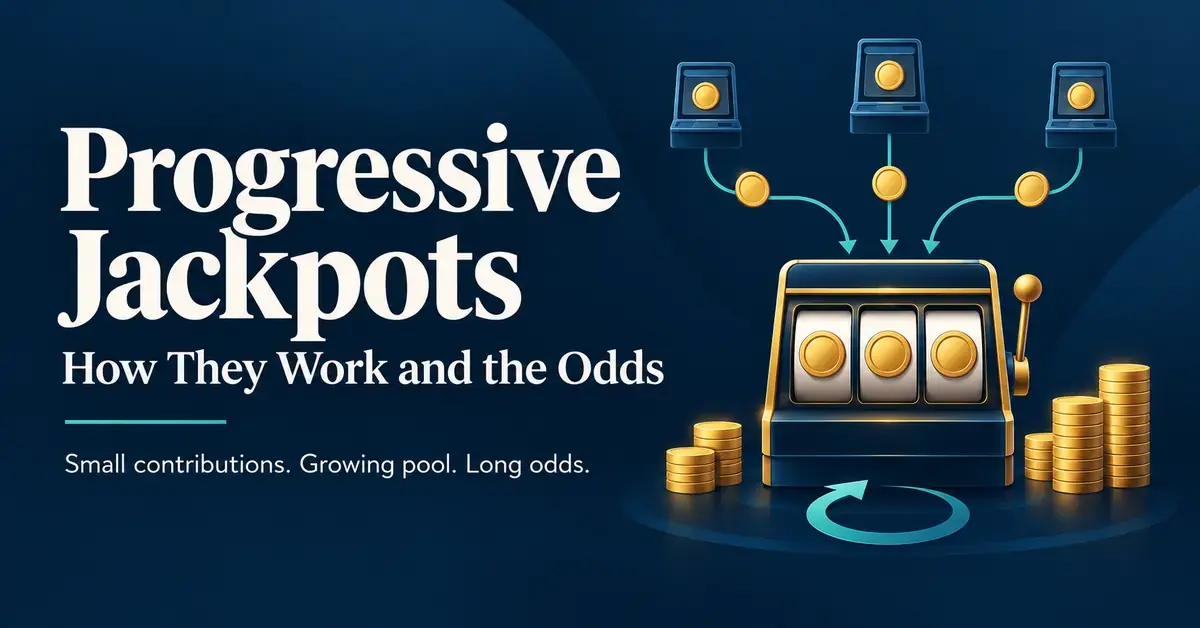
A progressive jackpot is a casino prize that grows a little with every qualifying bet players make, then pays the full pool to one winner before resetting to a starting amount and climbing again. You will see them most often on slot machines, where a jackpot can swell from a few thousand dollars into the tens of millions. This guide explains where that money comes from, the difference between standalone, linked and networked pools, how must-drop jackpots work, and — honestly — just how long the odds of winning really are.
Key Points
- A progressive jackpot grows as a small share of each qualifying bet is added to a shared pool, then resets to a seed value after a win.
- Pools come in three sizes: standalone (one game), local or in-house (a few linked games), and wide-area network (linked across many casinos).
- Jackpots are won by a symbol combination, a bonus game, or a purely random trigger — the game’s rules tell you which.
- Must-drop jackpots guarantee a payout before a set amount or time, but this does not improve the odds on any single spin.
- Odds are extremely long — Mega Moolah’s top tier is estimated near 1 in 50 million — and every spin is independent and random.
- Progressive slots usually return slightly less in the base game, because part of each bet funds the jackpot pool.
What is a progressive jackpot?
A progressive jackpot is a prize that increases over time instead of paying a fixed amount. Each qualifying bet adds a small amount to a shared pool, so the advertised figure keeps rising until someone wins it. The moment it is paid out, the jackpot drops back to a preset starting value — called the seed — and begins growing all over again.
The opposite is a fixed (or flat) jackpot, which always pays the same top prize no matter how many people have played. Progressive prizes are more exciting precisely because they are open-ended, but that extra size comes with much longer odds and, usually, a slightly lower everyday return. Understanding both trade-offs matters before you decide a jackpot game is worth your money.
How progressive jackpots work
At heart, a progressive jackpot is just a pot that is topped up by players and emptied by a single winner. Three things decide how it behaves: how the pool grows, how a win is triggered, and what the prize resets to afterwards.
How the pool grows
Every qualifying bet sends a small slice of itself into the jackpot pool rather than into the base prizes. That slice is usually only a few percent of the stake, and the exact rate is fixed by the game studio and the operator, not by the player. Because thousands of people may be feeding the same pot at once, the headline number can climb quickly even though each individual contribution is tiny.
That contribution is built into the game’s overall odds, house edge and RTP. In plain terms, the money funding the jackpot is money that is not being returned to players in ordinary wins, which is one reason progressive slots can feel "colder" between bonuses.
How a jackpot is triggered
A progressive jackpot is won in one of three common ways, and the game’s rules tell you which applies:
- A symbol combination — lining up specific jackpot symbols on an active payline.
- A bonus game — reaching a pick-a-prize round or a jackpot wheel that awards the pool.
- A purely random trigger — the jackpot event can appear at the end of any spin, with no symbols required. Microgaming’s Mega Moolah is the classic example: a jackpot wheel can pop up at random.
In every case the result is decided by the game’s random number generator, the same engine behind how slot machines work. On some games a larger bet qualifies you for the top tier or raises the chance that the bonus event appears, but no stake can change the fact that each spin’s outcome is independent and random.
What happens after a win (reset and seed)
When the jackpot is won, it immediately resets to its seed value and starts building again. The seed is a guaranteed minimum so the prize still looks attractive the day after a big payout. Mega Moolah, for instance, runs four tiers — Mini, Minor, Major and Mega — and the top Mega tier reseeds at a guaranteed minimum of around $1 million (the exact figure varies by region and currency). The smaller tiers seed at much lower amounts and are won far more often.
Types of progressive jackpots
Progressive jackpots are grouped by how many games feed the same pool. The wider the network, the bigger the prize can grow — and the longer the odds become.
Standalone jackpots
A standalone jackpot is tied to a single machine or game, so only the people playing that one game contribute to it. The pool grows slowly and tops out at a modest size, often a few thousand dollars. Because fewer players are competing for it, the chance of hitting a standalone jackpot is typically shorter than on a huge networked prize — but the reward is correspondingly smaller.
Local or in-house (linked) jackpots
A local jackpot links several machines or games within a single casino or a small group of sites run by one operator. In a land-based casino these might be a bank of machines sitting side by side; online, a local jackpot may be shared across a handful of related games. Pooling more players makes the prize bigger than a standalone one, while keeping the odds shorter than a global network.
Wide-area network jackpots
A wide-area network jackpot is linked across many casinos, often across different brands, regions or countries. Qualifying bets from all of them feed one enormous pool, which is how prizes reach the tens of millions. These are the famous names — Mega Moolah and NetEnt’s Mega Fortune — and they carry the longest odds of all, because you are effectively competing with a global pool of players.
Jackpot Types Compared
| Jackpot type | What feeds the pool | Typical size | Odds of hitting |
|---|---|---|---|
| Standalone | One machine or game only | Smallest; grows slowly | Relatively shortest of the four (small prize) |
| Local / in-house | A bank of machines or a few linked games at one casino or operator | Medium | Longer than standalone |
| Wide-area network | Qualifying bets across many casinos and brands | Largest (tens of millions) | Longest (e.g. around 1 in 50 million) |
| Must-drop | Any of the above, plus a guaranteed-drop rule | Capped by an amount or a clock | Guaranteed to drop by the deadline; per-spin odds unchanged |
Must-drop and mystery jackpots
Must-drop jackpots are a popular variant that guarantees a payout before a set limit, so the prize cannot grow forever. The limit is either an amount or a time, and a related mechanic — the mystery jackpot — uses a hidden target. Crucially, a drop guarantee changes when a prize must be paid, not who wins it or how likely any single spin is to be the winning one.
Amount-based must-drop jackpots
An amount-based jackpot must be won before its meter passes a displayed ceiling. The game shows a "drops before" figure; as the pool nears that cap, a win becomes certain to land soon. The deadline makes the payout feel imminent, but every spin before it still has the same long odds as any other.
Time-based and daily must-drop jackpots
A time-based jackpot must be paid before a clock runs out rather than at a value. Common versions include daily-drop jackpots that guarantee a prize lands within each 24-hour cycle, and hourly drops that compress the window further. Again, the clock guarantees a winner by the deadline; it does not make your particular spin more likely to be the one.
Mystery jackpots
A mystery jackpot is awarded when the pool reaches a secret target value that was randomly chosen in advance. Linked games feed a controller that picks a hidden number between a start and end value; the jackpot climbs with each bet, and whoever’s wager tips the meter onto that number wins. Because the target is hidden, there is no way to time or predict a mystery drop.
What are the odds of winning a progressive jackpot?
The odds on a big progressive jackpot are extremely long, and it is only fair to say so plainly. Microgaming has never published an exact figure for Mega Moolah, but the chance of hitting its top tier is widely estimated at roughly 1 in 50 million per triggering event. Smaller standalone and local jackpots have far shorter odds because their pools — and payouts — are much smaller.
No stake size, time of day, lucky streak or "system" changes those odds. On games where a bigger bet improves the chance of triggering the jackpot round, you are paying more per spin for a still-tiny probability, not buying a meaningfully better shot at the prize. A progressive jackpot is best understood as a lottery-style long shot bolted onto an ordinary slot, not as a realistic target.
Progressive jackpots and your real return
Progressive slots usually return slightly less in the base game than comparable non-jackpot slots, because part of every bet is diverted to fund the pool. A game’s published RTP often already includes the jackpot contribution, which means a prize you never win effectively lowers the return you actually experience. In other words, you are trading a little everyday value for a remote chance at a huge one.
If your goal is simply to make your money last at the lowest cost, the house edge on games such as blackjack and other casino table games is generally far lower than on a jackpot slot. Progressive games are an entertainment choice, not an value-for-money one.
Famous progressive jackpot wins
A handful of record payouts show just how large these pools can grow — while also being the rare exceptions that prove how unusual a win is:
- Mega Moolah, 2015: UK player Jon Heywood won €17.88 million (about £13.2 million) on Betway, a payout recognised by Guinness World Records as the largest online slot jackpot at the time.
- Mega Moolah, 2018: a player at Grand Mondial Casino won €18.9 million from a 75-cent spin.
- Absolootly Mad Mega Moolah, 2021: a Belgian player on Napoleon Sports & Casino won more than €19.4 million from a €15 stake — widely reported as the largest online slot win on record.
- Mega Fortune (NetEnt), 2013: a player in Helsinki won €17.8 million on the Paf website, a world record for a slot payout at the time.
These are outliers drawn from many millions of losing spins. For every headline winner, countless players contributed to the same pool and won nothing from it.
Common mistakes and misconceptions
Most progressive-jackpot errors come from misreading randomness. The frequent ones:
- Thinking a jackpot is "due." A pool that has not paid for a long time is not more likely to hit on your spin. Each spin is independent, so past results tell you nothing about the next one.
- Believing a must-drop deadline improves your odds. It guarantees someone wins by the cap or clock — not that it will be you, and not that your spin is more likely than any other.
- Not checking the qualifying bet. Some games only enter you for the top tier at a higher or maximum stake; playing below it can mean you cannot win the big prize at all.
- Chasing losses with bigger bets. Raising your stake to "win it back" only increases how fast you can lose, not your chance of the jackpot.
- Ignoring the lower base return. Treating a progressive slot as if it pays like a standard slot overlooks the value quietly redirected into the pool.
Who are progressive jackpots for?
Progressive jackpots suit players who want the thrill of a tiny chance at a life-changing prize and who accept a lower realistic return as the price of that thrill. They are entertainment, not an income plan. If you are playing to try to profit, or with money you need for anything else, a progressive jackpot is the wrong tool — the long odds and the base-game cost both work against you.
Responsible gambling
You must be of legal gambling age in your province (19+ in most of Canada, 18+ in Alberta, Manitoba and Quebec) to play. Progressive jackpots carry very long odds, every spin is random, and no bet size, timing or strategy can improve your chance of winning. Treat any jackpot game as paid entertainment, set a budget before you start, and only ever play with money you can afford to lose. If gambling stops being fun or starts causing harm, free, confidential help is available — in Ontario you can reach ConnexOntario any time at 1-866-531-2600 or by texting CONNEX to 247247. For tools, limits and provincial support options, see our guide to responsible gambling in Canada.
Sources
- Guinness World Records — Largest jackpot payout in an online slot machine game
- Gaming Intelligence — Microgaming & Betway share Guinness World Record for largest online slot jackpot (2015)
- CasinoBeats — Mega Moolah sets new high with €18.9m win (2018)
- SBC News — Player lands world-record €19.4m slot win on Napoleon (2021)
- Gaming Intelligence — NetEnt’s Mega Fortune jackpot payout enters the record books
- esports.gg — How Mega Moolah works: jackpot wheel and four tiers
- Gambling.com — Progressive jackpots overview (Canada)
Frequently Asked Questions (FAQ)
How does a progressive jackpot work?
A small share of every qualifying bet is added to a shared prize pool, so the jackpot grows as people play. When a player triggers the win — through a symbol combination, a bonus game or a random event — they take the whole pool, and it resets to a preset seed value before building again.
What is the difference between standalone, linked and networked jackpots?
A standalone jackpot is fed by one game only, so it stays small but is relatively easier to hit. A linked or in-house jackpot pools several games at one casino or operator. A wide-area network jackpot combines bets from many casinos, which produces the biggest prizes and the longest odds.
What is a must-drop jackpot?
A must-drop jackpot is guaranteed to pay out before it passes a set amount or a set time, such as a displayed ceiling or a daily deadline. The guarantee affects when a prize must land, not your odds on any individual spin, which stay the same.
Do bigger bets improve my chances of winning a progressive jackpot?
On some games a larger bet is required to qualify for the top tier, or it raises the chance the jackpot round appears. Even then, the outcome of each spin is random, so a bigger stake mainly increases how much you risk rather than meaningfully improving your odds.
What are the odds of winning a progressive jackpot?
They are very long, especially on networked games. The top tier of Mega Moolah, for example, is widely estimated at around 1 in 50 million per triggering event. Smaller standalone jackpots have shorter odds but pay far less, and no strategy can change the result of a random spin.
