Three Card Poker is a fast casino table game in which you and the dealer are each dealt three cards, and the aim is either to make a better three-card hand than the dealer or simply to be dealt a pair or better. It combines a hand-versus-dealer wager with an optional bonus bet, so there are a handful of decisions to learn before you sit down. This guide covers the rules, every bet on the layout, the hand rankings (which are not the same as in regular poker), the odds and house edge, and the simple strategy that keeps the game as cheap as possible to play.
Key Points
- The game: you and the dealer each get three cards; make a better three-card hand than the dealer, or be dealt a pair or better.
- Main decision: after seeing your cards, fold (lose the ante) or make a Play bet equal to the ante.
- Dealer qualifies with Queen-high or better; if not, the ante pays 1:1 and the Play bet is returned.
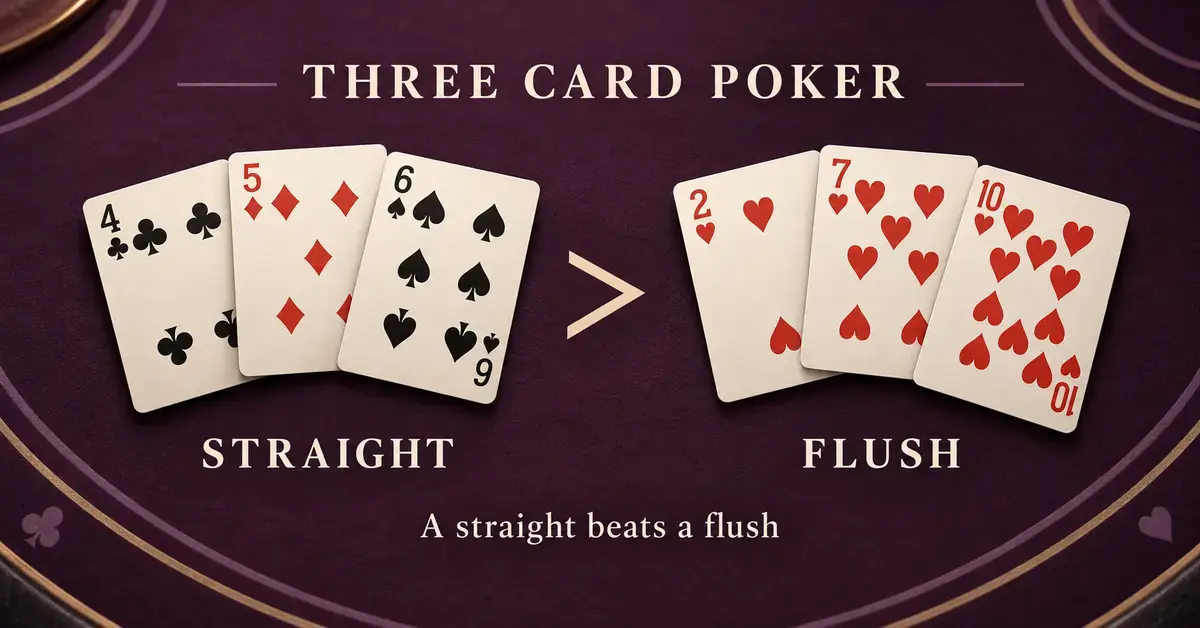
- Rankings differ from normal poker: a straight beats a flush, and there is no full house or four of a kind.
- Best strategy: play Queen-Six-Four or better, otherwise fold.
- House edge: about 3.37% of the ante (around 2.01% of total risked) on the main game; bonus bets cost more.
What is Three Card Poker?
Three Card Poker is a casino poker game played against the house, not against other players. It was created by British gambling entrepreneur Derek Webb in 1994 and patented in 1997, and it has since become one of the most common novelty poker games on casino floors and at online live-dealer tables. Because each hand uses only three cards and the rules are simple, rounds play quickly and the decision you face is usually just “raise or fold.”
The game uses a single standard 52-card deck. You never try to improve your hand by drawing or swapping cards — you are dealt three cards and you play them as they are. That makes it one of the easier card games to pick up, alongside the other casino table games. If you have played video poker, the hand names will look familiar, but the ranking order and the way you bet are different.
How to play Three Card Poker step by step
A round of Three Card Poker follows the same sequence every time. Here is the standard flow of the main ante-and-play game:
- Place your ante. You start the hand by putting a bet in the “Ante” box. At the same time you may place the optional “Pair Plus” bet (explained below); it is a separate wager with its own outcome.
- Receive three cards. You and the dealer are each dealt three cards face down. Your cards are revealed to you; the dealer’s stay hidden for now.
- Decide: fold or play. Look at your hand and choose one of two options. If you fold, you give up and lose your ante (and any Ante Bonus, but Pair Plus is still settled on its own). If you want to continue, you make a Play bet equal to your ante.
- The dealer reveals their hand. The dealer turns over their three cards. The dealer must have Queen-high or better to “qualify.”
- Settle the bets. If the dealer does not qualify, your ante pays 1 to 1 and your Play bet is returned (a push). If the dealer qualifies, the higher hand wins: a player win pays both the ante and the Play bet 1 to 1, a loss takes both, and a tie is a push.
“Queen-high” simply means the dealer’s best card is a Queen and the hand is not even a pair — for example Q-8-3. If the dealer’s top hand is Jack-high or lower, the dealer fails to qualify.
Three Card Poker hand rankings
The key thing to understand is that Three Card Poker rankings are not the same as standard five-card poker. Because you only hold three cards, the maths changes: a straight is harder to make than a flush, so a straight outranks a flush here — the reverse of normal poker. From strongest to weakest, the hands are:
- Straight flush — three cards in sequence, all the same suit (e.g. 7-8-9 of hearts).
- Three of a kind — three cards of the same rank (e.g. three Kings).
- Straight — three cards in sequence of mixed suits (e.g. 7-8-9).
- Flush — three cards of the same suit, not in sequence.
- Pair — two cards of the same rank.
- High card — none of the above; the hand is judged on its highest card.
If you already know the standard poker hand rankings, note the two differences: there is no full house or four of a kind (impossible with three cards), and straight beats flush. The table below shows how rare each hand is, which explains the ranking order and the bonus payouts.
Hand Rankings
| Rank | Hand | Example | Chance per hand |
|---|---|---|---|
| 1 (best) | Straight flush | 7-8-9 of hearts | 0.22% |
| 2 | Three of a kind | K-K-K | 0.24% |
| 3 | Straight | 7-8-9 mixed suits | 3.26% |
| 4 | Flush | 2-7-J of spades | 4.96% |
| 5 | Pair | Q-Q-5 | 16.94% |
| 6 (worst) | High card | A-9-4 mixed | 74.39% |
The bets in Three Card Poker explained
Three Card Poker can have up to four or five wagers on the layout. The two you will always see are the Ante and the Play bet; the rest are optional bonus bets with their own pay tables. Here is what each one does.
Ante and Play
The Ante is your main bet and the one that starts the hand. After seeing your cards you either fold (losing the ante) or match it with an equal Play bet to go up against the dealer. Both the Ante and the Play pay even money (1 to 1) when you win a qualifying showdown. This is the core game, and it is where the strategy below applies.
Ante Bonus
The Ante Bonus is an automatic extra payout on strong hands, and it is paid whether or not the dealer qualifies and even if your hand loses to the dealer. It rewards the three best hands only. A very common pay table is:
| Hand | Ante Bonus payout |
|---|---|
| Straight flush | 5 to 1 |
| Three of a kind | 4 to 1 |
| Straight | 1 to 1 |
You do not place a separate chip for the Ante Bonus — it pays out of the box automatically. Pay tables vary slightly between casinos, so check the felt.
Pair Plus
Pair Plus is a stand-alone bet that only looks at your own three cards; it has nothing to do with the dealer’s hand or whether you win the main game. You win if you are dealt a pair or better, and the payout scales with how strong the hand is. Two pay tables are common, and the difference matters a lot for the odds:
| Hand | Table A (flush pays 4) | Table B (flush pays 3) |
|---|---|---|
| Straight flush | 40 to 1 | 40 to 1 |
| Three of a kind | 30 to 1 | 30 to 1 |
| Straight | 6 to 1 | 6 to 1 |
| Flush | 4 to 1 | 3 to 1 |
| Pair | 1 to 1 | 1 to 1 |
Table A carries a house edge of about 2.32%, while Table B — now the more common version — raises it to about 7.28%. The only change is the flush payout, so it pays to look before you bet.
6 Card Bonus (optional)
Some tables offer a 6 Card Bonus. It combines your three cards and the dealer’s three cards to make the best possible five-card hand, and it pays regardless of every other bet. Payouts run from around 5 to 1 for three of a kind up to 1,000 to 1 for a royal flush. It is a long-shot bet: depending on the pay table, the house edge ranges from roughly 8.56% up to 15.28% — far higher than the main game — so treat it as entertainment, not value.
House edge and odds in Three Card Poker
The house edge in Three Card Poker depends on which bet you are talking about, so it is worth separating them.
- Ante and Play (the main game): on the standard pay table and with correct strategy, the house edge is about 3.37% of your ante. Because you also put out a Play bet on most hands, the edge measured against the total amount you actually risk — known as the “element of risk” — is lower, at about 2.01%. Both numbers describe the same game; they just use a different denominator.
- Pair Plus: about 2.32% on the better pay table (flush pays 4) and about 7.28% on the common one (flush pays 3).
- 6 Card Bonus: roughly 8.56%–15.28%, the worst value on the table.
For context, the ~2% element of risk on the main game is competitive with many casino games but still higher than optimal blackjack or the baccarat Banker bet. No bet in Three Card Poker gives the player an edge; the house wins over the long run on all of them.
Three Card Poker strategy: the Q-6-4 rule
The only decision that affects the odds in the main game is whether to fold or to make the Play bet, and there is one simple rule that gets it right nearly every time:
Make the Play bet with Queen-Six-Four or better; otherwise fold.
In practice that means: always play any pair or higher, always play any hand that is Queen-high or King-high or Ace-high up to the Q-6-4 threshold, and fold the rest. The borderline hand is exactly Q-6-4 — raising on Q-6-3 loses slightly more on average than folding, while raising on Q-6-4 loses slightly less, which is why that specific hand is the cut-off. Following this rule holds the main-game house edge to the 3.37% / 2.01% figures above. Raising on every hand pushes the edge up to about 7.65%, and simply copying the dealer’s qualifying line (playing any Queen or better) gives about 3.45%, so the Q-6-4 rule is measurably better than guessing.
There is no skill element to the bonus bets — they are dealt and paid automatically — so no strategy changes their odds.
Common mistakes to avoid
Most costly habits in Three Card Poker come from misunderstanding the bets rather than bad luck:
- Folding too much or playing everything. Both drift away from the Q-6-4 rule and raise the house edge. Learn the one threshold and the decision becomes automatic.
- Confusing Pair Plus with the Ante Bonus. They are different: the Ante Bonus pays on straights and better automatically within the main game, while Pair Plus is a separate wager you have to place and that pays on any pair or better.
- Ignoring the Pair Plus pay table. A flush paying 3 instead of 4 roughly triples the house edge on that bet. Always check the felt before betting Pair Plus.
- Chasing the 6 Card Bonus. The big 1,000-to-1 royal looks tempting, but the bet carries one of the highest house edges in the casino.
- Expecting a straight to lose to a flush. Remember that in this game a straight outranks a flush — the opposite of standard poker.
Who Three Card Poker suits
Three Card Poker suits players who want a poker-flavoured table game without the complexity of reading opponents, bluffing or multi-street betting. The rules take minutes to learn, the only real decision is one raise-or-fold call, and the main-game odds are reasonable when you follow basic strategy. It is less suitable for players chasing the lowest possible house edge — blackjack and baccarat are cheaper over time — or for anyone drawn to the bonus bets, which trade a shot at a big multiplier for a much larger built-in edge. As with every casino game, outcomes are random and the house keeps a long-term advantage; the strategy here only reduces that advantage, it never removes it.
A note on responsible gambling
This article is educational and does not encourage betting. Three Card Poker, like every casino game, is designed so the house wins over time, and no bet or strategy changes that in your favour over the long run. Play only with money you can afford to lose, set time and deposit limits, and never chase losses. In Canada you must be 18 or 19 depending on your province. If gambling stops being fun or feels hard to control, free, confidential help is available — in Ontario you can reach ConnexOntario at 1-866-531-2600, 24/7. See our responsible gambling guide and our page on the signs of problem gambling and how to get help.
Sources
Frequently Asked Questions (FAQ)
Is Three Card Poker hard to learn?
No. You get three cards, decide whether to fold or match your ante with a Play bet, and compare hands with the dealer. The only rule to memorise is to play Queen-Six-Four or better and fold everything else.
Does a flush beat a straight in Three Card Poker?
No. Because you hold only three cards, a straight is harder to make than a flush, so a straight ranks higher. This is the opposite of standard five-card poker and is one of the most common points of confusion.
What is the difference between Pair Plus and the Ante Bonus?
Pair Plus is a separate optional bet that pays on any pair or better regardless of the dealer. The Ante Bonus is an automatic payout inside the main game for a straight, three of a kind or straight flush, paid even if your hand loses to the dealer.
What is the house edge in Three Card Poker?
On the standard main game with correct strategy it is about 3.37% of your ante, or about 2.01% measured against the total you risk. Pair Plus runs from about 2.32% to 7.28% depending on the pay table, and the 6 Card Bonus is much higher.
Should I always make the Play bet?
No. Making the Play bet on every hand raises the house edge to about 7.65%. The optimal rule is to play only Queen-Six-Four or better and fold weaker hands, which keeps the edge at its lowest.
