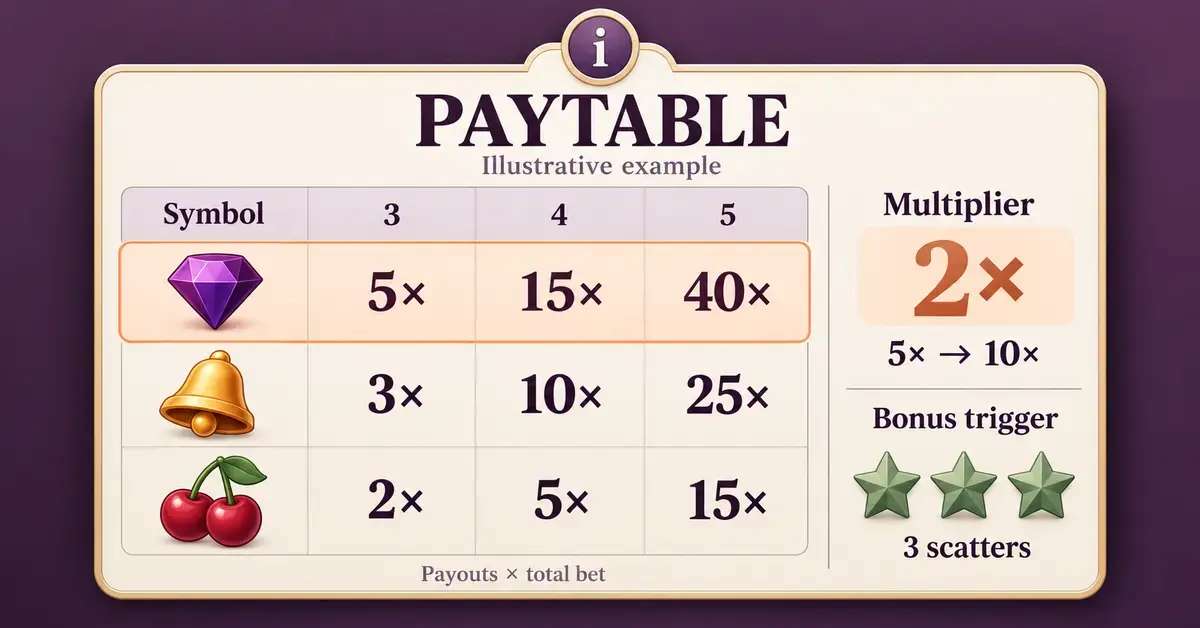
A slot paytable is the built-in information screen that tells you exactly what every symbol is worth, how a winning combination forms, and how the game’s bonus features start. Learning to read it takes a couple of minutes and is the single most useful habit before you spin a new slot, because two games that look almost identical can pay very differently. This guide walks through the paytable section by section — symbol values, wilds and scatters, multipliers, how payouts are calculated, bonus triggers, and where to find the return-to-player figure — in plain English, with no “system” or winning trick, because no such thing exists.
Key Points
- A paytable is a slot’s built-in rulebook: it lists what each symbol pays, how combinations form, and how bonuses trigger.
- Open it from the “i”, “?”, menu or “Paytable/Help” button before you spin — regulated games must make it accessible.
- Payouts are shown either as coins per line or as a multiple of your total bet; confirm which before reading any figure as cash.
- Wilds substitute for paying symbols (rarely scatters or bonus icons); scatters usually pay anywhere and start features.
- RTP (typically 94–97%) and volatility usually sit in the help/info screen, not on the main symbol chart.
What is a slot paytable?
A paytable is the reference sheet that explains how a specific slot pays. Every licensed slot has one, and it is the authoritative source for that game’s rules — not the marketing banner or the theme. A typical paytable lists the paying symbols from highest to lowest value, the payout for each matching combination, the role of special symbols (wilds, scatters and bonus icons), the number of paylines or ways to win, and a description of each bonus feature and how it triggers.
Think of it as the rulebook. Because slot outcomes are produced by a random number generator, the paytable cannot help you predict a spin — but it does tell you what you are actually playing, what a win is worth, and what the bonuses require. For the bigger picture of how the machine itself generates results, see our guide to how slot machines work.
Where do you find the paytable?
You open the paytable from a button on the game screen, usually before or between spins. On most online slots it is labelled with an “i” (information) icon, a “?”, a menu or hamburger icon, or a button literally marked “Paytable”, “Info” or “Help”. Tapping it opens one or more pages you scroll or swipe through.
On a physical machine in a land-based casino, the same information appears on a “See Pays” or “Help” screen, or sometimes printed on the glass above the reels. If you cannot find any pay information at all, treat that as a red flag and do not play — regulated games are required to make it accessible.
How to read symbol values
Symbol values are the heart of the paytable: each paying symbol is shown with the amount you win for landing two, three, four or five of them in a winning combination. Values run from the highest-paying symbols (usually the themed, detailed icons) down to the lowest (often playing-card ranks like 10, J, Q, K, A or simple fruit symbols). The more of a symbol you match, the larger the payout, and five-of-a-kind of a premium symbol is typically the top line-win on the game.
Standard (paying) symbols
Standard symbols are the ordinary icons that pay when enough of them line up on an active payline, normally from the leftmost reel rightwards. The paytable shows a small grid or list next to each symbol, for example “5 = 500, 4 = 150, 3 = 50”. Always read from the top of the list: the gap between the premium symbols and the low card symbols tells you a lot about how the game distributes its wins.
Wild symbols
A wild symbol substitutes for other paying symbols to help complete a combination, much like a joker in cards. Crucially, a wild usually does not substitute for scatters, bonus or jackpot symbols — the paytable states the exceptions. Many modern slots add behaviour to their wilds, and the paytable spells it out: expanding wilds grow to fill a whole reel, sticky wilds stay in place for several spins, walking wilds shift across the grid, and multiplier wilds boost any win they complete by a stated amount.
Scatter symbols
A scatter symbol pays or triggers a feature regardless of where it lands, so it does not need to sit on a payline. The paytable tells you two things: whether scatters pay a direct “scatter win” (often a multiple of your total bet), and how many are needed to start the bonus. A game may advertise free spins, yet the small print can require three scatters on specific reels — read it before you assume.
Bonus symbols
Bonus symbols are dedicated icons whose only job is to launch a bonus round, such as a pick-and-click game or a wheel. The paytable describes how many you need and on which reels, and what the bonus does. They are separate from scatters in some games and combined in others, so check the wording rather than guessing from the artwork.
Multiplier symbols
A multiplier increases the value of a win by a set factor — 2x, 3x, up to very large numbers in some bonus rounds. The paytable explains where multipliers come from: a multiplier symbol on the reels, a multiplier wild, or an escalating multiplier that climbs with each consecutive win in a free-spins round or a cascading/tumble feature. A “3x” on a 50-coin win pays 150 coins.
Slot Symbols Compared
| Symbol type | What it does | Pays on a payline? | Key note |
|---|---|---|---|
| Standard (paying) | Pays when enough match on an active line, usually left to right | Yes | Premium icons pay most; card ranks pay least |
| Wild | Substitutes for paying symbols to complete a win | Yes (as a substitute) | Usually cannot replace scatters or bonus symbols |
| Scatter | Pays or triggers a feature wherever it lands | No — any position | Check how many are needed and on which reels |
| Bonus | Launches a dedicated bonus round (pick game, wheel, etc.) | No — trigger only | Sometimes separate from, sometimes combined with scatters |
| Multiplier | Boosts a win by a set factor (e.g. 2x, 3x) | Depends on game | Often appears inside free spins or cascading wins |
How are slot payouts calculated?
Payouts are shown in one of two ways, and telling them apart is the most important skill on the whole paytable. A game either lists wins as coin or credit amounts (tied to your chosen coin value and lines) or as a multiple of your bet. The difference is large, so confirm which one you are looking at before reading any number as a dollar figure.
Are payouts per line or per total bet?
On classic payline slots, the symbol values are usually quoted per line, in coins. Your actual win is the paytable value multiplied by the coin size on the line that hit — not your whole stake. On many modern slots, especially ways-to-win and Megaways games, values are quoted as a multiple of your total bet, so a “20x” win on a $1 total stake pays $20 regardless of how the win is split across the grid. If a paytable gives a note like “wins shown are for the current bet” or “x total stake”, trust that wording over the raw numbers.
How paylines and ways to win appear on the paytable
The paytable also shows how winning combinations are allowed to form, which is just as important as the symbol values. On a fixed-payline game it displays a diagram of each line — straight, V-shaped, zig-zag — and states whether lines pay left-to-right only or both ways. The number of active lines affects your stake and which wins count.
Other games drop fixed lines entirely. A ways-to-win game pays for matching symbols on adjacent reels in any row, commonly 243 ways (that is 3 to the power of 5) or 1,024 ways (4 to the power of 5). Megaways, a mechanic from the studio Big Time Gaming, varies the symbol count per reel each spin for up to 117,649 ways (7 to the power of 6) on a six-reel grid. Cluster pays games reward groups of touching symbols instead of lines. The paytable names the system in use and the minimum combination size. For a deeper look at these mechanics, see our explainer on slot paylines, reels and symbols.
How to read bonus triggers and free spins
Bonus triggers are the conditions that start a feature, and the paytable states them precisely — this is where casual players lose track. Knowing that “three scatters start the free spins” is not enough; the paytable also tells you how many free spins you receive for three, four or five scatters, whether the feature can be retriggered by landing more scatters during it, and what special rules apply while it runs (extra wilds, rising multipliers, expanding reels and so on).
Read the whole feature description, not just the headline. Two games can both offer “free spins” while one adds a climbing multiplier that makes the round far more valuable and the other does not. For the full range of in-game features, see our guide to slot bonus features and free spins. If a slot carries a progressive prize, the paytable also explains the trigger and whether it is standalone or networked — covered in our article on progressive jackpots.
Where do you find RTP and volatility?
RTP (return to player) and volatility are usually in the help or information screen, not always on the main symbol chart — so look for them specifically. RTP is the share of all wagers a game is designed to pay back over the very long run, typically between 94% and 97% for online slots; the rest is the house edge. In Britain, the Gambling Commission requires machines to display the RTP or the odds of winning, and notes there is no statutory minimum figure, which is why RTP varies between games and even between versions of the same game.
Volatility (or variance) describes how a game delivers that return: low volatility means frequent small wins, high volatility means rarer but larger wins. The paytable or info screen sometimes shows a volatility rating, but not always. For how these two numbers shape a session, read our guide to slot RTP and volatility. Neither figure can predict a single spin — each spin is independent.
Common mistakes when reading a paytable
The most common mistake is reading per-line coin values as if they were your total win. A “500” next to a symbol is 500 coins on one line at your chosen coin size — not $500 and not your whole bet. Other frequent errors:
- Assuming wilds replace everything. Wilds rarely substitute for scatters or bonus symbols; the paytable lists the exceptions.
- Skipping the trigger conditions. Players often miss that scatters must land on set reels, or that the headline free-spin count only applies to the maximum number of scatters.
- Ignoring the “ways” versus “lines” distinction. On a ways-to-win game you are not choosing lines, and symbols pay from the leftmost reel in any row — different from a payline slot.
- Not checking the RTP of the specific version. The same title can ship with several RTP settings; confirm the one you are playing in the info screen.
- Treating a high top prize as a likely outcome. The biggest paytable numbers correspond to the rarest combinations; they do not change how a random spin behaves.
If any term on the paytable is new, our casino terms glossary defines the common ones in a sentence each.
What should Canadian players check on the paytable?
Canadian players on a licensed site should expect clear, honest pay information, and in Ontario the regulator requires it. The Alcohol and Gaming Commission of Ontario’s (AGCO) Registrar’s Standards for Internet Gaming require regulated slots to show the player’s net position in Canadian dollars rather than “credits”, prohibit auto-play, set a minimum spin time, and ban “losses disguised as wins” — animations that celebrate a spin that returns less than it cost. When you read a paytable on a regulated Ontario site, the game must also be certified by an accredited testing lab, which checks that the stated payouts and RTP are mathematically correct. If a site hides its pay information or is not licensed in your province, that is a reason to walk away.
Responsible Gambling Disclaimer
This article is educational and explains how slot paytables present information; it is not betting advice and does not suggest any way to improve your chances of winning. Slots are games of chance with a built-in house edge, and no paytable, feature or “system” changes the odds of a given spin. You must be of legal gambling age in your province or territory (18 or 19). If gambling is affecting you or someone you know, free, confidential help is available in Canada — see our pages on responsible gambling in Canada and the signs of problem gambling and how to get help.
Sources
- UK Gambling Commission — Displaying return to player (RTP) information on gaming machines
- AGCO — Registrar’s Standards for Internet Gaming
- Canadian Gaming Business — AGCO outlines rules for online casino games
- iGaming Business — Max Megaways by Big Time Gaming (Megaways ways-to-win format)
- PokerNews — Slot paylines explained
Frequently Asked Questions (FAQ)
What does a slot paytable show?
A slot paytable shows the value of each symbol, how winning combinations form, the number of paylines or ways to win, the behaviour of wilds and scatters, and how each bonus feature triggers. It is the game’s official rulebook and usually links to the RTP and volatility details too.
Are paytable payouts in dollars or in multiples of my bet?
It depends on the game. Classic payline slots usually quote wins as coins per line, which you multiply by your coin size, while many modern slots quote wins as a multiple of your total bet. Always check the wording on the paytable before reading any number as a dollar amount.
Does a wild symbol replace every other symbol?
No. A wild substitutes for standard paying symbols to complete combinations, but it normally cannot replace scatter, bonus or jackpot symbols. The paytable lists exactly what each wild can and cannot stand in for, along with any extra behaviour such as expanding or multiplying.
How do I know how many scatters trigger the bonus?
The paytable states the exact number of scatters needed and whether they must land on specific reels. It also shows how many free spins or what bonus you get for three, four or five scatters, and whether the feature can be retriggered while it is running.
Where is the RTP listed on a slot?
RTP is usually in the game’s help or information screen rather than on the main symbol chart. On regulated games it must be accessible; typical online slots return between 94% and 97% over the long run. Remember that RTP is a long-term average and cannot predict any single spin.
