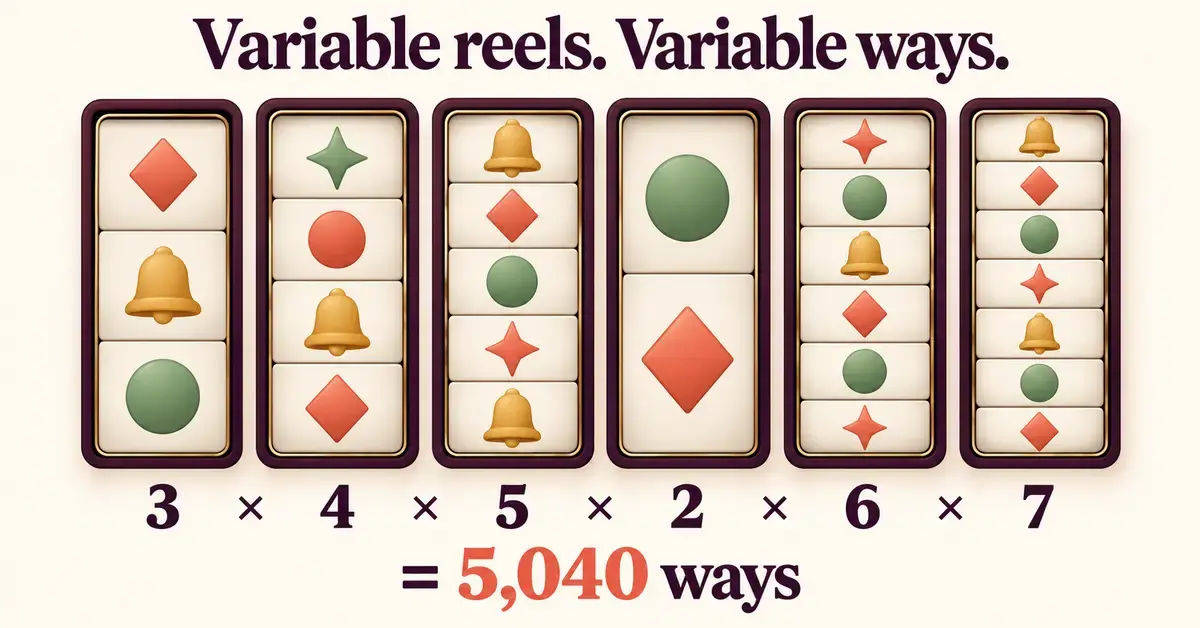
Megaways slots are online slot machines built on a variable-reel engine: instead of a fixed grid with set paylines, the number of symbols on each reel changes on every spin, and that changes how many different ways there are to win. The best-known setup produces up to 117,649 ways to win from a single spin. The mechanic was invented, patented and trademarked by the Australian studio Big Time Gaming (BTG) and is now licensed to dozens of game makers, so you will find the “Megaways” label across hundreds of titles. This guide explains what Megaways actually means, how the variable reels and ways-to-win maths work, what features usually come with them, and where the mechanic helps and where it is just marketing.
Key Points
- What it is: a licensed variable-reel slot mechanic from Big Time Gaming, used in place of fixed paylines.
- Variable reels: each of the (usually six) reels shows a changing number of symbols per spin, commonly 2–7.
- Ways to win: multiply the symbol counts across the reels; a six-reel game ranges from 64 up to 117,649 ways.
- How wins form: matching symbols on adjacent reels from the left, in any row — no fixed lines.
- Usual extras: cascading (tumbling) reels, increasing multipliers and scatter-triggered free spins.
- Maths: typically high volatility with an RTP often around 95–96.5%; more ways do not change the house edge.
What are Megaways slots?
Megaways slots are slot games that use a licensed variable-reel system in place of traditional fixed paylines. On a classic slot, each reel shows the same number of symbols every spin and wins are paid along a set number of fixed lines. On a Megaways slot, each reel can show a different number of symbols, and that number is re-drawn on every spin, so the shape of the grid and the number of ways to win change constantly.
“Megaways” is a brand and a patented mechanic, not a type of game you can copy freely. Any studio that wants to use it licenses the technology from Big Time Gaming, which is why you see the trademarked “Megaways” name attached to games from many different developers. The underlying idea is simple: more symbols on more reels means more possible winning combinations, up to a headline maximum that the games advertise prominently. If you want the broader picture of how reels and lines fit together, our explainer on slot paylines and ways to win covers the fundamentals that Megaways builds on.
How do variable reels work?
The defining feature of a Megaways slot is that the number of symbols per reel changes every spin. A standard Megaways game has six reels, and each reel can land anywhere from two to seven symbols at a time. Before the reels stop, the game’s software decides at random how tall each reel will be for that spin, so one spin might show a short three-symbol reel next to a full seven-symbol reel.
This is why the grid looks ragged rather than a neat rectangle. Because every reel is sized independently, the visible layout — and the number of ways to win — is different almost every time you press spin. Like all regulated slot outcomes, the symbol counts are produced by a certified random number generator, so you cannot predict or influence how tall the reels will be on the next spin.
Does more symbols always mean a better spin?
Not on its own. A taller grid creates more ways to win, but it also means each reel holds more symbols that must match. A spin that fills every reel with seven symbols gives you the maximum ways, yet you still need the same symbol to land on adjacent reels for anything to pay. More ways improve the chance that something lines up, but they do not change the game’s long-run return — that is fixed by the paytable and the maths behind it.
How are ways to win calculated?
The number of ways to win on any spin is the symbol counts on each reel multiplied together. There are no fixed lines to count; instead you take how many symbols landed on reel one, times how many landed on reel two, and so on across all the reels.
Here is a worked example on a six-reel game where the reels land with 4, 5, 3, 6, 7 and 2 symbols:
- 4 × 5 × 3 × 6 × 7 × 2 = 5,040 ways to win on that spin.
The maximum comes when every reel lands the full seven symbols:
- 7 × 7 × 7 × 7 × 7 × 7 (that is 7 to the power of 6) = 117,649 ways to win.
The smallest grid — two symbols on all six reels — gives just 2 × 2 × 2 × 2 × 2 × 2 = 64 ways. So on a six-reel Megaways slot the count swings between 64 and 117,649 ways depending on how the reels fall. The famous “117,649” figure is simply the ceiling, not what you get every spin. Some licensed spin-offs and extended formats advertise higher maximums by changing the reel setup, but the classic Megaways number is 117,649.
How do you actually win on a Megaways slot?
You win by landing matching symbols on adjacent reels, reading left to right, starting from the leftmost reel — regardless of where those symbols sit vertically. Because position within a reel does not matter, this is called a “ways” system rather than a payline system. If the same symbol appears somewhere on reels one, two and three, that is a winning combination, no matter which row each symbol is in.
Each extra matching reel adds to the value of the win, and the paytable tells you how much a run of three, four, five or six matching symbols pays. Wild symbols typically substitute for regular symbols to help complete these runs, while scatter symbols usually trigger the free-spins round rather than paying along the ways. Reading the in-game paytable is the only reliable way to see exactly how a specific title pays, since every game sets its own values.
What extra features usually come with Megaways?
Most Megaways slots pair the variable reels with a cascading (or “tumbling”) reels feature. When symbols form a win, they are removed and new symbols drop in to fill the gaps, which can create a chain of several wins from a single spin. This combination of changing ways and repeated cascades is what allows the very large maximum-win figures these games advertise.
Other common additions include:
- Unlimited or increasing multipliers: many titles raise a win multiplier with each cascade, especially during free spins, so consecutive wins are worth progressively more.
- Free spins triggered by scatters: landing enough scatter symbols starts a bonus round that often carries the biggest potential.
- An extra horizontal reel: some games (the hugely popular Bonanza is the classic example) add a horizontal reel above the main grid that drops in additional symbols, feeding the ways-to-win count.
These mechanics are the same families of features you see across modern video slots; our guide to slot bonus features and free spins breaks down how each one works in more detail.
What RTP and volatility do Megaways slots have?
Most Megaways slots are high-volatility games with a return to player (RTP) that typically sits in the mid-90s. Published figures vary by title, but many popular Megaways games cluster around 95% to 96.5% RTP, broadly in line with other online slots. Always check the specific game’s info screen, because the exact RTP is set per title and some operators offer lower-RTP versions of the same game.
High volatility means the wins tend to be less frequent but larger: you may sit through long stretches with little back, punctuated by occasional big hits, usually from the free-spins round. The huge ways-to-win numbers make these games feel high-energy, but they mostly increase the variance — the swings in your results — rather than the amount returned over the long run. For the full picture of how these two numbers interact, see our explainer on slot RTP and volatility.
Who invented Megaways, and when?
Megaways was created by Big Time Gaming, a studio founded in Sydney, Australia. BTG first brought the variable-reel mechanic to market in early 2016 with the slot Dragon Born, the first game to advertise the 117,649-ways system. The format did not take off immediately; it was BTG’s Bonanza, released in December 2016, that turned Megaways into a phenomenon and made the mechanic a household name among slot players.
BTG patented the mechanic in the United States and registered “Megaways” as a trademark, then began licensing it to other developers. Studios that have published Megaways-branded games include Blueprint Gaming, Red Tiger, Relax Gaming, Pragmatic Play, iSoftBet, ReelPlay and Microgaming, among others, and there are now well over 200 titles carrying the label. In 2021, the live-casino and slots giant Evolution agreed to acquire Big Time Gaming in a deal reported at around €450 million (roughly US$534 million).
Megaways vs traditional payline slots
The core difference is how wins are formed: Megaways uses a changing number of ways to win, while a traditional slot uses a fixed set of paylines. Neither approach is inherently more generous — the paytable and RTP decide that — but they feel very different to play.
Comparison
| Feature | Megaways slot | Traditional payline slot |
|---|---|---|
| Symbols per reel | Variable (changes each spin, often 2–7) | Fixed every spin |
| How wins form | Matching symbols on adjacent reels, left to right, any row | Along set paylines in fixed positions |
| Ways / lines | Up to 117,649 ways (six reels) | Typically 1–243 fixed lines |
| Grid shape | Ragged, changes each spin | Fixed rectangle |
| Common extra features | Cascading reels, rising multipliers, free spins | Varies; often simpler |
| Typical volatility | Usually high | Low to high (varies) |
| Licensing | Licensed from Big Time Gaming | Developer’s own design |
In short, Megaways trades the predictability of fixed lines for a more variable, higher-energy experience. That suits players who enjoy big swings and bonus-round chases, and suits others less if they prefer steadier, lower-variance play.
Common mistakes and misconceptions
The biggest misconception is that 117,649 ways to win means a near-certain or frequent payout. It does not: more ways raise the chance that some symbols connect, but the game’s maths still give the house a long-term edge, and most of those “ways” produce nothing on any given spin.
- Thinking more ways equals a higher RTP. Ways-to-win is a display mechanic; the RTP is set separately in the paytable. A Megaways slot can have a lower RTP than a simple three-reel game.
- Believing a game is “due” after a dry spell. Each spin is independent, decided by the RNG. High volatility produces long gaps between wins by design, not because a payout is building up.
- Assuming all Megaways games are the same. Reel counts, maximum ways, multiplier rules and RTP differ by title and even by operator version of the same title.
- Chasing the free-spins round with “buy feature” options. Where offered and legal, paying to trigger the bonus does not improve the odds; it simply converts a large stake into immediate access to a high-variance round.
- Treating the headline win cap as a target. Maximum wins of several thousand times the stake are extremely rare outcomes, not a realistic expectation.
Who are Megaways slots for?
Megaways slots suit players who enjoy variety and high-variance play and are comfortable with long stretches of small or no wins in exchange for the chance of a large hit. The constantly changing grid and cascading wins make them feel more dynamic than fixed-line slots, which is a large part of their appeal.
They are a weaker fit for players who want frequent, steady returns or a simple, predictable game, and for anyone on a tight budget, because high volatility can drain a bankroll quickly during cold runs. As with every casino game, the mechanic is designed for entertainment and the house keeps a long-term edge; no number of ways to win changes that. If you are new to slots generally, start with our overview of how slot machines work before diving into a Megaways title.
Disclaimer
This article is educational and explains how Megaways slots work; it is not gambling advice and does not encourage betting. All slots, including Megaways titles, are built so the house keeps a long-term mathematical edge, and no mechanic, feature or strategy changes that. In Canada you must be of legal gambling age (18 or 19, depending on your province or territory) to gamble. If gambling is affecting you or someone you know, free, confidential help is available: in Ontario, ConnexOntario operates a 24/7 line at 1-866-531-2600. For tools, limits and provincial support options, see our guide to responsible gambling in Canada.
Sources
- SoftSwiss — Megaways mechanic and history (Dragon Born 2016, Bonanza December 2016)
- Gambling Insider — BTG licenses its U.S. patented mechanic and Megaways trademark
- Gambling News — Evolution to acquire Big Time Gaming (2021)
- Bonus.com — Big Time Gaming RTP, licensing and portfolio overview
- Gambling.com — Wheel of Fortune Megaways (RTP 96.46%, high volatility)
- ConnexOntario — free, confidential gambling support (1-866-531-2600)
Vanliga frågor (FAQ)
What does “Megaways” actually mean?
Megaways is a trademarked, patented slot mechanic from Big Time Gaming in which each reel shows a changing number of symbols every spin. That variable layout replaces fixed paylines and can create up to 117,649 different ways to win on a six-reel game.
How many ways to win does a Megaways slot have?
It changes every spin. You multiply the number of symbols on each reel together, which on a standard six-reel game ranges from 64 ways (two symbols on each reel) up to the famous maximum of 117,649 ways (seven symbols on all six reels).
Are Megaways slots better than normal slots?
Not inherently. The large ways-to-win number mainly increases volatility — bigger but less frequent wins — rather than the long-run return. A Megaways game’s RTP is set in its paytable and can be higher or lower than a traditional slot’s.
What RTP do Megaways slots usually have?
Many popular Megaways titles have an RTP in the mid-90s, often around 95% to 96.5%, and most are high-volatility games. The exact figure is set per title, so check each game’s info screen, as some operators run lower-RTP versions.
Who invented Megaways slots?
Big Time Gaming, an Australian studio, created Megaways and launched the first title, Dragon Born, in early 2016. The format was popularised later that year by Bonanza. BTG licenses the patented mechanic to many other developers and was acquired by Evolution in 2021.
