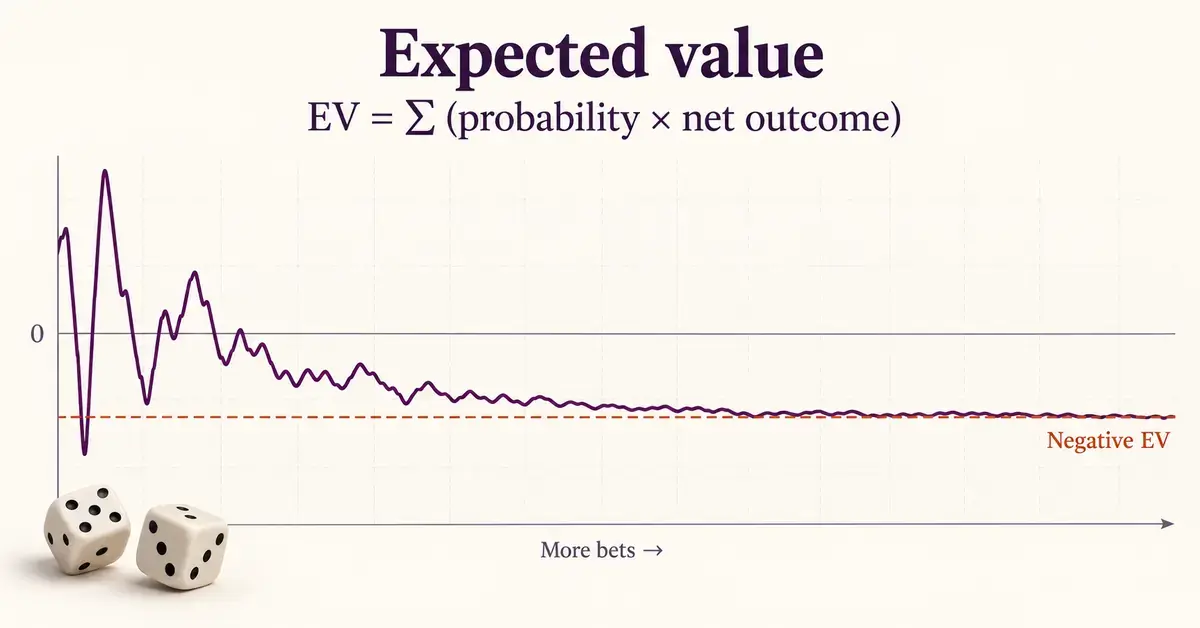
Expected value (EV) is the single most useful number for understanding any wager: it is the average amount a bet wins or loses per dollar staked if you could repeat it over and over. In casino games the figure is almost always negative, which is simply a precise, mathematical way of saying the house has an advantage. This guide explains what expected value means, shows the formula in plain English, and walks through worked examples — a coin flip, roulette and a multi-outcome game — so you can calculate the EV of a bet yourself and see exactly where the casino’s profit comes from.
Key Points
- Expected value (EV) is the average result of a bet per dollar staked, measured over the long run.
- The formula is EV = Σ (probability × value): multiply each outcome’s probability by its net win or loss, then add the terms.
- Negative EV favours the house, positive EV favours the player, and zero EV is a fair, break-even bet.
- A single-number bet pays −5.26% on American roulette and −2.70% on European roulette — the difference is the extra zero.
- House edge = −EV (as a % of stake), and RTP = 100% − house edge.
- Every standard casino bet has a negative EV; no betting system changes it, and short-run swings are variance, not an edge.
What is expected value in gambling?
Expected value is the long-run average result of a bet, found by weighting every possible outcome by how likely it is to happen. It is not what you expect to win or lose on any single bet — a single roulette spin can only pay out or not — but the average you would settle toward if the same bet were repeated a very large number of times.
Mathematicians call this weighted average the mean (or expectation) of a random variable, and the idea long predates casinos: it dates back to 17th-century work on games of chance. In gambling, EV is usually expressed either as an amount of money (for example, −$0.05 per bet) or as a percentage of the stake (−5%). A negative EV means the bet loses money on average; a positive EV means it makes money on average; an EV of zero describes a perfectly fair bet.
Because EV is an average over many repetitions, it never guarantees a result for one bet or even one session. It is a statement about the long run, which is exactly why casinos, which host millions of bets, can rely on it while individual players cannot.
The expected value formula explained
The expected value of a bet is the sum of each outcome’s value multiplied by its probability. Written out, the formula is:
EV = (p₁ × v₁) + (p₂ × v₂) + … + (pₙ × vₙ)
Here each p is the probability of a particular outcome and each v is the net amount you win or lose if that outcome occurs. You calculate the product for every possible outcome and then add the products together. The same calculation is written compactly with the summation sign as EV = Σ (p × v).
What each part means
- Probability (p): a number between 0 and 1 (or 0% to 100%) describing how likely an outcome is. Across all possible outcomes, the probabilities must add up to 1.
- Value (v): the net result of that outcome from the player’s point of view. A win is a positive number (your profit, not including the returned stake), and a loss is a negative number (usually the stake you forfeit).
- The sum: adding every (probability × value) pair gives the average result per bet.
A common slip is mixing up net profit and total return. If you keep the stake separate — counting only what you win or lose on top of it — the arithmetic stays clean. Understanding how payout odds differ from the true odds of an event makes it easier to fill in the right values.
What a positive, negative or zero EV tells you
The sign of the result tells you who the bet favours over time. A positive EV means the bet is profitable on average and favours the player; a negative EV means it loses on average and favours the house; and an EV of exactly zero is a break-even, fair bet that favours neither side. Virtually every bet offered against a casino carries a negative expected value by design — that built-in shortfall is how the business makes money.
How to calculate expected value step by step
You can work out the EV of almost any simple bet in five steps:
- List every possible outcome. For most casino bets there are just two: you win, or you lose.
- Find the probability of each outcome. Make sure the probabilities add up to 1.
- Write the net value of each outcome. Use a positive number for profit and a negative number for the stake you lose.
- Multiply each probability by its value.
- Add the products together. The total is the expected value per bet.
Take a fair coin flip where you stake $10, win $10 if it lands heads and lose your $10 if it lands tails. There are two outcomes, each with probability 0.5. The calculation is:
EV = (0.5 × +$10) + (0.5 × −$10) = $5 − $5 = $0
The result is zero, so the coin flip is a perfectly fair bet: over many flips you break even. A casino cannot profit from a zero-EV game, which is why real-money games are always priced so that the player’s expected value is below zero.
Worked examples from real casino bets
Real games turn a fair bet into a losing one by paying out slightly less than the true odds. Roulette is the clearest illustration because the maths is simple and the numbers are exact.
Single-number bet on American roulette
A straight-up bet on a single number in American roulette has an expected value of about −5.26% of your stake. An American wheel has 38 pockets (1–36 plus a single zero and a double zero), and a winning single-number bet pays 35 to 1. So for a $1 bet:
- Win: probability 1/38, net value +$35.
- Lose: probability 37/38, net value −$1.
EV = (1/38 × +$35) + (37/38 × −$1) = (35 − 37) / 38 = −2/38 ≈ −$0.0526
On average you lose about 5.26 cents for every dollar staked, or $5.26 per $100. The whole edge comes from those two extra pockets (the two zeros): a truly fair payout would be 37 to 1, but the casino pays 35 to 1.
The same bet on European roulette
A single-number bet on a European wheel has an expected value of about −2.70%, roughly half the American figure, because the wheel has only one zero and therefore 37 pockets. The payout is still 35 to 1, so for a $1 bet:
EV = (1/37 × +$35) + (36/37 × −$1) = (35 − 36) / 37 = −1/37 ≈ −$0.027
That single extra pocket is the entire difference between the two games. The gap is why the choice between European and American roulette matters so much more than any betting pattern a player might use.
A multi-outcome example
Expected value still works when a bet has more than two outcomes — you simply add one (probability × value) term for each. Imagine a $1 game with three possible results:
- Win $4 (net), probability 0.10
- Win $1 (net), probability 0.20
- Lose $1, probability 0.70
EV = (0.10 × +$4) + (0.20 × +$1) + (0.70 × −$1) = $0.40 + $0.20 − $0.70 = −$0.10
The bet loses 10 cents per dollar on average, a 10% disadvantage. The same method scales to slot paytables or craps, where many different payouts each carry their own probability; the arithmetic just gets longer, not harder.
Expected Value by Casino Bet
| Bet / game | Typical house edge | Expected value per $100 staked |
|---|---|---|
| Blackjack (basic strategy) | ~0.5% | −$0.50 |
| Baccarat (Banker bet) | 1.06% | −$1.06 |
| French roulette, even-money with la partage | 1.35% | −$1.35 |
| Craps (pass line bet) | 1.41% | −$1.41 |
| European roulette (most bets) | 2.70% | −$2.70 |
| American roulette (most bets) | 5.26% | −$5.26 |
| Slots (typical range) | 2%–10% | −$2 to −$10 |
| Keno (typical range) | 20%–30%+ | −$20 to −$30+ |
Figures are long-run averages for correct play and typical rules; actual results in any session vary widely.
How expected value connects to house edge and RTP
Expected value, house edge and return to player are three ways of describing the same underlying number. The house edge is the casino’s long-run advantage, and it is defined as the negative of a bet’s expected value expressed as a percentage of the stake. If a bet has an EV of −5.26%, the house edge is 5.26%.
The flip side is return to player (RTP), the share of money a game pays back over the long run. RTP and house edge always add up to 100%, so a game with a 5.26% edge has an RTP of 94.74%. Put simply: EV tells you the average outcome per bet, the house edge states that same average from the casino’s side, and RTP states it as a percentage returned to players. If you want to compare games on this basis, see which casino games have the lowest house edge.
Can a bet ever have a positive expected value?
A positive expected value is possible, but not in a straight bet against the house on a standard casino game. Every game offered against the casino — roulette, slots, baccarat, standard blackjack — is priced so the player’s EV is below zero. No betting system, staking pattern or “lucky” timing changes the EV of a bet, because each outcome’s probability and payout are fixed.
Positive-EV situations do exist in a few specific contexts, and they are matters of fact rather than tips:
- Player-versus-player games. In poker you bet against other players, not the house, so a stronger player can have a positive expected value against weaker opponents. The casino takes a fixed fee (the rake) rather than an edge on every hand.
- Promotional value. A bonus or rebate can, in principle, push the effective EV of a bet above zero, which is why operators attach wagering requirements that usually claw the value back.
- Advantage play. Techniques such as card counting aim to shift the EV of blackjack in the player’s favour under narrow conditions. They are difficult, countered by casinos, and outside the scope of this explainer.
For the ordinary player on ordinary games, the honest summary is that the expected value is negative, every time.
Why your actual results differ from the expected value
Your real results rarely match the expected value in a single session because EV is a long-run average, not a prediction for any one bet. Over a handful of spins you might finish well ahead or well behind the EV; it is only across thousands of bets that your average loss drifts toward the theoretical figure. This spread of short-run results around the long-run average is called variance.
A high-variance game produces big swings — long dry spells and occasional large wins — while a low-variance game produces frequent small results. Two games can share the same expected value yet feel completely different to play because of variance. Understanding that gap between the short run and the long run is central to managing a bankroll, since a negative EV means a budget will tend to shrink the longer you play.
Common mistakes when using expected value
Expected value is easy to misread, and a few errors come up repeatedly:
- Treating EV as a forecast for one bet. EV is an average over many repetitions, not what will happen on the next spin. A −$0.05 EV does not mean you will lose five cents next time; you will win or lose the full amount.
- Thinking a system can turn a negative EV positive. Progressions like the Martingale rearrange when wins and losses land but never change the underlying EV of a bet. Adding bets with negative EV only adds expected loss.
- Confusing a win streak with positive EV. Short-run luck is variance at work. A good run does not mean the bet has become profitable, and outcomes are independent, so past results do not change future probabilities.
- Counting the stake twice. Mixing up net profit and total return inflates or deflates the number. Keep the stake separate and count only what you win or lose on top of it.
- Ignoring the number of bets. A tiny per-bet EV adds up fast over hundreds of fast rounds, because expected loss grows with total amount wagered, not just with the size of a single bet.
Responsible Gambling Notice
This article explains a mathematical concept for educational purposes only. It is not betting advice and makes no promise of winnings. Because every standard casino bet carries a negative expected value, gambling should be treated as paid entertainment with a cost, never as a way to make money. Over time, the maths favours the house.
If gambling is causing harm to you or someone you know in Canada, free and confidential help is available. ConnexOntario offers 24/7 support at 1-866-531-2600, and the Responsible Gambling Council provides information and tools nationwide. You can also read our guide to responsible gambling in Canada for self-exclusion options and deposit and time limits. You must be of legal gambling age in your province (18 or 19) to gamble.
Sources
- LibreTexts Statistics — Expected Value of Discrete Random Variables
- Emory University Mathematics — Expected Value of a Discrete Random Variable
- Newcastle University (ASK) — Expected Values
- University of Hong Kong — Expected Values (worked gambling example)
- Lumen Learning / Tulsa Community College — Expected Value and Roulette
Frequently Asked Questions (FAQ)
What does expected value mean in simple terms?
Expected value is the average amount a bet wins or loses per dollar staked if you repeated it many times. You find it by multiplying each outcome’s probability by its value and adding the results. In casino games the figure is almost always negative, meaning the bet loses money on average.
How do I calculate the expected value of a bet?
List every outcome, write each one’s probability and its net win or loss, multiply each probability by its value, and add the products. For a $1 single-number bet on American roulette, that is (1/38 × +$35) + (37/38 × −$1), which comes to about −$0.053 per dollar.
Is expected value the same as the house edge?
They are two sides of the same number. The house edge is the negative of a bet’s expected value expressed as a percentage of the stake. A bet with an expected value of −2.70% corresponds to a 2.70% house edge, and a return to player of 97.30%.
Can expected value be positive in gambling?
Not on a standard bet against the casino, which is always priced below zero for the player. Positive expected value can appear in player-versus-player games like poker, through promotions with real value, or through advantage techniques — situations that sit outside ordinary casino play.
If a bet has negative expected value, why do people win?
Because expected value is a long-run average, not a single-bet outcome. Short-run swings, known as variance, let players win in a session or a streak. Over thousands of bets, though, results drift toward the negative average and the house advantage shows through.
