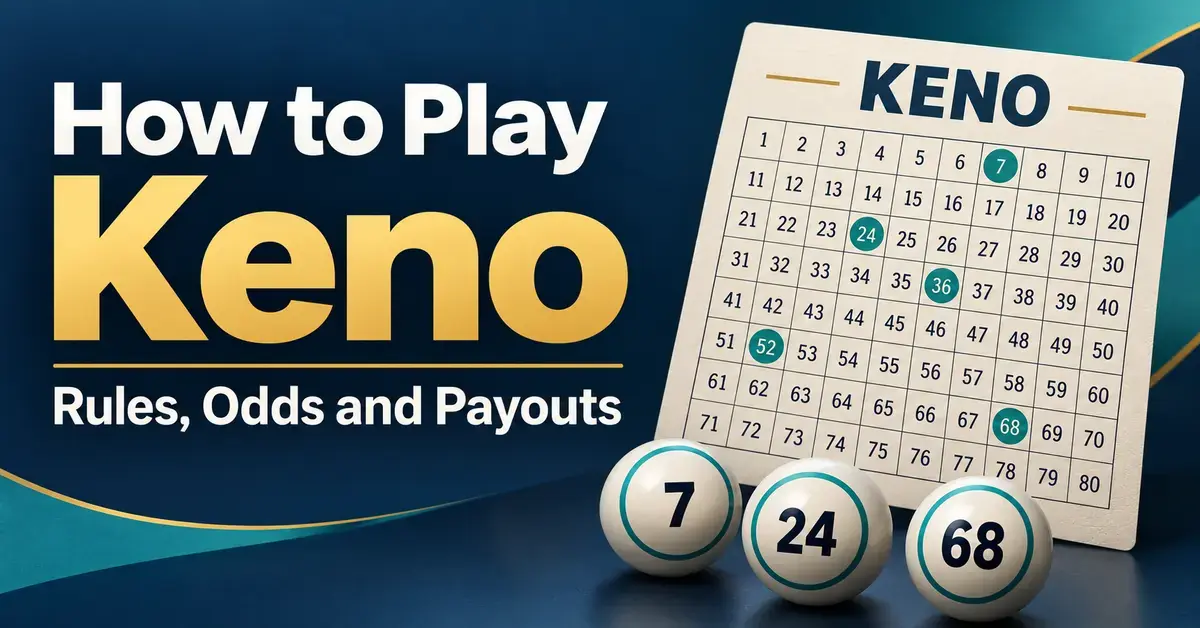
Keno is a lottery-style casino game of pure chance: you pick a handful of numbers, the game draws 20 numbers at random, and you are paid according to how many of your picks appear in the draw. It is easy to learn, needs no skill or strategy, and is found in casino lounges, on video machines, at online casinos and as a draw-based lottery game in Canada. This guide explains exactly how keno works — marking a ticket, the draw, pay tables and payouts — and gives the honest odds, including why keno carries one of the highest house edges of any casino game.
Key Facts
- Game type: a lottery-style casino game of pure chance — no skill involved
- Number grid: 1–80 in casino and video keno; 1–70 in Ontario’s Daily Keno
- Spots you pick: usually 1–10 (some casinos allow up to 15)
- Numbers drawn: 20 every round
- Odds any one number is drawn: about 1 in 4
- Odds of catching all 10 on a 10-spot ticket: about 1 in 8.9 million (80-number game)
- House edge: typically 20%–40% — among the highest in the casino
- Payout rule: set by the pay table, which varies widely between games
What is keno?
Keno is a number-matching game in which you choose numbers from a fixed grid and hope they match numbers drawn at random. In a standard casino or video game the grid runs from 1 to 80, and the game draws 20 of those 80 numbers each round. The numbers you choose are called your spots, and any of your spots that matches a drawn number is a catch.
The game descends from a centuries-old Chinese lottery and today sits alongside other draw and number games rather than skill-based options. Unlike card games, there are no decisions after you have placed your bet — you cannot hit, stand, fold or bluff. Keno is closer in spirit to a lottery or a slot machine than to blackjack, which is why it belongs with the simpler end of casino table games and lounge games rather than the strategy games.
How do you play keno, step by step?
You play keno by marking spots on a ticket, setting your bet, waiting for the draw of 20 numbers, and then checking how many of your spots were caught. Here is the full sequence.
1. Mark your spots on the ticket
Choose how many numbers to play. Most games let you pick anywhere from 1 to 10 numbers on the 80-number grid, and some casinos allow up to 15. You can mark the numbers yourself or let the machine choose them at random — often labelled Quick Pick or Auto Pick. The count of numbers you choose is called your ticket size, for example a “5-spot” or “10-spot” ticket.
2. Set your bet and the number of draws
Decide how much to wager per game. A keno pay table is built around a base bet (commonly $1), and prizes scale with your stake. In live and lottery keno you can usually buy the same numbers for several consecutive draws at once. Confirm your ticket before the draw begins; once numbers are drawn, the ticket is locked.
3. The draw: 20 numbers out of 80
The game draws 20 numbers at random from the pool. A live keno lounge uses a ball machine or air blower; video keno and online keno use a random number generator (RNG), the same kind of certified software that drives online slots and other electronic games. Every number has an equal chance of appearing, and each draw is independent — past results never influence the next draw, and there are no “due” or “hot” numbers.
4. Check your catches and collect
Compare your spots with the 20 drawn numbers and count your catches. Your payout depends on three things: how many spots you picked, how many you caught, and the specific pay table for that game. In a lounge you hand the ticket to the counter; on a machine or online the win is credited automatically. In lottery keno you check your ticket after the official draw.
What are the real odds in keno?
The odds in keno are long, and they get dramatically longer the more spots you try to catch. Because 20 of the 80 numbers are drawn, any single number you pick has about a 1-in-4 chance of being caught. Catching all of your chosen spots, however, becomes rare very quickly.
The table below shows the probability of catching every spot on a ticket in a standard 80-number game (20 numbers drawn). These figures come from the combinatorial math of the draw, not from any pay table.
Keno Odds by Pick Size
| Spots picked | Odds of catching ALL of them (80-number game, 20 drawn) |
|---|---|
| 1 | 1 in 4 |
| 2 | 1 in 16.6 |
| 3 | 1 in 72 |
| 4 | 1 in 326 |
| 5 | 1 in 1,551 |
| 6 | 1 in 7,752 |
| 7 | 1 in 40,979 |
| 8 | 1 in 230,115 |
| 9 | 1 in 1,380,688 |
| 10 | 1 in 8,911,711 |
Two points matter for beginners. First, picking more numbers does not improve your chances — it lowers the odds of a full catch while raising the potential top prize, which is why big keno jackpots are advertised but almost never hit. Second, most keno games also pay for partial catches (for example, catching 6 of your 10 spots), so you do not need a perfect ticket to win something. The size of those partial prizes is set entirely by the pay table.
How do keno payouts and pay tables work?
Keno payouts are governed by a pay table, and the pay table — not the odds of the draw — is what decides whether a game is generous or stingy. The draw math is the same everywhere, but two casinos can pay very different amounts for the same result. That difference is the single most important thing to check before you play.
A pay table lists, for each ticket size, how much a given number of catches pays per unit of bet. For example, a 6-spot ticket might pay nothing for 0-2 catches, a small amount for 3, more for 4, a solid prize for 5 and a large prize for all 6. Prizes are usually expressed as a multiplier of your base bet, so a $2 bet pays twice what the $1 column shows.
Because pay tables are not standardised, the practical advice is simple: compare the pay table of the exact game you are about to play, and favour the one that pays more for the catches you are realistically going to make (the lower-to-middle catches), rather than the one with the flashiest jackpot you will almost never reach.
Why does keno have such a high house edge?
Keno has one of the highest house edges in the casino because the pay tables return far less than the true odds of the draw would justify. The house edge is the average percentage of each bet the casino expects to keep over time; the rest is returned to players as the return to player, or RTP. For keno the edge is typically in the 20% to 40% range, and online versions reported publicly run anywhere from under 4% to over 35% depending on the game. By comparison, most table games keep the house edge under 5%.
To put that in context, here is how keno compares with other common games. The exact figures depend on the specific game and the choices a player makes, so treat these as typical values; our guide to house edge and RTP explains how the numbers are calculated.
| Game | Typical house edge |
|---|---|
| Keno (casino / video) | About 20%–40% |
| Slot machines | About 2%–15% |
| American roulette | 5.26% |
| European roulette | 2.70% |
| Baccarat (banker bet) | About 1.06% |
| Blackjack (basic strategy) | About 0.5% |
In plain terms: for every $100 wagered on keno over the long run you might expect to lose $20 to $40 on average, versus well under a dollar on well-played blackjack or about $2.70 on European roulette. Keno can be entertaining and the prizes can be large, but the cost of that entertainment is high relative to almost everything else on the floor. No betting pattern or number-selection method changes this — the edge is baked into the pay table.
How is keno played in Canada?
In Canada, keno appears in three main forms, and they do not all use the same rules. Knowing which one you are playing matters because the number pool and prizes differ.
- Lottery keno (draw-based): In Ontario, the Ontario Lottery and Gaming Corporation (OLG) runs Daily Keno, which uses a 1-to-70 number pool — not the 1-to-80 casino grid. Players pick between 2 and 10 numbers, choose a bet of $1, $2, $5 or $10, and the game draws 20 numbers twice a day. Other provincial lottery corporations (such as Loto-Québec and the Western Canada Lottery Corporation) offer their own keno-style draw games with their own rules.
- Video keno: Electronic keno machines in licensed casinos use the standard 1-to-80 grid and an RNG, and let you play round after round at your own pace.
- Live and online casino keno: Regulated online casinos — for example those licensed through iGaming Ontario — and physical lounges offer 80-number keno with their own pay tables.
Always confirm the number pool, pick range and current pay table on the official operator’s page before you play, because a 70-number lottery game and an 80-number casino game have different odds even when both draw 20 numbers.
What are the main keno variants?
Beyond the straight ticket described above, several common variations change how you bet rather than how the draw works:
- Straight ticket: the basic game — one set of spots, one bet.
- Way ticket: you group your numbers into several combinations on one ticket, effectively playing multiple tickets at once for a higher total stake.
- Combination ticket: mixes groups of different sizes into many possible winning combinations.
- King ticket: one circled “king” number is combined with other groups to form multiple bets.
- Power or multiplier keno: an optional side feature that multiplies winnings by a randomly drawn factor in exchange for a higher bet.
These formats can make a ticket more complex and more expensive, but none of them improves the underlying odds or lowers the house edge — they simply split or stack your wager across more combinations.
What are the most common keno mistakes?
The most common keno mistake is treating it as a game you can beat with skill or a system. Keno is pure chance, so the practical errors are about money and expectations rather than tactics.
- Chasing the top jackpot. Catching all 10 spots on a 10-spot ticket is roughly a 1-in-8.9-million event. Betting for the jackpot while ignoring the realistic lower prizes burns through a bankroll fast.
- Ignoring the pay table. Two games with identical draws can pay very differently. Playing without comparing pay tables means leaving value on the table.
- Believing in “hot,” “cold” or lucky numbers. Every draw is independent and every number has the same chance each round. Birthdays, patterns and previous results have no effect.
- Confusing the number pools. Applying 1-to-80 casino odds to a 1-to-70 lottery game (or vice versa) gives the wrong expectations.
- Overlooking the house edge. Keno’s 20%-40% edge means it is one of the most expensive ways to gamble per dollar wagered — fine as entertainment, poor as a strategy to win money.
Who is keno for — and is there any strategy?
Keno suits players who want a relaxed, low-effort game with the small chance of a large prize, and who treat the cost as the price of entertainment. There is no decision to agonise over and no learning curve, which is part of its appeal in a casino lounge or as a quick lottery pick.
There is no strategy that improves your odds of winning, because the draw is random and the house edge is fixed by the pay table. The only choices that affect your experience are practical ones: pick a game with a favourable pay table, choose a ticket size whose realistic prizes you are happy with, and set a budget before you start. If a guide promises a keno “system” that beats the game, it is wrong — the math does not allow it.
Responsible Gambling
Keno is a game of chance with a high house edge and long odds; over time the game is designed to return less than players wager, and no method changes that. Treat any money spent on keno as the cost of entertainment, not as income or an investment. The legal gambling age in Canada is 18 or 19 depending on the province.
Set a budget and a time limit before you play, never bet money you cannot afford to lose, and never chase losses. If gambling is causing you stress or financial harm, free, confidential help is available. In Ontario you can reach ConnexOntario any time at 1-866-531-2600. For tools such as deposit limits and self-exclusion, and for help lines across Canada, see our guide to responsible gambling in Canada.
Sources
Frequently Asked Questions (FAQ)
How many numbers should you pick in keno?
There is no number that gives better value, because every choice carries the same house edge. Picking fewer spots (such as 3 to 6) produces smaller but more frequent wins, while picking 8 to 10 chases rare, larger prizes. Choose based on whether you prefer steady small returns or a long-shot at a big payout.
What are the odds of winning keno?
Any single number you pick has about a 1-in-4 chance of being drawn. Catching all of your spots gets much harder as you add numbers: about 1 in 1,551 for all 5 spots and roughly 1 in 8.9 million for all 10 in a standard 80-number game. Most games also pay for partial catches.
Can you use a strategy or system to win at keno?
No. Keno draws are random and independent, and the house edge is set by the pay table, so no number pattern, betting system or “hot number” can improve your long-term chances. The only sensible choices are selecting a game with a good pay table and managing your budget.
Is keno the same as the lottery?
Keno is a lottery-style game, and in Canada some versions are run by provincial lottery corporations, such as Ontario’s Daily Keno. Casino and video keno use an 80-number grid and draw numbers continuously, whereas lottery keno may use a different pool (Daily Keno uses 1 to 70) and fixed daily draws.
Why does keno have such a high house edge?
Because the pay tables return far less than the true odds of the draw would justify, keno’s house edge typically runs 20% to 40% — much higher than blackjack, roulette or baccarat. The edge is built into the prizes, so the longer you play, the more the math works against you.
