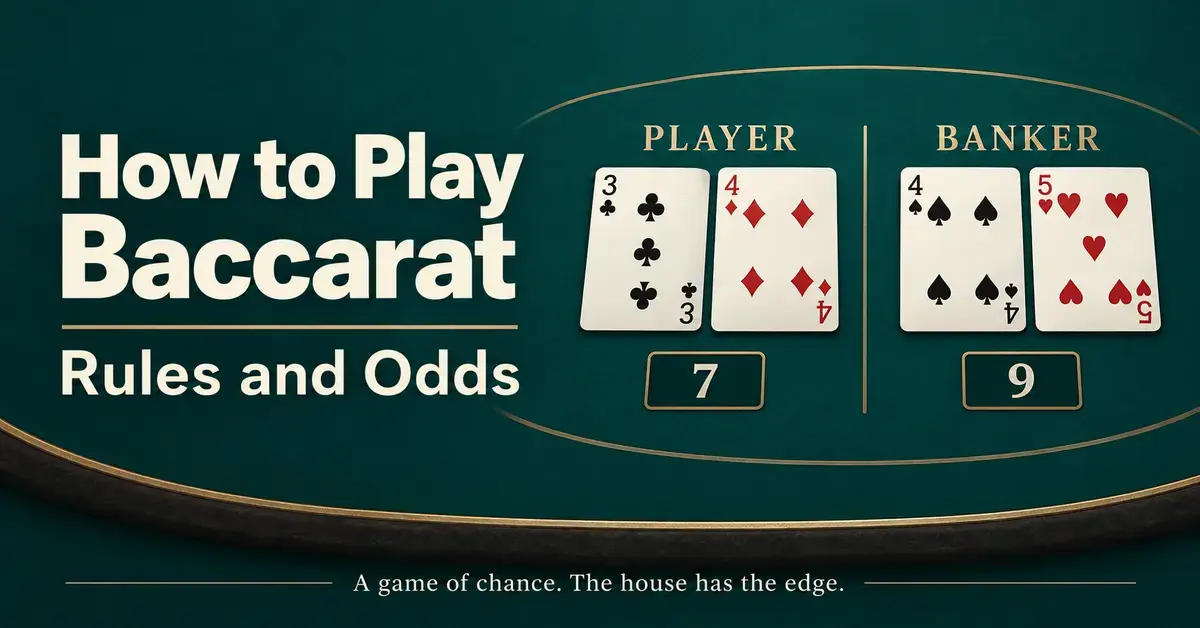
Baccarat is one of the simplest card games in the casino to play, because you never decide how the cards are dealt — you only choose which of three outcomes to bet on. This guide explains how a round works, how card values are counted, the fixed “third-card” rule the dealer follows, and the real odds and house edge behind the Banker, Player and Tie bets. It is written to inform, not to encourage play; baccarat, like every casino game, is built to favour the house over time.
Key Points
- Goal: bet on whichever hand — Player or Banker — finishes closest to a total of 9, or bet on a Tie.
- Card values: aces = 1, cards 2–9 = face value, and 10s and face cards = 0; only the last digit of the total counts.
- No decisions: the dealer draws the third card for both hands using fixed rules — players only choose which bet to make.
- House edge: Banker about 1.06%, Player about 1.24%, Tie about 14.36% at 8:1.
- Commission: winning Banker bets pay even money minus a 5% commission.
- Baccarat is a game of chance; no system changes the long-run house edge.
What is baccarat?
Baccarat is a comparing card game in which two hands — called the Player and the Banker — are dealt, and the goal is to bet on whichever hand will finish closest to a total of nine. Despite the names, you are not required to back the “Player” hand, and the “Banker” hand is not your opponent: both are simply labels for two sets of cards on the table. You can bet on either hand to win, or on the two hands tying.
The version found in most North American casinos is Punto Banco, where the house always banks the game and both hands are drawn according to fixed rules. Because those rules are automatic, baccarat involves no skill-based decisions once your bet is placed — unlike blackjack, where your choices change the outcome. Baccarat is part of the wider family of casino table games, and it is usually found in both a high-limit “big table” form and a lower-stakes mini-baccarat form.
How are card values counted in baccarat?
In baccarat, only the last digit of a hand’s total matters, and face cards are worth nothing. The card values are:
- Aces — worth 1 point.
- 2 through 9 — worth their printed (face) value.
- 10s, Jacks, Queens and Kings — worth 0 points.
A hand’s score is the sum of its cards, but if that sum reaches 10 or more, the tens digit is dropped and only the final digit counts. For example, a 7 and an 8 total 15, which scores as 5; a King and a 4 total 4; and a 9 and a 6 total 15, which scores as 5. The highest possible total is 9, which is why the hand closest to nine wins. There is no “bust” as in blackjack — a hand can never go over.
How is a round of baccarat played?
A round begins after you place a bet on the Banker, the Player or a Tie, and the dealer then deals two cards to each hand face up. From there the sequence is fixed:
- The dealer deals two cards to the Player hand and two to the Banker hand.
- If either hand totals 8 or 9 on those first two cards, it is called a natural. The round ends immediately, no more cards are drawn, and the higher total wins.
- If there is no natural, the fixed third-card rule decides whether either hand draws one more card.
- The hand closest to 9 wins. If both hands tie, Banker and Player bets push (are returned) and only the Tie bet is paid.
Crucially, the dealer applies every drawing decision for you. Players never choose to “hit” or “stand,” so once your chips are down there is nothing further to do but watch the hand play out.
What is the third-card rule in baccarat?
The third-card rule is the fixed set of instructions that tells the dealer whether the Player or Banker hand draws one extra card, and it is the only genuinely fiddly part of the game. You do not need to memorise it to play, but understanding it removes the mystery. It always resolves the Player hand first, then the Banker hand.
When does the Player hand draw a third card?
The Player hand follows a simple total-based rule when neither side has a natural:
- Total 0–5: the Player draws a third card.
- Total 6 or 7: the Player stands.
When does the Banker hand draw a third card?
The Banker’s decision depends on whether the Player drew, and on the exact value of the Player’s third card. If the Player stood, the Banker simply draws on 0–5 and stands on 6 or 7. If the Player drew a third card, the Banker follows this table:
- Banker total 0, 1 or 2: always draws.
- Banker total 3: draws unless the Player’s third card was an 8.
- Banker total 4: draws only if the Player’s third card was 2–7.
- Banker total 5: draws only if the Player’s third card was 4–7.
- Banker total 6: draws only if the Player’s third card was a 6 or 7.
- Banker total 7: always stands.
These rules are identical at every Punto Banco table, so no casino can change them to its advantage. The dealer carries them out automatically — and if you ever want to check them, most tables post the drawing rules on a card or in the game information.
What are the three baccarat bets?
There are three standard bets in baccarat, and choosing between them is the only decision that affects your odds. Each pays differently and carries a different house edge — the built-in mathematical advantage the casino keeps over the long run, explained in our guide to how casino games work.
The Banker bet
The Banker bet wins when the Banker hand finishes closest to nine, and it has the lowest house edge of the three main bets at about 1.06%. It pays even money (1:1), but the casino takes a 5% commission on winnings, so a winning $20 Banker bet returns $19 in winnings rather than $20. The Banker hand wins slightly more often than the Player hand — roughly 45.86% of all decisions — which is exactly why the commission exists.
The Player bet
The Player bet wins when the Player hand finishes closest to nine, and it has a house edge of about 1.24%. It pays even money with no commission, which makes it the simplest bet to track. The Player hand wins about 44.62% of decisions — marginally less often than the Banker hand, which is the small gap the figures above reflect.
The Tie bet
The Tie bet wins only when both hands finish on the same total, which happens about 9.52% of the time. It typically pays 8:1, but at that payout its house edge is about 14.36% — more than ten times the Banker bet. Some casinos pay 9:1 on ties, which lowers the edge, but even then it remains far worse than the two main bets. As a matter of pure value, the Tie is the weakest wager on the table.
Bet Comparison
| Bet | Payout | House edge | How often it wins | Notes |
|---|---|---|---|---|
| Banker | 1:1 minus 5% commission | ~1.06% | ~45.86% | Lowest edge; best long-run value |
| Player | 1:1 | ~1.24% | ~44.62% | Even money, no commission |
| Tie | 8:1 | ~14.36% | ~9.52% | Highest edge; weakest value |
What are the odds and house edge in baccarat?
Over a full shoe, the Banker hand wins about 45.86% of decisions, the Player hand about 44.62%, and the two tie about 9.52% (figures based on a standard eight-deck game). Translating those frequencies and the payouts into a house edge gives 1.06% on the Banker bet, 1.24% on the Player bet and 14.36% on the Tie at 8:1. In plain terms, for every $100 wagered, the theoretical long-run loss is roughly $1.06 on Banker, $1.24 on Player and $14.36 on Tie.
Those edges are among the lowest in the casino for the two main bets, which is part of baccarat’s appeal to informed players. But “low” is not “zero”: the house still holds an advantage on every bet, every outcome is independent, and no sequence of play changes the underlying percentages.
Why is there a 5% commission on the Banker bet?
The 5% commission exists because the Banker hand wins slightly more often than the Player hand, and without it the Banker bet would favour the player. By taking 5% of Banker winnings (so the bet effectively pays 19:20 rather than 1:1), the casino restores its edge and keeps the game profitable. The commission is only charged on winning Banker bets, not on the stake itself, and it is usually tracked by the dealer and collected at the end of the shoe. Even after the commission, the Banker bet still carries the lowest house edge of the three, which is why it is so often described as the mathematically strongest wager.
What are the main variants of baccarat?
Baccarat comes in a few forms, and the differences mostly affect who controls the drawing decisions and the size of the table. The core card values and the goal of reaching nine stay the same across all of them.
- Punto Banco: the standard casino version in North America. The house banks every hand and all draws follow the fixed third-card rules, so players make no card decisions.
- Mini-baccarat: the same rules and odds as Punto Banco, played on a smaller blackjack-sized table at lower minimums, with a single dealer handling all the cards. This is the version most Canadian players encounter.
- Chemin de Fer: an older French version in which players take turns acting as the banker and can choose whether to draw a third card. It is rarely offered in modern casinos but is famous from early James Bond films.
- Baccarat Banque: the earliest form, in which one player holds the bank for longer against two groups of opponents. It too is uncommon today.
What mistakes do beginners make in baccarat?
The most common mistakes in baccarat come from misreading the odds rather than misplaying the cards, since there are no cards to misplay. Avoiding these keeps your expectations realistic:
- Chasing the Tie bet. Its 8:1 payout looks tempting, but at a 14.36% house edge it is the worst value on the table.
- Believing in “patterns.” Baccarat scorecards and roadmaps track streaks of past results, but each hand is independent — past outcomes do not change the odds of the next hand, and no pattern can predict it.
- Forgetting the commission. The 5% charge on Banker wins is real; it does not erase the Banker’s edge advantage, but it does mean a winning Banker bet returns slightly less than even money.
- Treating a low house edge as a winning system. A 1.06% edge is favourable by casino standards, but it still guarantees a long-run loss. No bet selection turns baccarat into a positive-return game.
How does baccarat compare to other table games?
Baccarat’s two main bets sit among the lowest house edges in the casino, which puts it in the same value tier as well-played blackjack and better than most roulette bets. The trade-off is that baccarat offers no skill element to improve your odds further, whereas other games reward strategy or bet selection.
- Versus blackjack: blackjack can reach roughly a 0.5% house edge, but only with correct strategy on every hand. See how to play blackjack for the decisions involved. Baccarat reaches 1.06% with no decisions at all.
- Versus roulette: European roulette carries about a 2.7% edge on every bet, higher than baccarat’s main bets. Our guide to roulette explains the inside and outside bets.
- Pace and simplicity: baccarat is faster to learn than either, because you only pick an outcome and the dealer does the rest.
Who is baccarat suited to?
Baccarat suits players who want a simple, fast game with a low house edge on the two main bets and no strategy to memorise. It is a poor fit for anyone looking to influence the result through skill, since the drawing rules are entirely fixed, and the Tie bet makes it a trap for players chasing big multipliers. For a beginner who understands that the game is still a long-run loss, sticking to the Banker or Player bet and treating any money staked as the cost of entertainment is the realistic way to approach it.
Responsible gambling and Canadian rules
This article is educational and is not betting advice. Baccarat is a game of chance with a permanent house edge, so no bet, pattern or system can overcome the odds over time — the only certainty is that the house keeps its advantage. Treat any money wagered as spent, set limits before you play, and never gamble to recover losses.
In Canada, the legal gambling age is 19 in most provinces and 18 in Alberta, Manitoba and Quebec. If gambling is affecting you or someone you know, free, confidential help is available. In Ontario you can reach ConnexOntario at 1-866-531-2600 (or text CONNEX to 247247), and every province offers its own help line and self-exclusion programs. For tools, limits and support across Canada, see our responsible gambling page.
Sources
Frequently asked questions (FAQ)
Is the Banker bet always the best bet in baccarat?
In terms of house edge, yes: at about 1.06% after the 5% commission, the Banker bet has the lowest long-run cost of the three bets. It is “best” only in a relative sense, however — it still carries a house edge, so it does not make baccarat a winning game.
Do I need to learn the third-card rule to play?
No. The dealer applies the entire third-card rule automatically, and players never choose whether a hand draws. Knowing the rule helps you follow the action, but it has no effect on the result or your odds.
What happens to my bet if the hands tie?
If both hands finish on the same total and you bet on Banker or Player, your bet is returned as a push — you neither win nor lose. Only a Tie bet is paid in that case, usually at 8:1.
Can patterns or scorecards help me win at baccarat?
No. Scorecards track past results, but each hand is independent and the odds reset every time. Past outcomes cannot predict the next hand, so no pattern changes the house edge.
What is the difference between baccarat and mini-baccarat?
Mini-baccarat uses the same rules, card values and odds as the standard Punto Banco game. It is simply played on a smaller table at lower minimum bets, with one dealer handling all the cards and a faster pace.
