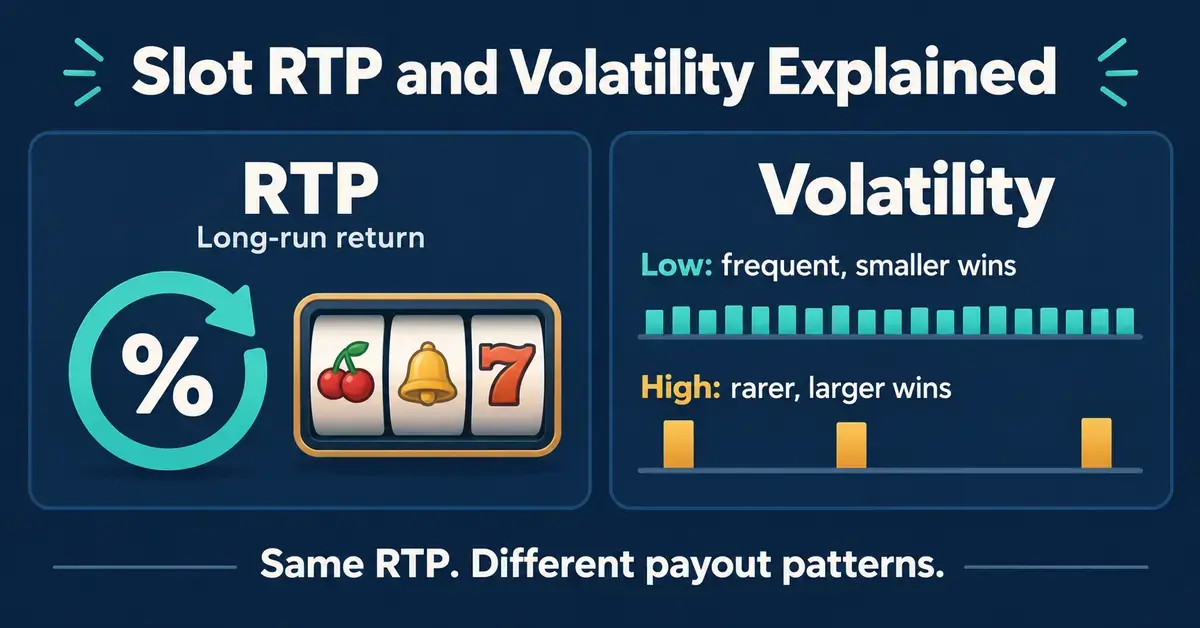
Every slot is governed by two numbers that decide how it behaves over time: its RTP and its volatility. RTP (Return to Player) tells you how much of the money wagered a game is designed to pay back over the long run, while volatility — also called variance — describes how evenly or unevenly those payouts arrive. Understanding both helps you read a slot’s information screen honestly, set realistic expectations for a session, and see why two games with the same payback can feel completely different. This guide explains each concept in plain language, applies it specifically to slots, and shows how the figures are tested and regulated.
Key Takeaways
- RTP (Return to Player) is the share of all wagered money a slot is built to pay back over the long run — most online slots sit in the 94–97% band.
- Volatility (variance) describes how those returns are spread out: low volatility means frequent small wins, high volatility means rare but larger ones.
- RTP and volatility are independent — two slots can share a 96% RTP yet play completely differently.
- Both are long-run statistics; neither predicts your next spin, and no strategy, demo play or timing improves them.
- The house edge equals 100% minus the RTP, so a 96% RTP slot carries a 4% house edge.
What is RTP (Return to Player) on a slot?
RTP is the percentage of all money wagered that a slot is built to return to players over a very large number of spins. If a game has an RTP of 96%, it is designed to pay back about $96 for every $100 staked across its lifetime — not in a single session. The testing body eCOGRA defines % RTP as “the expected return on bets wagered in a specific online gambling game over an extended period,” confirmed through simulations on very large sample sizes.
Three things are worth stressing. First, RTP is a long-run average, not a promise for your afternoon; short sessions can land far above or far below it. Second, the figure already accounts for everything the game pays, including bonus rounds and feature wins. Third, the leftover is the casino’s built-in margin: the house edge is simply 100% minus the RTP, so a 96% RTP slot carries a 4% house edge. If you want the wider picture of margins, odds and payouts across the casino floor, our guide to how casino games work sets out the same maths for every game type.
What is slot volatility (variance)?
Volatility describes how a slot’s returns are spread out — how often wins land and how big they tend to be — rather than how much is returned overall. “Volatility” and “variance” mean the same thing in slots and are used interchangeably. A game can be low, medium or high volatility, and that single trait does more to shape the minute-to-minute experience of play than RTP does.
- Low volatility: frequent but small wins. The balance moves up and down gently, and long dry spells are less common.
- Medium volatility: a middle ground, mixing regular modest wins with occasional bigger ones.
- High volatility: wins are rarer, with longer gaps between them, but the payouts can be far larger when they do arrive.
Importantly, volatility says nothing about whether a game is “generous.” It only tells you the shape of the payouts, not the total. A high-volatility slot is not more likely to pay in the long run than a low-volatility one with the same RTP.
Volatility versus hit frequency
Hit frequency is the share of spins that produce any win at all, and it is related to — but not the same as — volatility. A slot can have a high hit frequency yet still be highly volatile if most of those “wins” return less than the stake and the real money sits in a rare bonus round. Hit frequency is also reported inconsistently: many providers do not publish it, and there is no shared industry benchmark, so treat any single number with caution and read it alongside the volatility rating.
How are RTP and volatility different, and why do both matter?
RTP and volatility measure different things and move independently of each other. RTP fixes the long-run payback (and therefore the house edge); volatility fixes how bumpy the road to that payback is. This is why two slots can share an identical 96% RTP and still feel like different games — one drips out small wins steadily, the other goes quiet for dozens of spins and then pays a large multiple of your stake.
eCOGRA’s testers make this link explicit: when they check a game, the acceptable range for its measured payout depends on the game’s volatility, because a high-variance slot needs far more spins before its results settle toward the stated RTP. For players, the practical takeaway is to read both numbers together — RTP for the value of the game over time, volatility for what a realistic session with your bankroll will feel like.
Slot Volatility Compared
| Volatility level | Win frequency | Typical win size | Session feel | Bankroll demand |
|---|---|---|---|---|
| Low | High — wins land often | Small | Steady, gentle swings, few long dry spells | Lower; suits longer play on a small budget |
| Medium | Moderate | Mixed small and occasional larger | Balanced between steady and streaky | Moderate |
| High | Low — longer gaps between wins | Large when they land | Streaky; long quiet runs then big hits | Higher; needs a larger budget or smaller stakes |
What is a typical slot RTP?
Most online slots fall in roughly the 94–97% RTP range, with many studios targeting a figure around 96%. The broader band seen across the market runs from about 92% to 98%. Where a specific game lands depends on its design and its jackpot structure:
- Standard online video slots: commonly 94–97%, often near 96%.
- Progressive jackpot slots: frequently lower, often around 88–95%, because part of every bet funds a growing jackpot pool rather than the base game.
- Land-based machines: often lower than their online counterparts, as physical venues carry higher running costs.
You can usually find a game’s RTP in its information, help or paytable screen; regulated operators are expected to make the likelihood of winning available to players. If a game hides its RTP entirely, that is a reason to be cautious. Because the number is a lifetime average measured over millions of spins, it tells you nothing about whether the next hour will be lucky.
How does volatility shape your session and bankroll?
Volatility is the single biggest driver of how your balance behaves during real play. The key point is that the same deposit lasts very differently depending on the variance you choose.
Low-volatility slots suit longer, steadier sessions and smaller bankrolls. Wins arrive often, so the balance erodes slowly and the experience is calmer — but the ceiling on any single spin is modest, and regular small wins do not cancel out the house edge over time. Low volatility does not mean low risk, guaranteed wins, or results that must match the stated RTP in a short session.
High-volatility slots suit players chasing a large payout who accept long losing runs to get there. They can drain a small bankroll quickly during dry spells, so they generally call for a larger budget, smaller stakes per spin, or both. Neither style changes the long-run odds — the RNG behind every spin makes outcomes independent, so no slot is ever “due” to pay. See how slot machines work for the mechanics behind reels, paylines and random outcomes.
How are slot RTP and volatility tested and regulated?
Slot RTP and volatility are not self-reported marketing numbers; in regulated markets they are verified by independent laboratories before a game goes live. Testing houses such as eCOGRA and Gaming Laboratories International run statistical analysis on huge simulated samples to confirm that a game’s random number generator (RNG) produces genuinely random, independent outcomes and that the measured payback converges on the published RTP.
In Canada’s largest regulated online market, Ontario, the Alcohol and Gaming Commission of Ontario (AGCO) operates a Gaming Lab accredited to ISO 17025:2017 that assesses slot machines, RNGs and gaming systems against the Registrar’s Technical Standards, running statistical analysis on data sets with millions of data points and mathematically modelling each game’s payback and award odds. The UK Gambling Commission’s technical standards (RTS 7) set the same core principle in different words: outcomes must be “acceptably random,” and games that adapt their odds to recent results — so-called compensated games — are not permitted.
Two consequences follow for players. First, certification covers the RNG and the game build; it does not guarantee any particular result on any particular spin. Second, because each spin is independent, a slot that has gone 300 spins without a big win is no more or less likely to pay on spin 301 than on spin 1.
Common mistakes about slot RTP and volatility
Most misunderstandings come from treating long-run statistics as short-run predictions. The frequent errors below all stem from that mistake.
- Expecting RTP to apply to your session. A 96% RTP does not mean you will lose only 4% of your deposit today; real sessions scatter widely around the average.
- Thinking a machine is “due.” Independent RNG outcomes mean past spins never influence the next one. This is the gambler’s fallacy.
- Confusing high volatility with better value. Variance changes the shape of payouts, not the long-run payback. A high-variance slot is not a higher-RTP slot.
- Reading hit frequency as win size. A high hit frequency can still accompany mostly sub-stake returns.
- Assuming any strategy changes the odds. Bet size, stop-loss rules and timing affect how long you play, not the mathematical edge. No system, demo play or “hot” time improves your chances.
- Chasing losses on a high-volatility game. Increasing stakes to recover a dry spell accelerates bankroll loss rather than reversing it.
Which RTP and volatility suit which player?
The right combination depends on your budget, your patience and what you enjoy — not on any edge, because none exists. As a general rule, favour the highest RTP you can find, then pick the volatility that matches your goal.
- Longer entertainment on a small budget: high RTP, low-to-medium volatility, small stakes.
- Chasing a rare big multiplier: high volatility with a larger bankroll and smaller per-spin bets to survive the dry spells.
- Jackpot dreamers: accept that progressive slots often carry a lower base-game RTP in exchange for the jackpot chance.
Slots sit at the higher-house-edge end of the casino. If long-run value matters more to you than the slot experience, lower-edge options among casino table games such as blackjack typically return more over time with correct play.
Responsible gambling: This article is educational and is not betting advice. RTP and volatility are long-run statistics that describe a game’s design; they cannot predict results, improve your chances, or make any slot “due” to pay. Every slot keeps a built-in house edge, so over time the game is expected to win. Gambling is 19+ in most of Canada (18+ in Alberta, Manitoba and Quebec). Set deposit and time limits before you play, never chase losses, and treat any money wagered as spent on entertainment. If gambling stops being fun, free, confidential help is available — ConnexOntario operates 24/7 at 1-866-531-2600. For tools, limits and self-exclusion options across the country, see our guide to responsible gambling in Canada.
Sources
Frequently Asked Questions (FAQ)
Is a higher RTP always better?
For long-run value, yes — a higher RTP means a smaller house edge, so the game is designed to keep less of your money over time. But RTP is a lifetime average and will not protect any single session from a losing run, and it says nothing about how the payouts are spread out.
Does high volatility mean a slot pays more?
No. Volatility describes the shape of the payouts — rarer but larger wins — not the total returned. A high-volatility slot and a low-volatility slot with the same RTP are designed to pay back the same amount over the long run; they just get there very differently.
Can I use RTP or volatility to predict my next spin?
No. Each spin is produced by a random number generator and is independent of every spin before it, so no machine is ever “due.” RTP and volatility only describe behaviour across millions of spins, not the result of the one in front of you.
Where do I find a slot’s RTP and volatility?
Both are usually listed in the game’s information, help or paytable screen, and volatility is often shown as a low/medium/high rating or a risk meter. In regulated markets, operators are expected to make the likelihood of winning available. If a game hides its RTP, be cautious.
What is a good RTP for an online slot?
Most online slots fall between about 94% and 97%, with many near 96%. Anything in that band is typical; progressive jackpot slots are often lower because part of each bet funds the jackpot. Treat figures below roughly 92% as comparatively poor value.
