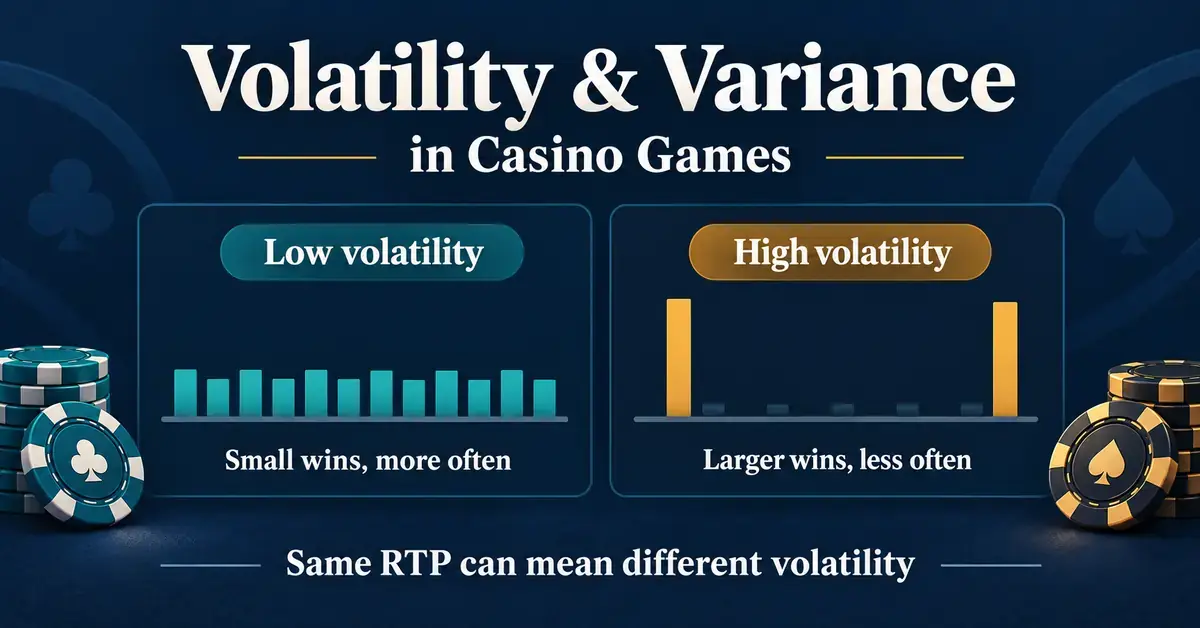
Volatility is the main reason two casino games with the same payout percentage can feel completely different to play. It describes how a game’s wins are spread out over time — how often you win and how large those wins tend to be. A low-volatility game pays small amounts often; a high-volatility game pays rarely but can pay big. Crucially, volatility says nothing about whether a game returns more or less money in the long run; that is a separate number. This guide explains what volatility (and its twin term, variance) means, how it differs from RTP and the house edge, and how the idea plays out across different casino games.
Key Points
- Volatility = the spread of wins: how often a game pays and how big the payouts are.
- Volatility and variance mean the same thing in casino language; variance is just the precise statistical term.
- Volatility is not RTP. RTP and the house edge are the long-run average; volatility is the short-run shape. Two games can share one RTP and feel completely different.
- Low volatility: frequent small wins, gentle swings, longer sessions. High volatility: rare large wins, long dry spells, faster losses.
- Same long-run return either way. For a given RTP, low- and high-volatility games cost the same per bet on average.
- Payout (hit) frequency is the clearest everyday signal of volatility — but a “hit” can still be less than your stake.
What is volatility in casino games?
Volatility measures how a game’s results swing around its average — the size and frequency of the wins and losses you experience. A game is called high volatility when outcomes are spread far apart (long losing stretches broken by occasional large payouts) and low volatility when outcomes cluster close together (frequent small wins and smaller losses).
Think of two games that both hand back the same amount of money over a very long time. One drips out tiny wins almost every round. The other is quiet for dozens of rounds and then pays a large amount at once. Over thousands of rounds they are equivalent; over a single session they produce completely different experiences. That difference is volatility.
Volatility is a property of the game’s design — its pay table and the probability of each outcome — not something a player can change through strategy or timing. To understand where it sits among the other core numbers, it helps to see how casino games work at a high level first.
Is volatility the same as variance?
In everyday casino language, yes — volatility and variance describe the same idea. Both refer to how widely a game’s payouts are dispersed. You will see slot studios and review sites use the words interchangeably, often alongside “risk level.”
There is a small technical distinction worth knowing. In statistics, variance is a precise figure: the average of the squared differences between each outcome and the mean. Its square root is the standard deviation, which measures the typical distance of a result from the average. “Volatility” is the plain-language label the industry puts on that maths. Game providers rarely publish the raw variance or standard deviation, so in practice you mostly see loose categories such as low, medium and high.
How is volatility different from RTP and the house edge?
Volatility describes the shape of a game’s payouts, while RTP and the house edge describe the average. They answer different questions, and confusing them is the most common mistake beginners make.
RTP and house edge: the long-run average
RTP (Return to Player) is the percentage of all money wagered that a game is expected to pay back over a very large number of rounds. The house edge is simply the rest: if a game has an RTP of 96%, the house edge is 4%. These figures are long-run averages measured over millions of rounds, not a promise about any single session.
Volatility: the short-run spread
Volatility describes how your results are likely to arrive on the way to that long-run average. Two games can share the exact same 96% RTP yet feel nothing alike: a low-volatility version might pay something on roughly a third of rounds in small amounts, while a high-volatility version might pay on far fewer rounds but occasionally return many times the stake. Same average, very different ride.
A useful way to hold the two ideas apart: RTP and house edge tell you what to expect over the long run, and volatility tells you how bumpy the short run is likely to be. Neither one changes the other. A high-volatility game is not “worse value” than a low-volatility game if their RTPs match — the expected cost per bet is identical. Only the pattern of wins and losses differs.
High volatility vs low volatility: what actually changes?
The practical difference between high and low volatility is how often you win and how big those wins are — not how much the game keeps on average. Here is what each end of the scale looks like.
Low volatility
Low-volatility games deliver frequent, modest wins and shallow swings. Your balance tends to move gently up and down, and a session lasts longer on the same bankroll because big losing streaks are less common. The trade-off is that large payouts are rare, so sessions can feel repetitive and the top prizes are small.
High volatility
High-volatility games pay rarely but can pay large amounts when they do. Expect long stretches with little or nothing, punctuated by the occasional big hit. The upside is the chance of a sizeable payout from a small stake; the downside is that a bankroll can drain quickly during a dry spell, and the big win may never arrive in a given session.
Medium volatility
Medium volatility sits between the two: wins are reasonably regular, and payouts are large enough to matter without the extreme droughts of a high-volatility game. Because there is no official standard, one provider’s “medium” can be another’s “low-medium” or “high” — the labels are conventions, not regulated thresholds.
Comparison
| Feature | Low volatility | High volatility |
|---|---|---|
| Win frequency | High — wins on many rounds | Low — wins on few rounds |
| Typical win size | Small | Large but rare |
| Bankroll swings | Shallow and steady | Deep and uneven |
| Session length (same bankroll) | Usually longer | Often shorter |
| Session feel | Steady, can be repetitive | Long quiet runs, occasional big hit |
| Long-run return (same RTP) | Identical — volatility does not change the average | |
| Example bet | Red/black in roulette; banker/player in baccarat | Single number in roulette; tie in baccarat |
What does payout frequency (hit frequency) mean?
Payout frequency — also called hit frequency — is the share of rounds that return any win at all, and it is the clearest everyday signal of volatility. A game that pays something on 40% of rounds has a high hit frequency and will usually feel low-volatility; a game that pays on 15% of rounds has a low hit frequency and will usually feel high-volatility.
Two cautions keep payout frequency honest. First, a “win” can be smaller than your stake — returning part of a bet still counts as a hit, so a high hit frequency does not mean you are ahead. Second, payout frequency and payout size pull in opposite directions: for a fixed RTP, paying more often means paying less each time, and paying rarely means the hits must be larger to balance out. That inverse relationship is the mechanism behind the whole low-versus-high volatility distinction.
How volatility shows up across casino games
Volatility exists in every casino game, but it is easiest to see when you compare the bets within a single game. The game’s rules and pay table set the volatility; the bet you choose can move it up or down.
- Roulette: an even-money bet such as red or black wins close to half the time for a roughly even payout — low volatility. A single-number bet wins about once in 37 spins on a single-zero wheel but pays 35 to 1 — high volatility. Both carry the same 2.7% house edge on European roulette, so the spread differs while the long-run cost does not. See how to play roulette for the full bet menu.
- Blackjack: most hands resolve at even money or 3:2, so swings are relatively contained — moderate volatility — and the house edge can fall to around 0.5% under favourable rules with correct play. Side bets, by contrast, are high volatility. The basics are covered in how to play blackjack.
- Baccarat: the banker and player bets win nearly half the time at close to even money (banker edge about 1.06% after commission), making them low volatility, while the tie bet pays 8:1 and hits rarely — much higher volatility.
- Slots: slot machines cover the widest range of all, from gentle low-volatility games to extreme high-volatility titles with huge top prizes. The game-specific detail lives in the guide to how slot machines work.
Independent testing laboratories such as Gaming Laboratories International verify a game’s random number generator and its theoretical RTP before it reaches the public. They confirm the long-run average and the payout distribution; they do not set or cap how volatile a game is allowed to be.
Why does volatility matter for your bankroll?
Volatility matters because it decides how long your money is likely to last and how large the swings will be, even when the long-run cost is fixed. A fixed bankroll will usually survive far more rounds on a low-volatility game than on a high-volatility one, because the high-volatility game can post a long losing run before any big hit.
That is why the “right” volatility depends on what you want from a session rather than on which game is mathematically superior — if RTPs match, none is. A player who wants a long, steady session leans low; a player chasing a rare large payout and willing to risk a fast loss leans high. Neither choice improves the odds; it only changes the distribution of outcomes.
Common mistakes people make about volatility
The biggest error is treating volatility as if it changed a game’s long-run return. It does not. Here are the misconceptions worth avoiding:
- Thinking low volatility means better value. For a given RTP, low- and high-volatility games cost the same per bet on average; only the pattern of wins differs.
- Thinking a high-volatility game is “due” to pay. Outcomes are independent. A long drought does not make a big win more likely on the next round.
- Confusing a high hit frequency with profit. Frequent small returns can still add up to a net loss, because many “wins” return less than the stake.
- Assuming volatility can be changed by strategy or timing. Volatility is built into the pay table; bet selection shifts it within a game, but no system alters the underlying maths.
- Treating provider labels as standards. “High” and “low” are informal categories with no agreed thresholds, so compare like with like.
Which volatility level suits which player?
The best volatility level depends on your goal for the session and the size of your bankroll, not on any edge one offers over another. Use the trade-offs rather than a “best” label:
- Low volatility suits players who want longer sessions, steadier balances and frequent small wins, and who are not chasing a large one-off payout.
- High volatility suits players who accept long dry spells and the risk of a quick loss in exchange for the chance of a rare large payout.
- Medium volatility suits players who want a balance of reasonably regular wins and the occasional meaningful payout.
Whatever the level, the long-run expectation is set by RTP and the house edge — every game keeps a share over time — and volatility only shapes how that result is likely to feel along the way.
A note on responsible play
This article explains volatility as a mathematical concept and is for information only; it is not betting advice and does not describe a way to win. Every casino game carries a built-in house edge, so over time the game keeps a share of all money wagered regardless of its volatility, and no understanding of variance changes that. Volatility affects how outcomes are distributed, not whether a game can be beaten in the long run. Set money and time limits before you play, and if gambling stops feeling like entertainment, see our guide to responsible gambling in Canada for tools and support.
Sources
Frequently Asked Questions (FAQ)
Does high volatility mean a game pays out more?
No. High volatility means a game pays rarely but in larger amounts, while low volatility means frequent smaller wins. The total returned over the long run is set by the game’s RTP, not by its volatility, so two games with the same RTP give back the same amount on average whatever their volatility.
Is volatility the same as variance?
In casino usage they mean the same thing: how widely a game’s payouts are spread. Variance is the precise statistical term (the square of the standard deviation), while “volatility” is the everyday label the industry uses for the same idea.
Can I change a game’s volatility?
You cannot change the volatility built into a game’s pay table, but within some games you can choose bets with different volatility — for example an even-money roulette bet versus a single-number bet. No betting system or timing alters the underlying maths.
How do I find out a game’s volatility?
Some providers state it in the game rules or pay table as low, medium or high, and a game’s hit frequency (how often it pays anything) is a practical clue. Because there is no official standard, the labels are conventions and can differ between providers.
Is a low-volatility game safer than a high-volatility one?
“Safer” is misleading. A low-volatility game has smaller swings and tends to make a bankroll last longer, but for the same RTP it costs the same per bet on average. Both still favour the house over time; only the pattern of wins and losses differs.
