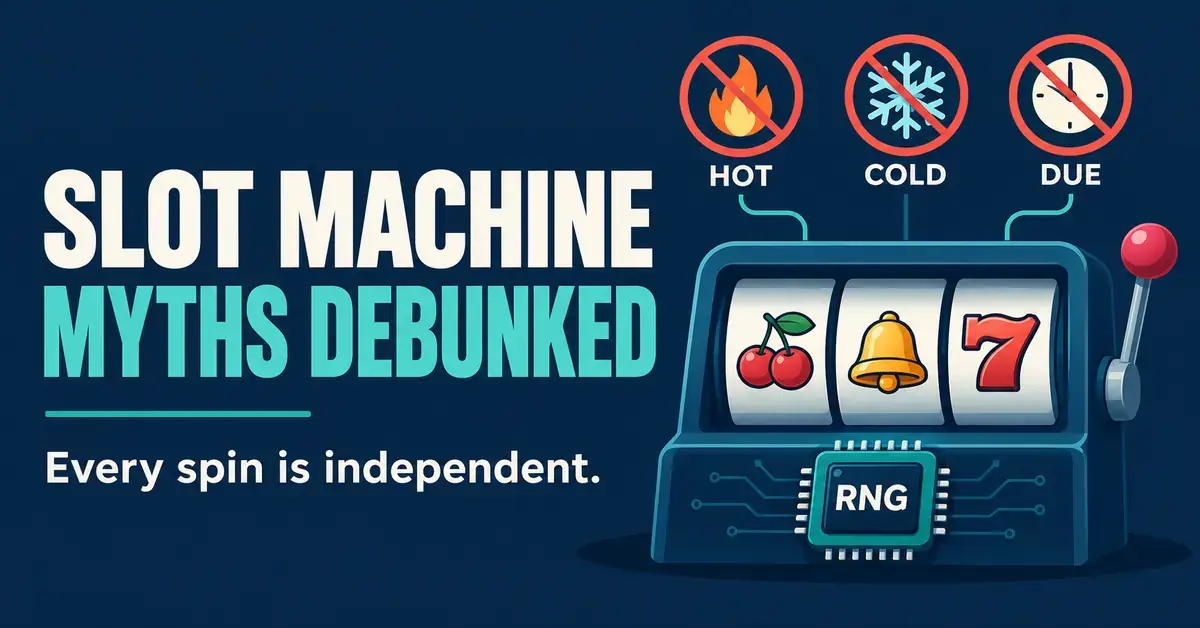
Slots attract more folklore than any other casino game: players swap tips about “hot” and “cold” machines, machines that are “due” to pay, lucky times of day, and secret button rhythms. Almost none of it is true. Modern slot machines, online and in land-based casinos, decide every result with a random number generator (RNG) that has no memory of what came before. This guide works through the most common slot machine myths one by one, explains what actually determines a win, and is clear about the one thing none of these beliefs can change: the built-in house edge. There are no tricks to beat slots, and anyone promising otherwise is selling a story.
Key Points
- Every spin on a modern slot is produced by a random number generator (RNG) and is independent of every spin before it — the machine has no memory.
- “Hot” and “cold” machines, and the idea that a slot is “due” to pay, are versions of the gambler’s fallacy. Recent results do not change your next spin.
- Time of day, day of week, using a players card, pulling a lever versus pressing a button, or the rhythm you press it make no difference to the outcome.
- No system, app or trick can beat a slot’s built-in house edge. RTP is a long-run average measured over millions of spins, not a promise for your session.
- In regulated markets like Ontario, games and RNGs must be certified by an AGCO-registered independent testing lab before they go live — fair, but still favouring the house over time.
Why slot myths are so convincing
Slot myths survive because randomness does not look random to the human brain. Over a short session you will naturally see streaks — several wins in a row, or a long drought — and the mind reaches for a cause: the machine must be “hot,” or it must be “due.” In reality those streaks are exactly what independent random outcomes produce. The machine is not on a run and it is not holding back; it simply has no mechanism to track your history.
Two design features make the illusion stronger. Slots show spinning reels and play celebratory sounds, which makes the result feel like a skill-based, unfolding event rather than an instant draw. And they are built to deliver frequent small payouts and “near misses,” both of which keep the feeling of momentum alive. Understanding that pull is the first step to seeing the myths for what they are. For the underlying mechanics, our guide to how slot machines work walks through the RNG, reels and paylines in detail.
Myth: slot machines run “hot” and “cold”
There is no such thing as a hot or cold slot machine. A “hot” machine is simply one that happens to have paid out recently, and a “cold” one is one that has not — but neither state tells you anything about the next spin. Each spin is an independent event decided fresh by the RNG at the moment you press the button, so recent results do not raise or lower your chances going forward.
The confusion comes from looking at a handful of spins. Flip a fair coin ten times and you may well see four heads in a row; that does not make the coin “hot.” Slots work the same way, except the odds on each symbol combination are fixed by the game’s maths, not 50/50. A machine that just paid a jackpot is exactly as likely to pay again on the next spin as it was before — no more, no less. Chasing a machine because it looks hot, or avoiding one because it looks cold, is chasing a pattern that is not there.
Are slots ever “due” to hit?
No slot machine is ever “due” to hit, no matter how long it has gone without paying. This belief is a textbook example of the gambler’s fallacy — the mistaken idea that past results change future odds. The Responsible Gambling Council defines it plainly: people assume an outcome is due after it has been absent for a while, but past results do not affect future probabilities.
A slot’s RNG does not keep a running tally of how overdue a jackpot is. On a machine where a top prize hits, on average, once in many millions of spins, that long-run average is produced by millions of independent draws — it is not a countdown that gets “closer” as you play. A machine that has not paid in hours has exactly the same chance on the next spin as one that paid thirty seconds ago. The same independence applies across the casino floor: it is the same principle behind why a roulette wheel is not “due” for red after a run of blacks, which we cover in our guide to how to play roulette.
Myth: time of day, day of week or crowds change your odds
Your odds on a slot are identical at 3 a.m. on a quiet Tuesday and at peak time on a busy Saturday. The RNG runs continuously and does not know the clock, the calendar or how many people are in the room. A casino cannot “loosen” or “tighten” a machine on the fly to match the crowd, and payout percentages are not nudged up on paydays or down on holidays.
Why does it sometimes feel otherwise? Busier periods simply mean more spins are happening across the floor, so you are more likely to see or hear someone win — the total number of wins is higher because the total number of plays is higher, not because each spin got better. Changing a game’s configured payout settings is a controlled, logged process, not something staff do by time of day.
Myth: lucky timing, stop buttons and button rhythm
Nothing about when or how you press the button changes the result. The RNG is generating numbers constantly, thousands of times a second, and the outcome is locked in the instant you trigger the spin. Pausing for a “lucky” moment, hammering the button, or using a stop button to halt the reels does not let you catch a better combination.
The stop feature and the spinning animation are presentation, not control. As the Responsible Gambling Council’s own glossary puts it, the reels’ motion is only for entertainment and no strategy can beat the RNG. Pulling a physical lever instead of pressing a button makes no difference either — both do the same thing. The same goes for superstitions like warming coins, rubbing the screen, or playing a “lucky” seat: pleasant rituals, zero effect on the maths.
Myth: a players card or loyalty program lowers your payouts
Using a players club or loyalty card does not make a machine pay less. The card tracks your play so the casino can award points, comps or bonuses; it is read by a separate system and is not wired into the RNG that decides outcomes. Inserting it, or leaving it out, has no effect on your odds on any given spin.
This myth is easy to disprove logically: the game’s payout maths is certified before it goes live and is the same for every player, carded or not. Declining the card only means you miss out on rewards you would otherwise earn for play you were doing anyway.
Myth: a “system” or trick can beat slots
No betting system, app, pattern or trick can give you a long-term edge over a slot machine. This is the most important myth to retire, because it is the one that costs players money. Unlike blackjack, slots offer no decision that changes the odds — there is no equivalent of basic strategy, and there is nothing to count. Every spin is an independent RNG draw, so staking patterns such as “increase your bet after a loss” do not change your expected result; they only change how fast your bankroll swings up and down.
Bet-size systems, “due” trackers, and paid “cheat” guides all rest on the hot/cold and “due” fallacies above. The house edge is baked into every game’s pay table and cannot be strategised away. If a tactic genuinely beat slots, casinos and regulators would not allow the game to run. The honest framing: slots are entertainment with a known, unavoidable cost over time, which our overview of how casino games work explains through house edge and RTP.
Myth vs Fact
| Common belief | The reality |
|---|---|
| This machine is “hot” / “cold” | Streaks are normal randomness; recent results do not change the next spin. |
| It’s “due” after a dry spell | The RNG has no memory or countdown — this is the gambler’s fallacy. |
| Late night / weekends pay better | The RNG ignores the clock and calendar; busy times just show more wins. |
| Timing the button or using stop helps | The result is fixed the instant you spin; the reels are just animation. |
| Using a players card lowers payouts | The card tracks rewards only and is not connected to the RNG. |
| A system or trick can beat slots | No staking pattern changes independent RNG odds or the house edge. |
| High RTP means I’ll win this session | RTP is a long-run average; a single session can run well above or below it. |
What actually decides whether you win
Three real factors shape your experience on a slot, and none of them is a secret you can exploit. The RNG decides the symbols; the game’s return to player (RTP) sets the long-run payout percentage; and volatility (how the payouts are distributed) decides whether wins are frequent-but-small or rare-but-large.
The RNG decides every result
The random number generator is a program that produces unpredictable numbers continuously; at the moment of your spin it fixes the outcome, and the reels then animate to display it. Because it is memoryless, it is the mathematical reason every myth above fails — there is no past, no due date and no momentum for it to act on.
RTP is a long-run average, not a session promise
Return to player is the theoretical percentage of all money wagered that a game pays back over the very long run — typically measured across millions of spins. A 96% RTP does not mean you get $96 back from $100 in a sitting; a single session can end far above or far below that figure. RTP describes the game’s maths over time, not your next hour, and the remaining few per cent is the house edge that keeps the casino profitable.
Volatility explains the streaks
Volatility (sometimes called variance) is why two games with the same RTP feel completely different. A high-volatility slot pays rarely but can pay big, producing long dry spells that feel “cold”; a low-volatility slot pays often in small amounts and feels steadier. Both patterns are just the design doing its job — not a machine warming up or cooling down.
How near misses and “losses disguised as wins” fool your brain
Slot design nudges your perception even when the odds are fixed, and knowing the two main tricks helps you read your own play honestly. The first is the near miss: a result that lands just short of a jackpot, such as two matching symbols and a third just above or below the line. A University of Alberta team reviewing and re-testing the near-miss effect in the Journal of Gambling Studies could not replicate the long-assumed finding that near misses increase the rate of play — though they stressed this does not make players any less vulnerable, and that near misses still register in brain activity and heart rate.
The second is the loss disguised as a win (LDW): on a multi-line slot, winning a few cents on one line while losing your larger total stake still triggers the full win animation and sound. Research including a 2023 study of more than 900 participants found that people exposed to LDWs tended to overestimate how often they actually won. Neither effect changes your odds, but both can make a losing session feel like a winning one — which is exactly how the “hot machine” feeling takes hold.
Common mistakes these myths cause
The myths matter because of what they lead people to do. The most damaging patterns all follow from believing the machine has a memory or a schedule:
- Chasing a “due” machine. Pouring more money into a game because it “has to hit soon” — it does not, and the extra spins only increase expected losses.
- Loss-chasing. Raising bets after losses to “win it back,” on the false premise that a turnaround is overdue.
- Switching machines to find a hot one. Moving around the floor hunting momentum that does not exist, often playing longer than planned.
- Paying for “systems” or guides. Spending real money on tactics that cannot change RNG outcomes.
- Misreading RTP. Treating a high RTP as a guarantee for the session rather than a long-run average, and playing longer because of it.
- Trusting the celebration. Letting win sounds on net-losing spins create a false sense of being ahead.
Who makes sure slots are fair in Canada?
In regulated Canadian markets, slot fairness is verified by independent testing, not taken on trust. In Ontario, for example, the Alcohol and Gaming Commission of Ontario (AGCO) requires that key igaming components — including games and random number generators — be certified against the Registrar’s Standards for Internet Gaming by an AGCO-registered independent testing laboratory before they can be deployed in the regulated market. The AGCO does not test the technology in its own lab; it registers accredited third-party labs (such as Gaming Laboratories International, eCOGRA, BMM and others) to do that work.
This is the real answer to “are slots rigged?”: in a licensed, regulated setting, the RNG and pay table are tested and certified, and operators risk their licence by tampering with them. It also means the house edge is disclosed through the game’s maths rather than hidden — the game is fair in the sense of being genuinely random, but random still favours the house over time. If you play on an unlicensed site, none of these protections apply, which is a separate and real risk.
Responsible gambling
This article is educational and is not betting advice or a guide to winning. Slots are games of chance with a permanent house edge: over time the machine is designed to keep a share of everything wagered, and no myth, system or trick changes that. Treat any money played on slots as the cost of entertainment, never as a way to make money or recover losses, and set firm time and deposit limits before you start.
You must be of legal gambling age in your province or territory (19+ in most of Canada; 18+ in Alberta, Manitoba and Quebec). If gambling is causing you or someone you know harm, free, confidential help is available in Ontario through ConnexOntario at 1-866-531-2600 (or text CONNEX to 247247), and comparable provincial help lines operate across Canada. For tools such as deposit limits and self-exclusion, and a full list of support services, see our guide to responsible gambling in Canada.
Sources
- Alcohol and Gaming Commission of Ontario (AGCO) — Independent Testing Labs Registered for igaming in Ontario
- Responsible Gambling Council — Gambling Dictionary (gambler’s fallacy, RNG, independence of events)
- University of Alberta — Near misses on slot machines may not encourage continued gambling
- Pisklak, Yong & Spetch — The Near-Miss Effect in Slot Machines, Journal of Gambling Studies
- The Conversation — How slots trick gamblers into losing more than they know (losses disguised as wins)
- Myles et al. (2023), Addictive Behaviors Reports — Losses disguised as wins and overestimation of winning
Frequently Asked Questions (FAQ)
Are slot machines “due” to hit after a losing streak?
No. Each spin is an independent event decided by the random number generator, which has no memory of previous results. A machine that has not paid in a long time has exactly the same chance on the next spin as one that just paid. Believing otherwise is the gambler’s fallacy.
Do hot and cold slots really exist?
No. A machine that paid recently or has not paid in a while is simply showing normal random streaks. There is no underlying “hot” or “cold” state, and recent results do not change your odds on the next spin.
Is there a best time of day to play slots?
No. The RNG runs the same way around the clock and does not track the time, day or how busy the venue is. Casinos cannot quietly loosen or tighten machines to match the crowd. Busy periods only mean more spins overall, so more wins are visible.
Can any system or trick beat slot machines?
No. There is no bet-sizing system, app or button technique that overcomes a slot’s house edge, because every spin is an independent RNG outcome with no decision that affects the odds. Paid “cheat” guides rely on the same myths they claim to exploit.
Are online and casino slots in Canada rigged?
In licensed, regulated markets, no. Games and RNGs must be certified as genuinely random by accredited independent testing labs before they go live, and operators risk their licence by interfering. The games are fair but still carry a built-in house edge, so they favour the operator over time. Unlicensed sites offer none of these protections.
