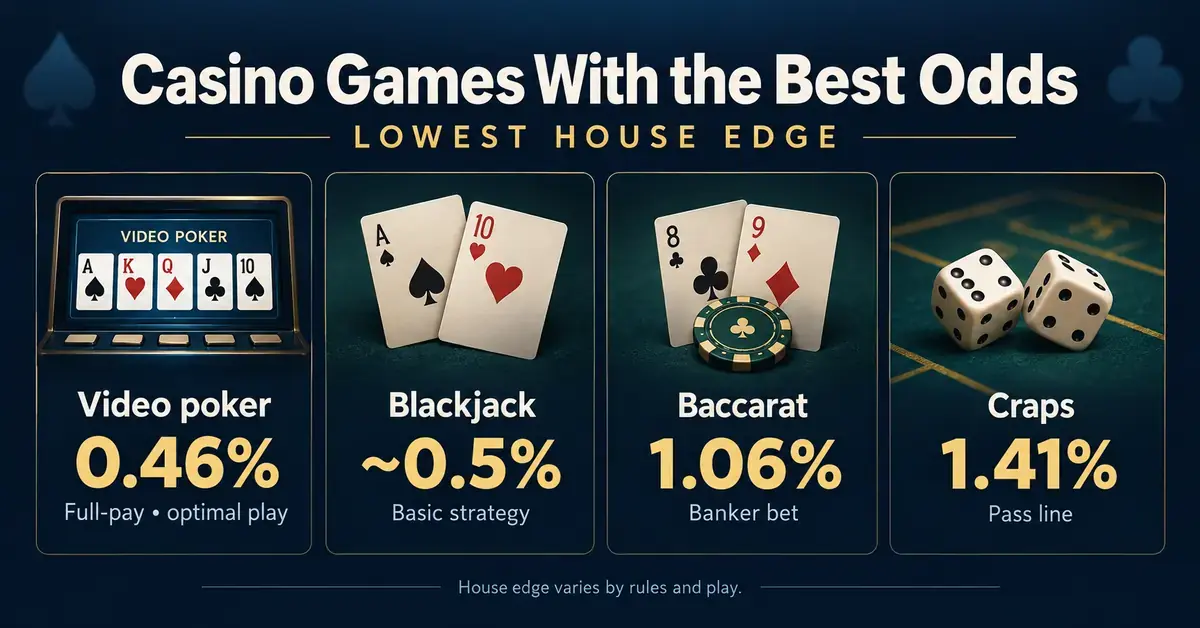
The casino games with the lowest house edge are blackjack and full-pay video poker, both close to half a percent, followed by baccarat’s banker bet at about 1.06% and craps’ pass line at 1.41%. “House edge” is simply the share of every bet a casino keeps on average over the long run, so a lower number means the game costs you less per dollar wagered over time. This guide ranks the main casino games by house edge, explains why each sits where it does, and points out the best and worst bets inside each game. It compares games only — it is not a guide to where to play, and no amount of strategy removes the edge entirely.
Key Points
- Blackjack has the lowest edge of any common casino game — about 0.5% with correct basic strategy (full-pay video poker is comparable at 0.46%).
- Baccarat’s banker bet (1.06%) and craps’ pass line (1.41%) are the best low-edge bets that need no strategy.
- Choose European roulette (2.70%) over American (5.26%) — the extra “00” pocket doubles the edge on the same game.
- Slots carry a wider, usually higher edge (about 2%–10%) and cannot be improved by skill.
- A low house edge lowers the long-run cost of play — it never guarantees a win in any single session.
What does “house edge” actually mean?
The house edge is the percentage of each wager the casino expects to keep, averaged over a very large number of plays. A 1% house edge means that, in theory, you lose one cent of every dollar you bet across thousands of rounds — not that you lose exactly 1% every session. It is the mirror image of return to player (RTP): a game with a 2.70% house edge has a 97.30% RTP.
Two things follow from this. First, the edge is a long-run average, not a prediction of any single session — short-term results swing well above and below it. Second, the edge is built into the payouts, so it applies whether you win or lose a given hand. For the full picture of how odds, payouts, RTP and variance fit together, see our explainer on how casino games work.
Which casino games have the lowest house edge?
Ranked from lowest to highest, blackjack and full-pay video poker lead, table games like baccarat and craps sit in the middle, and roulette and slots carry higher edges. The table below summarises the typical figures; the sections after it explain each game.
House Edge by Game
| Game / bet | Typical house edge | Notes |
|---|---|---|
| Video poker (9/6 Jacks or Better) | 0.46% | Full-pay machine, perfect play only |
| Blackjack (basic strategy, 3:2) | ~0.5% | Varies 0.3%–0.7% by rules; far worse on 6:5 tables |
| Baccarat — Banker | 1.06% | Includes the 5% commission; no skill needed |
| Craps — Don’t pass / don’t come | 1.36% | Odds bet behind it carries 0% edge |
| French roulette (even-money, la partage) | ~1.35% | Even-money bets only; not offered everywhere |
| Craps — Pass line / come | 1.41% | Taking odds lowers the combined edge |
| Baccarat — Player | 1.24% | Even money, no commission |
| European roulette (single zero) | 2.70% | 37 pockets |
| American roulette (double zero) | 5.26% | 38 pockets |
| Slots | ~2%–10% | RTP ~90%–98%; varies by machine |
| Baccarat — Tie | 14.36% | One of the worst bets on the floor |
| Keno | ~25%+ | Among the highest edges; varies by pay table |
Blackjack — about 0.5% with basic strategy
Blackjack has the lowest house edge of any common casino game when you play correctly, typically around 0.5%. That figure depends heavily on the table rules and on playing “basic strategy” — the mathematically optimal decision for every hand. Liberal rule sets can push the edge below 0.4%, while poor rules raise it well above 1%.
The single biggest rule to check is the payout for a natural blackjack: a 3:2 payout is standard, but a 6:5 payout adds roughly 1.4% to the house edge, wiping out blackjack’s advantage. Playing “by feel” instead of basic strategy also costs several extra percent. Learn the actions and payouts first in our guide to how to play blackjack.
Video poker — as low as 0.46% on full-pay machines
Full-pay “9/6” Jacks or Better video poker returns about 99.54% with perfect play, a house edge of just 0.46%. The “9/6” refers to the payouts for a full house (9x) and a flush (6x); short-pay versions reduce those payouts and raise the edge sharply — an 8/5 pay table is around 2.70%, and a 6/5 table about 5%.
Two conditions matter: you need to find a full-pay machine, which is far from guaranteed, and you need to make the mathematically correct hold on every hand. Miss either and the real-world edge climbs.
Baccarat — 1.06% on the banker bet
The banker bet in baccarat carries a 1.06% house edge, one of the lowest bets you can make with no skill or decisions required. The figure already includes the standard 5% commission casinos charge on winning banker bets. The player bet is close behind at 1.24%, and the tie bet is one of the worst wagers on the floor at 14.36% — it should be avoided despite its tempting payout.
Baccarat is almost entirely a game of chance: you simply bet on banker, player or tie, and the outcome is fixed by the rules of the draw. That makes the banker bet the easiest low-edge option for beginners. Baccarat sits alongside the other options covered in our overview of casino table games.
Craps — 1.41% on the pass line, and 0% on the odds bet
The pass line bet in craps has a 1.41% house edge, and the don’t pass bet is marginally lower at 1.36%. Craps is unusual because it offers the only true zero-edge wager in the casino: the “odds” bet placed behind a pass or don’t pass line pays true odds with no house advantage at all.
You cannot make the odds bet on its own — it must back a line bet — but adding it lowers the combined edge of your total wager. With single odds, the blended edge on a pass line bet falls to roughly 0.85%; with higher odds multiples it drops further. The many other bets on a craps table carry far higher edges, so the pass/don’t-pass line plus odds is the value play.
Roulette — 2.70% in Europe, 5.26% in America
European (single-zero) roulette has a 2.70% house edge, while American (double-zero) roulette nearly doubles it to 5.26%. The only difference is the extra “00” pocket on the American wheel — 38 pockets instead of 37 — which is why choosing a single-zero table is the simplest way to halve your cost on the same game.
French roulette can be lower still on even-money bets (red/black, odd/even). Rules called “la partage” or “en prison” return or hold half your even-money stake when the ball lands on zero, cutting the edge on those specific bets to about 1.35%. Those rules apply only to even-money bets and are not offered everywhere, so check the table before assuming the lower figure. See our full guide to how to play roulette for the bet types and payouts.
Slots — usually 2% to 10%, and you can’t tell by looking
Slot machines typically carry a house edge between about 2% and 10%, corresponding to RTPs of roughly 90% to 98%, though some games fall outside that range. Unlike table games, slots require no decisions and no skill, and the edge is fixed in the game’s design — there is nothing you can do to improve it.
The catch is transparency: online slots often publish their RTP, but you usually cannot see the exact figure on a physical machine, and higher-denomination machines tend to have lower edges than penny slots. Because the edge is baked into the random number generator, “hot” and “cold” streaks are just variance, not patterns you can exploit. Our guide to how slot machines work explains RTP and volatility in detail.
Which casino games have the worst odds?
The highest house edges belong to keno, big-wheel games and certain side and proposition bets, which can take 15% to 30% or more of every wager on average. Keno, for example, is commonly cited with a house edge in the region of 25% or higher depending on the pay table — many times worse than blackjack or baccarat.
Within otherwise low-edge games, specific bets can be traps. The baccarat tie bet (14.36%), most craps proposition bets, and slot or table “side bets” that promise big bonus payouts usually carry much higher edges than the main game. As a rule, the more a bet dangles a large jackpot-style payout, the higher its house edge tends to be.
Does a low house edge mean you’ll win?
No — a low house edge reduces how much a game costs you over time, but every game listed here still favours the casino, and none can be beaten by ordinary play. Over a long enough period, the math guarantees the house keeps its percentage. A 0.5% edge is cheaper entertainment than a 10% edge, but it is still an edge against you.
What a low edge does buy is playing time and smaller average losses for the same amount wagered. Short sessions are dominated by variance — the normal swings of luck — so you can win in the short run at any game and lose in the short run at the lowest-edge game. Treat the house edge as the long-run price of playing, not a forecast of tonight.
How to get the best odds at the games you play
The most reliable way to lower the edge is to pick the right game and the right bet within it, then play it correctly. The biggest, most controllable factors are:
- Learn basic strategy for blackjack. Correct play is the difference between roughly 0.5% and several percent.
- Insist on 3:2 blackjack and full-pay video poker. A 6:5 blackjack table or a short-pay machine quietly multiplies the edge.
- Bet banker in baccarat (1.06%) and avoid the tie (14.36%).
- Back the pass/don’t-pass line in craps and take the odds, which carry no house edge, instead of the flashy centre-table bets.
- Choose single-zero (European or French) roulette over American whenever you can.
- Skip most side bets. They almost always carry a far higher edge than the base game.
Common mistakes players make with house edge
The most common mistake is assuming a famous “low-edge” game is low-edge at every table — the rules and pay tables decide the real number. A 6:5 blackjack table, a no-commission baccarat variant that only pays half on a banker six, or a short-pay video poker machine can all turn a sub-1% game into a much worse bet without obvious warning.
Other frequent errors include:
- Chasing the tie, side and proposition bets because the payout looks big, ignoring the edge behind them.
- Believing a betting “system” changes the house edge. Systems rearrange when you bet, not the underlying math — the edge is unchanged.
- Reading a streak as a pattern. Each spin, roll or hand is independent; past results don’t shift future odds.
- Confusing RTP with a guarantee. A 96% RTP slot does not return 96 cents every spin; it is a long-run average with wide short-term swings.
- Forgetting that the lowest edge still loses over time. Low edge means cheaper play, not a winning plan.
Responsible gambling and disclaimer
This article is educational information about game mathematics only. It is not betting advice, and it does not suggest that any game, bet or strategy can be played at a profit over time — every game described here keeps a mathematical edge for the casino. In Canada you must be of legal gambling age in your province or territory (18 or 19 depending on where you live) to play.
If gambling is no longer fun, or you are worried about your own or someone else’s play, free, confidential help is available. In Ontario you can reach ConnexOntario any time at 1-866-531-2600. For deposit and time limits, self-exclusion options and a full list of provincial help lines, see our guide to responsible gambling in Canada.
Sources
Frequently Asked Questions (FAQ)
Which casino game has the lowest house edge?
Blackjack played with correct basic strategy has the lowest house edge of any common casino game, typically about 0.5% and sometimes lower depending on the rules. Full-pay 9/6 Jacks or Better video poker is comparable at 0.46% with perfect play. Both require learning the right decisions to reach those figures.
Is baccarat or blackjack better for odds?
Blackjack has a lower house edge (around 0.5%) than baccarat’s best bet (the banker at 1.06%), but only if you play basic strategy correctly. Baccarat’s banker bet reaches 1.06% with no skill or decisions at all, which makes it the easier low-edge choice for a complete beginner.
Why is European roulette better than American roulette?
European roulette has one zero and a 2.70% house edge, while American roulette adds a second “00” pocket, raising the edge to 5.26%. The games are otherwise identical, so playing a single-zero wheel roughly halves the cost of the same bets.
Do slot machines have a high house edge?
Slots usually carry a higher edge than the main table games — commonly 2% to 10%, equal to an RTP of about 90% to 98%, and sometimes outside that range. The edge is fixed in the game’s design, requires no skill, and cannot be improved by how or when you spin.
Does a low house edge mean I will win money?
No. A low house edge means a game costs you less on average over time, but every casino game still favours the house, and none can be beaten by normal play. Over the long run the casino keeps its percentage; short-term wins are variance, not an edge in your favour.
