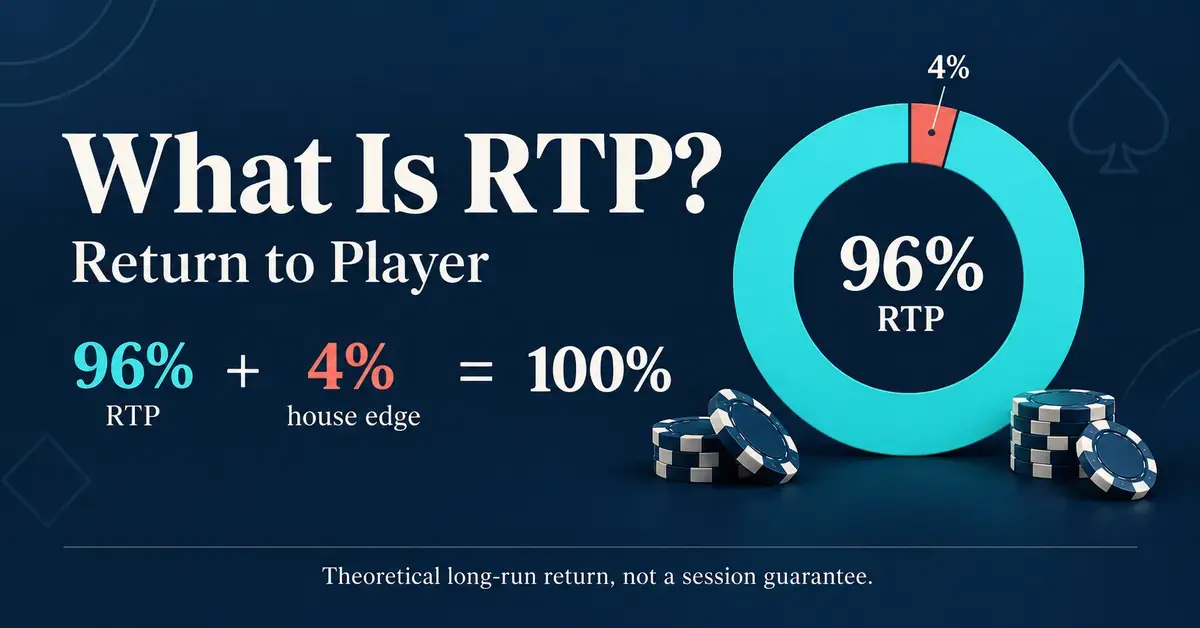
RTP stands for “return to player,” and it is one of the most useful numbers to understand before you play any casino game. It tells you, as a percentage, how much of all the money wagered on a game is designed to be paid back to players over the long run. A game with a 96% RTP is built to return about C$96 for every C$100 staked across millions of rounds, with the remaining C$4 kept by the operator. This guide explains what RTP really means, how it connects to the house edge, why your own results can look nothing like the headline figure, and how RTP compares across slots, table games and video poker.
Key Points
- RTP (return to player) is the percentage of total wagers a game is designed to pay back over the long run.
- RTP and the house edge always add up to 100% — a 96% RTP equals a 4% house edge.
- The figure is theoretical and long-run, based on millions of simulated rounds, not a prediction for your session.
- Short sessions swing far from the RTP in both directions because of volatility.
- Typical online slots return about 92%–98%; blackjack and video poker can exceed 99% with correct play.
What does RTP (return to player) mean?
RTP is the long-run percentage of total bets a casino game is designed to return to players. The key phrase is “total bets”: the figure is measured against every dollar wagered, not the amount you deposit. Because winnings are usually re-wagered, the same deposit cycles through the game many times, so the money actually at risk over a session is larger than your starting balance.
The number is a statistical average taken over a very large sample of rounds. On a 96% RTP game, the theoretical return is 96% of all wagers once you add up millions of plays. Over a single afternoon it tells you very little, which is the single most important thing to understand about it. If you want the wider picture of how these numbers fit together, our overview of how casino games work sets RTP alongside odds, payouts and variance.
How is RTP calculated?
RTP comes from the game’s own mathematics: the probability of each possible outcome multiplied by what that outcome pays, summed across every result. For a table game such as roulette the maths is exact and can be worked out on paper. For a modern slot with many symbols, paylines and bonus features, the developer runs the game through millions or even billions of simulated rounds to measure the average return the design produces.
That theoretical figure is then checked by independent testing laboratories before a game reaches a regulated market. In Ontario, for example, the Alcohol and Gaming Commission of Ontario (AGCO) requires that every internet-gaming game and its random number generator be certified by an approved independent test house before it goes live. The number you see in a game’s information screen is therefore a verified design specification, not a marketing estimate.
RTP vs house edge: two sides of the same coin
RTP and the house edge describe the same fact from opposite directions. The house edge is the share of wagers the operator expects to keep, and RTP is the share it expects to pay back. Add them together and you always get 100%.
- 96% RTP means a 4% house edge.
- 99.5% RTP means a 0.5% house edge.
- 94.74% RTP (American roulette) means a 5.26% house edge.
Thinking of RTP as the flip side of the house edge makes comparisons easy: a higher RTP is always a lower house edge, and vice versa. It also makes clear why no mainstream casino game reaches 100% RTP. The gap below 100% is exactly how the house makes money, which is why, over time, every game favours the operator.
A worked example: what 96% RTP actually means
Imagine a slot with a 96% RTP and 100 players who each spin C$1 a time. Suppose that, between them, they wager C$100,000 over an evening. The game is designed to return about C$96,000 of that in winnings and to keep roughly C$4,000.
The catch is that the C$96,000 is paid back as a mix of wins that get re-wagered. A player who starts with C$100 and keeps betting their returns will, on average, cycle that money through several times, so the 4% edge applies again to each new wager. That is why a 96% RTP does not mean you lose only 4% of your deposit in a night, and it is also why the house’s share grows the longer you play. The RTP is honest, but it describes the game, not your wallet.
Why your session rarely matches the RTP
RTP is theoretical and long-run, so a single session almost never lands on the stated figure. Over a handful of spins or hands, results swing far above or below the average in both directions. You can double your money on a 94% game or lose everything on a 98% one within an hour, and neither outcome contradicts the RTP.
The reason is volatility, sometimes called variance: how widely and how often a game’s results scatter around its average. Two games can share an identical 96% RTP while playing completely differently. A low-volatility game pays small wins frequently; a high-volatility game pays rarely but with larger prizes. The UK Gambling Commission puts it plainly in its own guidance: RTP is an average measured over a large number of games and will vary over a typical session because of normal game volatility. The headline percentage only emerges once the sample is huge.
RTP by game: a quick comparison
RTP varies widely between game types, and within table games it also depends on the rules and on playing correctly. The table below shows typical returns for the main casino games and the matching house edge. Table games such as blackjack and video poker can beat almost any slot on paper, while roulette depends heavily on whether the wheel has one zero or two.
RTP by Game
| Game | Typical RTP | House edge | Notes |
|---|---|---|---|
| Online slots | 92%–98% (often ~96%) | 2%–8% | Varies by title; shown in the game’s help screen |
| European roulette | 97.30% | 2.70% | Single-zero wheel |
| American roulette | 94.74% | 5.26% | Double-zero wheel |
| Baccarat (banker bet) | ~98.94% | 1.06% | After the standard 5% commission |
| Blackjack | ~99.5% | ~0.5% | With perfect basic strategy; casual play returns less |
| Video poker (9/6 Jacks or Better) | ~99.54% | ~0.46% | Full-pay table, max coins, optimal play |
The blackjack and video-poker figures assume near-perfect strategy; casual play returns less. Baccarat’s banker bet is close behind, which is one reason it features so often in guides to casino table games. Slots sit lower and span a wide band, so the published RTP matters more there than almost anywhere else.
What is RTP in slots?
In slots, RTP is the share of total wagers the machine is programmed to return over the long run, and it is usually the first statistic experienced players check. Online slots commonly run between about 92% and 98%, with many sitting around 96%. You can normally find a specific game’s figure in its information or help screen, often labelled “RTP” or “theoretical return to player.”
Two points matter most. First, RTP says nothing about volatility, so it will not tell you whether a slot pays little and often or rarely and big; that is a separate characteristic. Second, progressive-jackpot slots often advertise a lower base RTP because a slice of every bet feeds the jackpot pool, which is only returned when someone wins it. For the mechanics behind the figure, see our guide to how slot machines work.
RTP, hit frequency and volatility: don’t confuse them
RTP is only one of three numbers that shape how a game feels, and mixing them up leads to disappointment. Each answers a different question:
- RTP answers “how much is paid back overall?” It is a long-run average of returns against total wagers.
- Hit frequency answers “how often do I win anything?” A game can win on 25% of spins yet still have a modest RTP if most of those wins are small.
- Volatility (variance) answers “how big and how spread out are the swings?” High volatility means long dry spells punctuated by larger payouts; low volatility means steadier, smaller results.
A high-RTP game is not automatically a gentle one. A 97% slot with high volatility can take your balance to zero quickly while still being mathematically generous over the long run. Reading all three together gives a far more honest picture than RTP alone.
Common mistakes and misconceptions about RTP
The biggest mistake is treating a high RTP as a promise of winning. It is not. Here are the misreadings that trip players up most often:
- “A 97% RTP means I’ll get 97% of my money back tonight.” No. The figure applies across millions of rounds, not your session.
- “A game is due to pay out.” Each round is independent. RTP does not make a losing streak more likely to end, and a game does not “catch up” to its average on a schedule.
- “Higher RTP means more frequent wins.” That is hit frequency, a different measure. A high-RTP, high-volatility game can feel cold for a long time.
- “Every version of this game has the same RTP.” Operators sometimes offer different RTP configurations of the same title, and video-poker pay tables vary widely. Always check the specific game.
- “A good RTP justifies betting more.” Because the edge applies to every wager, betting more simply exposes more money to the same long-run loss.
How to find a game’s RTP, and who checks it
You can almost always find a game’s RTP in its rules, paytable or information screen inside the game itself. In regulated markets, publishing it is often required. UK gaming machines, for instance, must display the theoretical return to player, and the value must be verified by the manufacturer or an accredited test house.
Regulators focus on honesty and certification rather than guaranteeing a particular return. Neither the UK Gambling Commission nor the AGCO sets a fixed minimum RTP; instead they require that the figure be accurate, clearly available and independently tested. In practice that means the number you read is trustworthy as a description of the game’s long-run design, even though no regulator can promise what any individual player will take home.
A note on playing responsibly
RTP is an educational concept, not a strategy. Because every mainstream game has an RTP below 100%, the house wins over time and no return figure changes that. Treat any money wagered as the cost of entertainment, never as an investment, and never chase losses. If gambling stops feeling fun, Canadian players can find deposit limits, self-exclusion tools and help-line details on our responsible gambling page.
Sources
Frequently Asked Questions (FAQ)
What does RTP stand for?
RTP stands for “return to player.” It is the percentage of all money wagered on a game that the game is designed to pay back to players over the long run, expressed as a figure such as 96%.
Is a higher RTP always better?
A higher RTP means a lower house edge, so over a very large number of rounds it returns more of what is wagered. For a single session it guarantees nothing, because results swing widely around the average depending on the game’s volatility.
Does RTP tell me how much I’ll win?
No. RTP is a long-run theoretical average, not a prediction for your play. Short sessions can land far above or far below the stated percentage, and the figure describes the game rather than any individual result.
What is a good RTP for slots?
Online slots typically range from about 92% to 98%, with many around 96%. A figure at the higher end of that band means a smaller house edge, but it says nothing about how often or how large the wins are.
How is RTP different from the house edge?
They are the same fact stated two ways. RTP is the share of wagers paid back to players; the house edge is the share the operator keeps. The two always add up to 100%, so a 96% RTP equals a 4% house edge.
