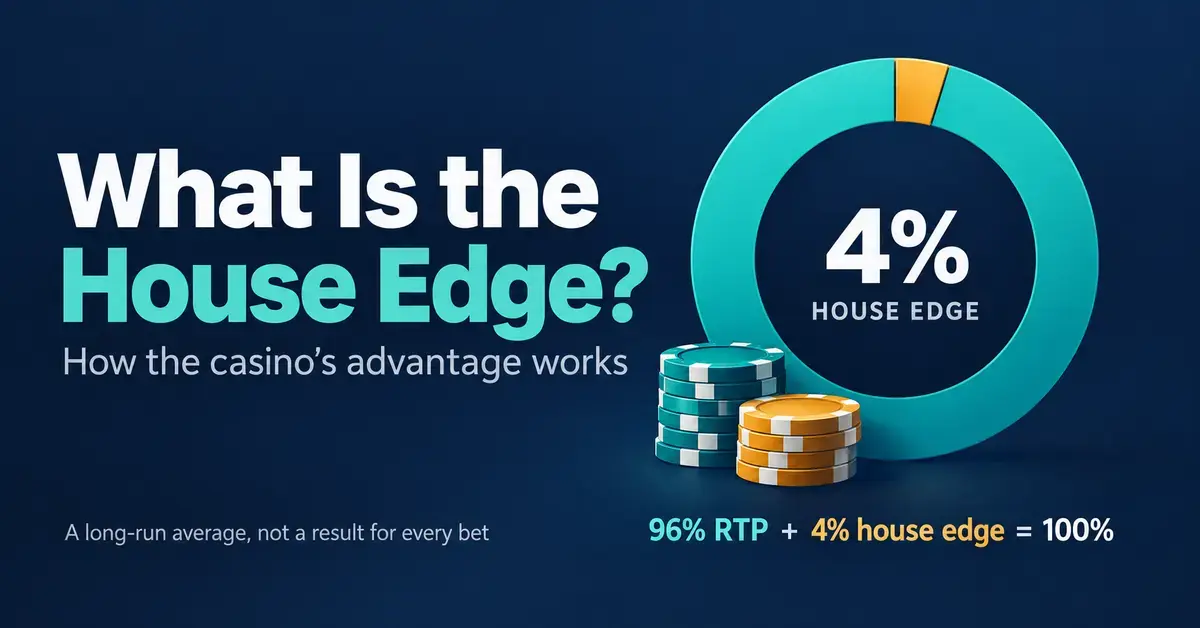
The house edge is the built-in mathematical advantage a casino holds on every bet — the small percentage of each wager it expects to keep over the long run. It is the single most important number in casino gambling, because it explains why the house comes out ahead over time no matter how any one session turns out. This guide defines the house edge in plain terms, shows the formula with fully worked examples, and compares the edge across the major casino games so you can see exactly what you are up against.
Key Points
- The house edge is the casino’s built-in long-run advantage — the percentage of each bet it expects to keep on average.
- It is calculated as the negative expected value of a bet divided by the stake: for an American roulette single number, that is 2/38 = 5.26%.
- House edge + RTP = 100%. A 96% RTP is a 4% house edge; they are the same number from opposite sides.
- The edge is a long-run average, not a per-bet result — players still win in the short term because of variance.
- Your expected loss = total wagered × house edge, so betting more or faster costs more even at the same percentage.
- Lowest edges: blackjack (~0.5%), baccarat banker (1.06%), craps pass line (1.41%). Highest: keno (25%-29%) and many slots.
What is the house edge?
The house edge is the average amount a casino expects to win from a bet, expressed as a percentage of the original stake. Formally, it is the ratio of a player’s average loss to the initial bet. If a game has a 5% house edge, the casino expects to keep about $5 of every $100 wagered on that game over a very large number of bets.
Two points matter from the start. First, the edge is an average over the long run, not a prediction for any single bet or session — individual players win and lose all the time. Second, the edge is baked into the payouts and the rules of the game, not into any single spin, deal or roll. The casino does not need to cheat; the maths does the work. For a wider view of how these numbers fit together, see our overview of how casino games work.
How does the house edge work?
The house edge works by paying winners slightly less than the true odds of their bet. In a perfectly fair game, the payout would exactly match the probability of winning, and neither side would have an advantage. Casinos shorten those payouts just enough to tilt the long-run result in their favour.
A single-number bet in American roulette is the clearest example. The wheel has 38 pockets, so the true odds of hitting your number are 1 in 38. A fair payout would be 37 to 1. The casino pays 35 to 1 instead. That small gap — two units withheld across 38 possible outcomes — is the entire house edge. You still win the bet roughly 1 time in 38; you are simply paid a little less than the odds justify when you do.
Because the edge lives in the payout structure, it applies automatically to every bet. The casino does not win every round, and it does not need to. It only needs the average outcome of millions of bets to land on its side, which the arithmetic guarantees.
How is the house edge calculated?
The house edge is calculated as the negative of a bet’s expected value, divided by the stake, written as a percentage. Expected value (EV) is what you would win or lose per bet on average if you could repeat it endlessly. To find it, multiply each possible outcome by its probability and add the results:
- Expected value = (probability of winning × amount won) − (probability of losing × amount lost)
- House edge = −Expected value ÷ stake, shown as a percentage
A positive expected value would favour the player; in casino games it is always negative, and the house edge is simply how negative it is. The worked examples below show the calculation three ways.
Worked example 1: American roulette, single number
You bet $1 on one number. There are 38 pockets, so you win 1 time in 38 and lose 37 times in 38. A win pays 35 to 1, meaning you keep your $1 and gain $35.
- EV = (1/38 × +$35) + (37/38 × −$1)
- EV = ($0.921) − ($0.974) = −$0.0526
- House edge = 5.26%
Over time, the casino expects to keep about 5.26 cents of every dollar bet on a double-zero wheel.
Worked example 2: European roulette, single number
The same bet on a European wheel shows how rules change the edge. This wheel has only 37 pockets — one zero instead of two — but still pays 35 to 1.
- EV = (1/37 × +$35) + (36/37 × −$1)
- EV = ($0.946) − ($0.973) = −$0.027
- House edge = 2.70%
Removing a single pocket almost halves the edge. That is why the European (single-zero) wheel is the better bet whenever you can find one, a point we cover in our guide to how to play roulette.
Worked example 3: an even-money bet
The edge is not limited to long-shot bets. On an American wheel, a $1 bet on red wins if any of 18 red pockets lands and pays 1 to 1 (even money). You lose on the other 20 pockets, including the two green zeros.
- EV = (18/38 × +$1) + (20/38 × −$1)
- EV = ($0.474) − ($0.526) = −$0.0526
- House edge = 5.26%
Every standard bet on a double-zero wheel carries the same 5.26% edge, because the two green pockets sit outside all of them. A fair coin flip, by contrast, has a 0% edge: a 50/50 chance paid at 1 to 1 has an expected value of exactly zero.
House edge vs RTP: what is the difference?
House edge and return to player (RTP) are two names for the same thing viewed from opposite sides, and they always add up to 100%. RTP is the share of total wagers a game is expected to pay back to players over the long run; the house edge is the share the casino keeps. A slot with a 96% RTP has a 4% house edge; a game with a 2.70% edge has a 97.30% RTP.
The only real difference is convention. Slots and video poker are usually advertised by RTP, because a high “return” number looks appealing. Table games are usually described by house edge. The maths is identical:
- RTP = 100% − house edge
- House edge = 100% − RTP
One caution: RTP is measured against total amount wagered (turnover), not the money you deposit. If you bet $1 a spin for 500 spins, you have wagered $500 of turnover even if you started with $50, because winnings are recycled back into new bets.
House edge vs the odds of winning
A low house edge does not mean you win often, and a high one does not mean you win rarely — the two measure different things. The odds of winning describe how frequently a bet pays off. The house edge describes how much the casino keeps on average once payouts are accounted for.
A single-number roulette bet wins only about 2.6% of the time yet, on a European wheel, carries a modest 2.70% edge. An even-money red/black bet on an American wheel wins nearly half the time but carries a larger 5.26% edge. Frequent small wins can disguise a steep edge, while a rare-but-fair-ish payout can hide a gentle one. Always check the edge, not just how often the bet lands.
What is the house edge for each casino game?
The house edge varies widely by game and even by the specific bet within a game. The table below lists the edge for the main casino games under typical rules, with the matching RTP. Figures come from standard references; actual numbers shift with table rules, pay tables and the specific machine.
House Edge by Game
| Game / bet | House edge | Approx. RTP | Notes |
|---|---|---|---|
| Blackjack (correct basic strategy) | ~0.5% (as low as 0.28%) | ~99.5% | Depends on table rules; worsens without strategy |
| Craps — pass / come line | 1.41% | 98.59% | Backing it with free odds (0% edge) lowers the combined edge |
| Baccarat — banker | 1.06% | 98.94% | Best bet in the game (before commission adjustments) |
| Baccarat — player | 1.24% | 98.76% | Slightly worse than banker |
| Baccarat — tie | 14.36% | 85.64% | Long-shot bet; avoid |
| Roulette — European (single zero) | 2.70% | 97.30% | Same on all standard bets |
| Roulette — American (double zero) | 5.26% | 94.74% | Extra green pocket nearly doubles the edge |
| Slot machines | ~2%-15% (often 4%-8%) | ~85%-98% | Varies by machine, provider and jurisdiction |
| Keno | ~25%-29% | ~71%-75% | Among the highest edges in the casino |
Two patterns stand out. Skill-based games played correctly (blackjack, some video poker, the craps pass line with odds) sit at the low end. Pure-luck games with long-shot payouts (keno, the baccarat tie, many slots) sit at the high end. For the game-by-game breakdown of the lower-edge table options, see our guide to casino table games.
Does the house edge mean I will always lose?
No — the house edge is a long-run average, not a guarantee for any single session. Over a few bets, randomness (often called variance) dominates, and players win all the time. The edge only asserts itself reliably over thousands or millions of bets, which is why the casino, not the player, is the one who sees the long run.
Think of it this way: the house edge is the direction the water flows, while variance is the waves on top. On any given day you might ride a wave up. Keep playing, though, and your results drift toward the expected loss the edge predicts. No betting pattern, “system” or lucky streak changes the underlying percentage, because each bet’s odds are fixed and independent of the last.
How much does the house edge actually cost?
Your expected loss equals the total amount you wager multiplied by the house edge — not the amount you bring to the table. This is the figure that matters for a budget, and it is driven as much by how much you bet as by the edge itself.
Compare an evening of American roulette at a 5.26% edge with one of blackjack at a 0.5% edge, both at 60 bets an hour of $10 each ($600 wagered per hour):
- American roulette: $600 × 5.26% = about $32 expected loss per hour
- Blackjack with correct play: $600 × 0.5% = about $3 expected loss per hour
Same stakes, same number of bets, a roughly tenfold difference in cost — purely from the edge. Betting faster, or at higher stakes, raises the turnover and therefore the expected loss even when the percentage stays the same.
Common misconceptions about the house edge
Several widespread beliefs about the house edge are simply wrong, and they cost players money. Clearing them up is the practical payoff of understanding the maths.
- “A machine is due to pay out.” Results are independent. A slot or wheel has no memory, so past outcomes do not change the next one. The edge applies to every bet identically.
- “A betting system beats the edge.” Progressions such as the Martingale rearrange when you win and lose but never change the percentage the house keeps. Over time the edge still applies to every dollar wagered.
- “Low house edge means I will win.” A low edge means you lose less slowly on average. It is still a loss over the long run, not a profit.
- “House edge is the chance I lose each bet.” It is not a per-bet win probability. A 1.41% edge does not mean you lose 1.41% of bets; it means the casino keeps about 1.41% of everything wagered on average.
- “Demo or free play improves my odds.” Playing for fun or for real money does not change a game’s house edge. Nothing a player does to a fixed-odds game alters its built-in percentage.
Which casino games have the lowest house edge?
Blackjack played with correct basic strategy has the lowest house edge of the common games — often around 0.5%, and as low as about 0.28% under liberal rules. Several other games sit well under 2% when you stick to their best bets:
- Blackjack: roughly 0.5% with correct blackjack play; higher if you deviate from basic strategy.
- Baccarat: 1.06% on the banker bet, the best bet in the game; avoid the 14.36% tie.
- Craps: 1.41% on the pass line, and the free-odds bet behind it carries a 0% edge because it pays true odds — though it still wins or loses like any wager.
- European roulette: 2.70% on every standard bet, versus 5.26% on the American double-zero wheel.
At the opposite end, keno (around 25%-29%) and many slot games (commonly 4%-8%, and higher on some machines) carry the steepest edges. Choosing a lower-edge game and learning its correct strategy is the only legitimate way to reduce the house’s long-run advantage — you cannot remove it. Slot returns in particular vary by machine and jurisdiction; our guide to how slot machines work explains how RTP is set and where to find it.
A note on responsible play
Because every casino game carries a house edge, the long-run expected result of casino play is a loss, and no game, bet or system changes that. Treat gambling as paid entertainment with a cost, never as a way to make money, and only wager what you can afford to lose. In Canada you must be of legal gambling age (18 or 19 depending on the province). If gambling stops being fun, free confidential help and self-exclusion tools are available — see our page on responsible gambling in Canada.
Sources
Frequently Asked Questions (FAQ)
What does a 5% house edge mean?
A 5% house edge means the casino expects to keep about $5 of every $100 wagered on that game over the long run. It is a long-term average across many bets, not the amount you lose on any single bet or in any one session.
Is the house edge the same as the odds of winning?
No. The odds of winning describe how often a bet pays off, while the house edge describes how much the casino keeps on average after payouts. A bet can win frequently and still carry a high edge, or win rarely and carry a low one, so the two numbers must be read separately.
How is house edge related to RTP?
House edge and return to player (RTP) always add up to 100%. RTP is the share of wagers a game pays back over time; the house edge is the share it keeps. A 96% RTP equals a 4% house edge — the same figure described from the player’s side instead of the casino’s.
Can you beat the house edge?
For standard casino games played as designed, no — the edge is fixed in the payouts and no betting system changes it. You can only reduce it by choosing lower-edge games and using correct strategy. Short-term wins happen because of variance, but they do not overcome the long-run edge.
Which casino game has the lowest house edge?
Blackjack with correct basic strategy usually has the lowest edge, often around 0.5% and as low as about 0.28% under liberal rules. Baccarat’s banker bet (1.06%) and the craps pass line with free odds are also among the lowest-edge options.
