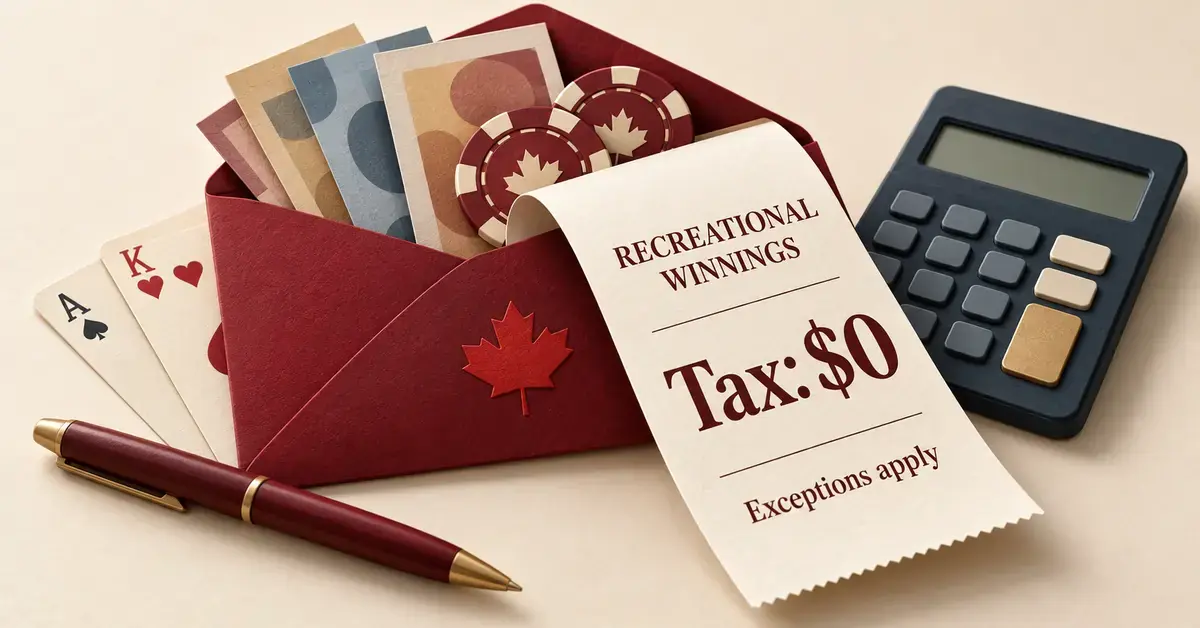
In almost all cases, gambling winnings are not taxable in Canada. If you win money on a lottery ticket, a slot machine, a hand of blackjack, a sports bet or a bingo card as a recreational player, the Canada Revenue Agency (CRA) treats that money as a windfall rather than income, and you keep every dollar. There is no “gambling tax” to pay and nothing to report. That said, a few specific situations do attract tax — most notably gambling carried on as a business, any investment income you earn on your winnings, and money won in the United States. This guide explains the general rule, why it exists, and exactly where the exceptions kick in.
Key Points
- Recreational winnings are tax-free. Lottery, casino, sports betting, poker and bingo wins are windfalls, not income, so the CRA does not tax them.
- Nothing to report or withhold. Canadian casinos and lotteries pay out in full; there is no line for winnings on your T1 return.
- Professional gamblers are the exception. If gambling is run as a business, winnings are taxable income (and losses become deductible).
- Investment income is taxable. Interest, dividends or capital gains earned after you invest winnings must be reported.
- US winnings are different. The IRS withholds 30% on many payouts, but Canadians can often reclaim it via Form 1040-NR under the tax treaty.
The short answer: are gambling winnings taxable in Canada?
No — for the vast majority of Canadians, gambling winnings are tax-free. The Income Tax Act taxes income that comes from a recognised “source” such as employment, business or property. A one-off win based on luck does not fit any of those categories, so the CRA classifies it as a windfall and does not tax it. This applies whether you win $20 on a scratch card or a multi-million-dollar lottery jackpot.
Because the winnings are not income, you do not enter them anywhere on your T1 personal tax return, and you do not need to keep receipts to prove them. The CRA’s own guidance on amounts that are not taxed lists most lottery and gambling winnings as non-taxable. This treatment is one reason gambling is regulated the way it is across the country — if you want the wider legal picture, see our guide to gambling laws in Canada.
Why doesn’t Canada tax most gambling winnings?
Canada does not tax most gambling winnings because the law treats them as windfalls, and a windfall is not income from a source. Courts and the CRA look at a set of factors — drawn from case law such as The Queen v. Cranswick — to decide whether a receipt is a non-taxable windfall. A payment tends to be a windfall when:
- the person had no enforceable right to receive it;
- they made no organised effort to obtain it;
- it was not sought after or solicited as part of a business;
- it was unexpected and unlikely to recur regularly; and
- it was not consideration for a service or property the person supplied.
A casual bet or lottery ticket ticks these boxes: the outcome is pure chance, you have no legal claim to the prize before you win, and the win is a one-off piece of luck rather than the product of a trade or business. A separate provision of the Income Tax Act, paragraph 40(2)(f), also deems any gain or loss on disposing of a chance to win a prize (or the right to a prize) to be nil — so there is no capital gain to tax either. Put simply, the money falls outside the tax system entirely.
Which gambling winnings are tax-free?
Virtually every form of recreational gambling in Canada produces tax-free winnings. For a casual player, none of the following are taxed:
- Lottery winnings — Lotto 6/49, Lotto Max, provincial lotteries, raffles and 50/50 draws. You receive the full advertised jackpot with nothing withheld.
- Casino games — slots, blackjack, roulette, baccarat, craps and other table games, whether in a land-based casino or on a regulated Canadian online casino.
- Sports betting — single-event and parlay wagers through provincial or licensed operators.
- Poker — winnings from recreational cash games and tournaments.
- Bingo, keno and scratch tickets.
- Prizes won purely by chance, such as a radio call-in draw, where you did nothing to earn the prize beyond entering.
The common thread is that the win is luck-based and recreational. To understand how the odds and payouts behind these games actually work, see our explainer on how casino games work. Being old enough to play legally matters too — check the legal gambling age in your province before you wager.
When are gambling winnings taxable in Canada?
Gambling winnings become taxable in three main situations: when gambling is carried on as a business, when you earn investment income on money you have won, and when a prize is really a form of employment or promotional pay. Each one is narrow, but each is real.
Quick Facts
| Situation | Taxable in Canada? |
|---|---|
| Recreational casino winnings | No |
| Lottery / raffle winnings | No |
| Recreational sports bets & poker | No |
| Online winnings (regulated Canadian sites) | No |
| Gambling carried on as a business | Yes — business income (T2125) |
| Interest / dividends / gains on invested winnings | Yes |
| Winnings at a US casino | No Canadian tax (30% US withholding may apply) |
1. Professional or business gambling
If the CRA decides you are carrying on gambling as a business, your net winnings become taxable business income. This is the most important exception and the one most likely to surprise people. A “professional gambler” in tax terms is someone whose gambling is systematic, skill-based and organised enough to look like a commercial operation rather than a hobby. When that line is crossed, the winnings are taxed as income — but the person can then also deduct gambling losses and expenses against them, and must report everything on form T2125 (Statement of Business or Professional Activities).
This is settled law. In Fournier-Giguere v. Canada (2025 FCA 112), the Federal Court of Appeal upheld findings that full-time poker players’ earnings were taxable business income rather than windfalls, and the Supreme Court of Canada declined to hear a further appeal in June 2026. The courts focused on how the players operated — devoting almost all of their waking time to poker and treating it as their livelihood — not on any magic dollar figure.
2. Investment income earned on your winnings
The prize itself is tax-free, but any income it later generates is taxable. If you deposit a $1-million lottery win in a savings account, the interest it earns is taxable investment income. The same applies to dividends from shares you buy with the money, rental income from a property you purchase, or a capital gain when you sell an investment bought with winnings for more than you paid. You report that income normally — only the original win escapes tax.
3. Employment-linked or promotional prizes
A “prize” that is really payment for work or a business activity can be taxable. Examples include a cash award from your employer (a taxable employment benefit) or winnings from a contest tied to achievement in a field you work in professionally. The test again is whether the money is a genuine windfall or compensation for something you did.
How does the CRA decide if you are a professional gambler?
The CRA weighs how you gamble, not how much you win, to decide whether gambling is a business. There is no income threshold that automatically makes you a professional, and winning a large jackpot once does not make you one. Instead, the CRA and the courts look at factors such as:
- Time and commitment — whether you gamble full-time and treat it as your main occupation;
- Skill and system — whether success depends on genuine expertise and a methodical approach rather than luck (poker and sports betting draw more scrutiny than slots or lotteries, which are chance-only);
- Intention to profit — whether you pursue gambling in a businesslike way with the aim of making a living;
- Reliance on winnings — whether gambling is your primary source of income;
- Record-keeping — whether you track results like a business would.
Each tax year is assessed on its own facts. In practice, the overwhelming majority of Canadians — including regular recreational players who happen to be good at a game — are not considered professionals, and their winnings stay tax-free. This is a genuinely grey area, so anyone whose gambling might approach a business should get advice from a tax professional.
Do you pay tax on winnings from US casinos?
Yes — the United States taxes gambling winnings even for visitors, so a Canadian who wins at a US casino usually has tax withheld on the spot. The Internal Revenue Service (IRS) applies a flat 30% withholding to many types of gambling payout for non-residents. Common triggers include slot or bingo wins of US$1,200 or more and certain keno and poker-tournament prizes. The casino issues a Form 1042-S showing the amount won and the tax withheld.
The good news is that Canadians can often recover some or all of that 30% because of the Canada-US tax treaty:
- Offsetting losses. Under Article XXII of the treaty, residents of Canada may deduct US gambling losses against US gambling winnings for the same year. You file a US non-resident return (Form 1040-NR), report the winnings and losses, and claim a refund of the tax withheld on your net result. You need proof of losses, such as wager records or statements.
- Table games. Winnings from blackjack, baccarat, craps, roulette and the big-6 wheel are treated differently, and the withholding on them can generally be recovered even without documented losses.
- An ITIN. To file, you usually need a US Individual Taxpayer Identification Number, obtained with Form W-7 submitted alongside your return.
Note that recovering the US tax does not create a Canadian tax bill — the winnings remain tax-free in Canada. The US rules are separate, and the refund process is a US filing. Game-show and some contest winnings are treated less favourably and may not be recoverable, so it is worth confirming how a payout was categorised on the 1042-S.
Do you have to report gambling winnings on your tax return?
Recreational gamblers do not report their winnings to the CRA at all. Because the money is a non-taxable windfall, there is no line for it on your T1 return and no slip to file. You only have reporting obligations if:
- you earn investment income on winnings you have invested — report that interest, dividend or capital-gain income;
- the CRA considers you a professional/business gambler — report net winnings on form T2125; or
- you are recovering US withholding tax — that is a US filing (Form 1040-NR), not a Canadian one.
Common mistakes and misconceptions
Most confusion about gambling taxes in Canada comes from a handful of myths. Clearing them up:
- “Big jackpots are taxed, small wins aren’t.” Size makes no difference for a recreational player. A $10-million lottery jackpot is just as tax-free as a $10 scratch-card win.
- “The casino withholds tax from my winnings.” Canadian casinos and lotteries do not withhold tax from winnings. The 30% withholding only applies in the United States.
- “I can deduct my gambling losses.” Recreational players cannot deduct losses, because their winnings are not taxed in the first place. Only someone taxed as a business gambler can offset losses — against taxable winnings.
- “Online winnings are taxed differently.” They are not. Winnings from a regulated Canadian online casino are treated the same as land-based winnings — tax-free for recreational players.
- “Being a skilled, frequent player automatically makes me a professional.” Skill and frequency are factors, but the CRA looks at the whole picture; most serious hobbyists are not classed as businesses.
- “Winnings count as income, so they affect my benefits.” Tax-free winnings are not employment or business income, though very large amounts sitting in accounts can indirectly affect income-tested benefits through the investment income they generate.
Disclaimer
This article explains how Canadian tax rules generally apply to gambling winnings. It is for general information only and is not tax, legal or financial advice. Tax outcomes depend on your individual circumstances, and the line between recreational and business gambling is a matter of judgement — consult the Canada Revenue Agency or a qualified tax professional before acting on anything here. Gambling should be entertainment, never a way to make money, and winnings are never guaranteed. If gambling is becoming a problem, free and confidential support is available: see our guide on where to get help and our overview of responsible gambling tools in Canada.
Sources
- Canada Revenue Agency — Amounts that are not taxed
- Income Tax Act, paragraph 40(2)(f) (Justice Laws Website)
- Fournier-Giguere v. Canada, 2025 FCA 112 — professional poker winnings as business income
- TaxTips.ca — US gambling taxes and recovering withholding
- IRS Publication 519 — US Tax Guide for Aliens
- Department of Finance Canada — Canada-US tax treaty (Article XXII)
Vanliga frågor (FAQ)
Do I have to pay tax on casino winnings in Canada?
No. For recreational players, casino winnings — slots, blackjack, roulette, baccarat and the rest — are treated as tax-free windfalls, whether you win in a land-based casino or on a regulated Canadian online casino. You keep the full amount and report nothing.
Are lottery winnings taxed in Canada?
No. Canadian lottery winnings, including Lotto Max and Lotto 6/49, are not taxable. You receive the full advertised prize with nothing withheld. Only the investment income you later earn on that money — interest or dividends, for example — is taxable.
Do professional poker players pay tax in Canada?
Yes, if the CRA considers their play a business. When gambling is systematic, skill-based and relied on as a livelihood, winnings become taxable business income reported on form T2125, and losses can be deducted. The 2025 Federal Court of Appeal decision in Fournier-Giguere confirmed this for full-time poker players.
Do I pay tax on winnings from a US casino?
The US generally withholds 30% from larger gambling payouts to non-residents, reported on Form 1042-S. Canadians can often recover some or all of it by filing a US return (Form 1040-NR) and offsetting US gambling losses under the Canada-US tax treaty. The winnings stay tax-free in Canada.
Do I need to report gambling winnings to the CRA?
Not as a recreational player — there is no line for tax-free winnings on your return. You only report income if you earn investment income on winnings, or if you are taxed as a business gambler. Recovering US withholding is a separate US filing.
