A casino bonus almost never arrives as free cash you can simply cash out. Attached to it is a wagering requirement — the fine print that decides how much you have to bet before any bonus money, and the winnings it produces, turn into real, withdrawable cash. Wagering requirements are the most misunderstood part of any casino promotion, and misreading them is the usual reason a “winning” bonus ends up worth nothing. This guide explains what wagering requirements are, how the playthrough maths actually works, why not every bet counts the same, and the other bonus terms that quietly decide whether an offer is worth taking.
Key Points
- A wagering requirement (also called playthrough or turnover) is how many times you must bet bonus funds before you can withdraw any winnings.
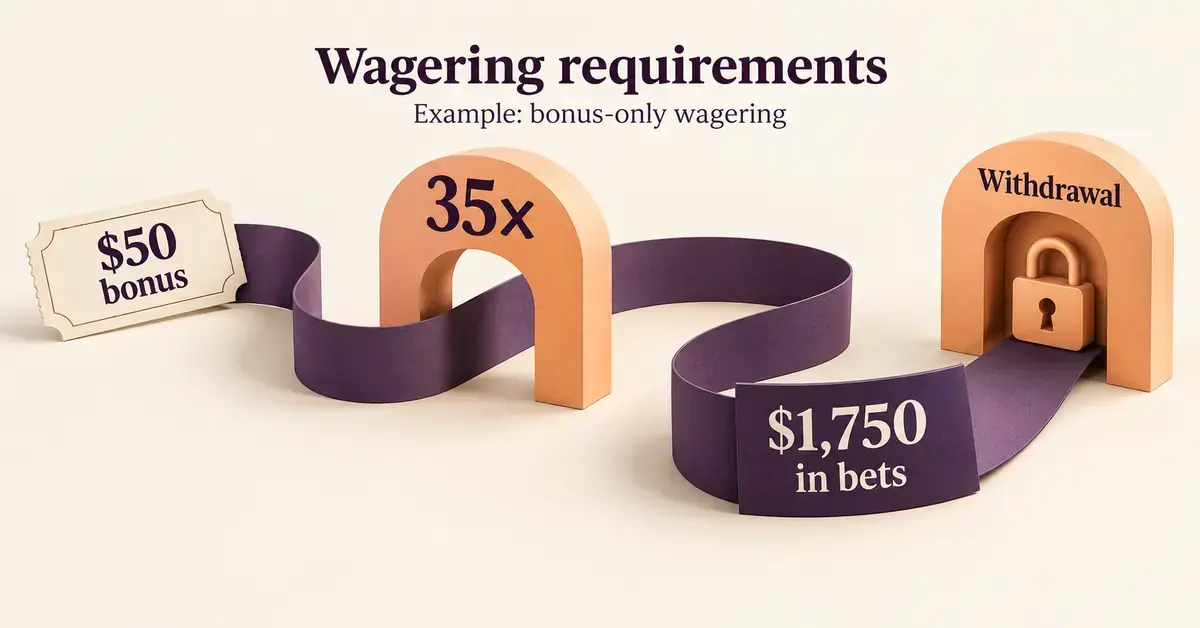
- It is written as a multiplier: a $50 bonus at 35x means $1,750 in total bets.
- Always check the base — the multiplier may apply to the bonus only, or to the deposit plus bonus, which can double the target.
- Game weighting means not every bet counts the same: slots often count 100%, while blackjack or roulette may count 10% or less.
- Max-bet caps, time limits, restricted games and maximum-cashout rules can all void a bonus if broken.
- Because every bet carries the house edge, clearing a large playthrough often costs more than the bonus is worth.
What is a wagering requirement?
A wagering requirement is the number of times you must bet an amount of bonus money before you are allowed to withdraw any winnings tied to it. It is also called a playthrough or a turnover requirement, and all three words mean the same thing. The casino offers the bonus as an incentive; the wagering requirement is the condition that stops you from taking the money straight to the cashier.
The requirement is written as a multiplier, such as “35x” or “40x wagering”. That number tells you how many times the relevant amount has to be staked in total — not on one bet, but added up across as many bets as it takes. The bets can win or lose along the way; what matters to the casino is the total amount you have cycled through the games, known as your turnover.
For example, a $50 bonus with a 35x requirement means you must place $1,750 in total bets (35 × $50) before the bonus and anything you won with it can be withdrawn. Until you reach that figure, the balance is usually marked as “bonus” or “locked” funds that cannot leave your account.
How are wagering requirements calculated?
The core calculation is a single multiplication: the amount the requirement applies to, times the multiplier. The hard part is knowing which amount the casino means, because that choice can double the real target.
Bonus-only versus deposit-plus-bonus
There are two common bases for the calculation, and the terms will state which one applies:
- Bonus only: the multiplier applies to the bonus amount. A $100 bonus at 30x means $3,000 in total bets.
- Deposit plus bonus: the multiplier applies to your deposit and the bonus combined. If you deposit $100 and get a $100 bonus at 30x, the base is $200, so the target is $6,000 — double the first case for the same headline number.
This single detail is where most people miscalculate. UK regulatory research found that about seven in ten people could not work out how much they would need to bet to meet a wagering requirement, and that figure rose to nearly nine in ten when the requirement applied to the deposit and bonus together. The headline “30x” looks identical in both offers; the real commitment is not.
A worked example
Say you deposit $200 and claim a 100% match, giving you a $200 bonus and a $400 balance, with 35x wagering on the bonus only:
- Base amount: $200 (the bonus).
- Total bets required: 35 × $200 = $7,000.
- You must cycle $7,000 of bets through eligible games before withdrawing.
If the same 35x applied to deposit plus bonus ($400), the target would jump to $14,000. Reading that one line of terms is the difference between a reasonable offer and an almost impossible one.
Game weighting: why not every bet counts the same
Game weighting means each type of game contributes a different percentage of your bets toward the wagering requirement. A dollar wagered on one game may clear a full dollar of the requirement, while a dollar on another clears only ten cents — or nothing at all. Casinos use weighting to protect themselves on low-house-edge games, because a player could otherwise clear a bonus cheaply on a game where the casino barely has an advantage.
Slots almost always count 100%, which is why bonuses are usually built around them. Table games with a low house edge, such as blackjack, baccarat and sometimes roulette, often count 10% or less, and some games are excluded entirely. The exact percentages vary by operator, so the contribution table in the specific bonus terms is the only figure that counts; the values below are typical examples, not fixed rules.
Typical Game Weighting
| Game type | Typical contribution | What a $10 bet clears |
|---|---|---|
| Slots | 100% | $10 |
| Keno / scratchcards | often 100% | $10 |
| Video poker | 10–20% | $1–$2 |
| Roulette | often 10% (up to 50%) | $1–$5 |
| Craps / other table games | 0–10% | $0–$1 |
| Baccarat | 0–10% | $0–$1 |
| Blackjack | 0–10% | $0–$1 |
| Live dealer games | often 10% or 0% | $0–$1 |
Contribution rates are illustrative and vary by operator; the table in the specific bonus terms is the one that applies.
The practical effect is large. If blackjack counts at 10% and you bet $10 a hand, only $1 goes toward the requirement, so a $3,000 playthrough would take $30,000 of blackjack bets. The same $3,000 on slots that count fully takes $3,000 of spins. Playing a low-weighting game to “clear a bonus faster” is a common and costly mistake — it is far slower, and on some games it does not count at all.
The other bonus terms that matter
The playthrough multiplier is only one line of the terms. Several other conditions can slow you down or void the bonus completely, and they are just as important to read.
Maximum bet rule
While a bonus is active, casinos usually cap how much you can stake on a single bet or spin — a figure such as $5 is common. Place one bet above the cap, even by accident, and many operators will void the bonus and any winnings from it. This is one of the most frequent reasons players lose a cleared or nearly cleared bonus.
Time limit
Bonuses expire. Free-spin offers can lapse within 24 hours, while larger welcome packages often run 7 to 30 days. Any part of the requirement you have not completed when the clock runs out is forfeited, along with the related bonus and winnings.
Restricted and excluded games
Some games cannot be played at all while a bonus is active, and others do not contribute to the requirement. Playing an excluded game can breach the terms even if you did not realise it was off-limits.
Maximum cashout
No-deposit bonuses and free spins frequently cap how much you can withdraw from your winnings — for instance, a limit of $50 to $100 regardless of how much you actually won. Anything above the cap is removed when you withdraw.
Sticky versus non-sticky bonuses
A non-sticky (or “parachute”) bonus keeps your deposit and the bonus separate, so you can withdraw your own money at any time and only the bonus is subject to wagering. A sticky bonus merges the two: the bonus amount itself is never withdrawable — it only funds your play — and you can withdraw only what you win on top of it after clearing the requirement. Non-sticky terms are far more player-friendly, and the difference is rarely stated in the headline.
What does clearing a bonus really cost?
Every bet you place to clear a wagering requirement is exposed to the game’s house edge, so the turnover has an expected cost that can rival or exceed the bonus itself. The house edge is the casino’s built-in long-run advantage on each wager, and it applies to bonus play exactly as it does to normal play.
Take a $100 bonus at 35x on slots: that is $3,500 of turnover. On a slot returning 96% to players (a 4% house edge), the expected loss over $3,500 of bets is about 4% × $3,500 = $140. On average, in other words, you would expect to lose more than the $100 bonus just working through the requirement. That does not mean every player loses — short-run results swing widely — but it shows why a high playthrough can turn a generous-looking offer into a negative-value one. The lower the requirement and the higher the game’s return to player, the better the real value. For context on which games carry the smallest edge, see our comparison of casino games with the lowest house edge.
How to compare two bonuses fairly
The headline match percentage tells you almost nothing on its own; the effective playthrough is what matters. To compare offers, work out the total turnover each one demands:
- Offer A: 200% match, 40x wagering, $100 deposit → a $200 bonus → 40 × $200 = $8,000 in bets (and more if it is deposit-plus-bonus).
- Offer B: 100% match, 20x wagering, $100 deposit → a $100 bonus → 20 × $100 = $2,000 in bets.
The “bigger” 200% offer asks for four times the turnover of the smaller one. Add game weighting on top: a 10x requirement on a game that counts at only 20% effectively becomes a 50x requirement in real play. Always convert the terms into a single number — total dollars you must bet — before deciding whether an offer is worth your time and bankroll.
Wagering requirements in Canada and abroad
There is no national cap on casino wagering requirements in Canada, so the multipliers and terms are set by each operator and can vary widely. In Ontario’s regulated iGaming market, the Alcohol and Gaming Commission of Ontario (AGCO) restricts how bonuses can even be shown: under its advertising Standard 2.05, materials that communicate gambling inducements, bonuses and credits are prohibited except on an operator’s own gaming site and through direct marketing sent to players who have actively consented. In practice that means Ontarians generally will not see public bonus ads, but the offers — and their wagering requirements — still exist on licensed sites, so reading the terms remains entirely up to the player. Outside Ontario, provincial lottery and gaming corporations run their own regulated platforms and promotions. For the bigger picture, see our overview of how gambling is regulated in Canada.
Some jurisdictions have gone further and capped playthrough directly. In Great Britain, the Gambling Commission announced in March 2025 that, from 19 January 2026, the wagering requirement on promotional offers may not exceed 10 times the bonus amount, and that promotions mixing different gambling products (for example betting and slots in one offer) are banned. Canada has no equivalent cap, which is one reason local requirements can still run to 35x, 40x or higher. Learning the key terms once — turnover, weighting, max bet — carries across every market; our casino terms glossary defines them in plain English.
Common mistakes with wagering requirements
- Treating the bonus as cash. Bonus funds are locked until the requirement is met; they are not money you can withdraw on sign-up.
- Ignoring the base. Assuming “bonus only” when the terms say “deposit plus bonus” can double the real turnover without you noticing.
- Grinding low-weighting games. Clearing a bonus on blackjack or roulette is far slower than on slots, and on some games it does not count at all.
- Breaking the max-bet rule. A single oversized stake can void the entire bonus and its winnings.
- Missing the deadline. Unfinished wagering is forfeited when the time limit expires.
- Overlooking the max cashout. On no-deposit and free-spin offers, a large win can be capped at a small withdrawable amount.
- Chasing the playthrough. Depositing more or betting bigger just to “rescue” a bonus is loss-chasing, and it is how a small promotion turns into a real loss.
Responsible gambling: a wagering requirement is not a shortcut
A bonus does not improve your odds on any game, and clearing a wagering requirement does not change the house edge — every bet you make to meet it still favours the casino over time. No bonus, strategy or system can turn a negative-expectation game into a reliable profit. Treat any bonus as entertainment with strings attached, never as a way to make money, and never deposit or bet more than you can afford to lose simply to satisfy a playthrough.
In Canada you must be of legal gambling age — 18 or 19 depending on the province — to gamble. If gambling stops being fun or feels hard to control, free, confidential help is available. In Ontario you can reach ConnexOntario any time at 1-866-531-2600. See our guides to responsible gambling in Canada and the signs of problem gambling and how to get help for support options and self-exclusion tools.
Sources
Frequently Asked Questions (FAQ)
What does “35x wagering” mean?
It means you must bet 35 times the relevant amount before withdrawing. If the requirement applies to a $50 bonus, that is 35 × $50 = $1,750 in total bets across eligible games. The bets can win or lose; it is the total turnover that counts.
Does the requirement apply to my deposit as well as the bonus?
It depends on the terms. Some offers apply the multiplier to the bonus only, others to the deposit plus bonus combined. The second version roughly doubles the turnover for the same headline number, so check this line before claiming any offer.
Which games clear wagering requirements fastest?
Slots, because they almost always count 100% toward the requirement. Table games such as blackjack, baccarat and roulette usually count 10% or less, and some are excluded, so they clear a bonus far more slowly or not at all.
Can I withdraw before meeting the wagering requirement?
With a non-sticky bonus you can usually withdraw your own deposit at any time, forfeiting the bonus. With a sticky bonus, withdrawing before the requirement is met typically cancels the bonus and the winnings tied to it. The terms state which rule applies.
Are low wagering requirements always better?
Lower is generally better value, but not on its own. Game weighting, a small maximum bet, a short time limit or a low maximum cashout can make a 10x offer worse than a 30x one. Convert everything into total dollars you must bet before comparing.
