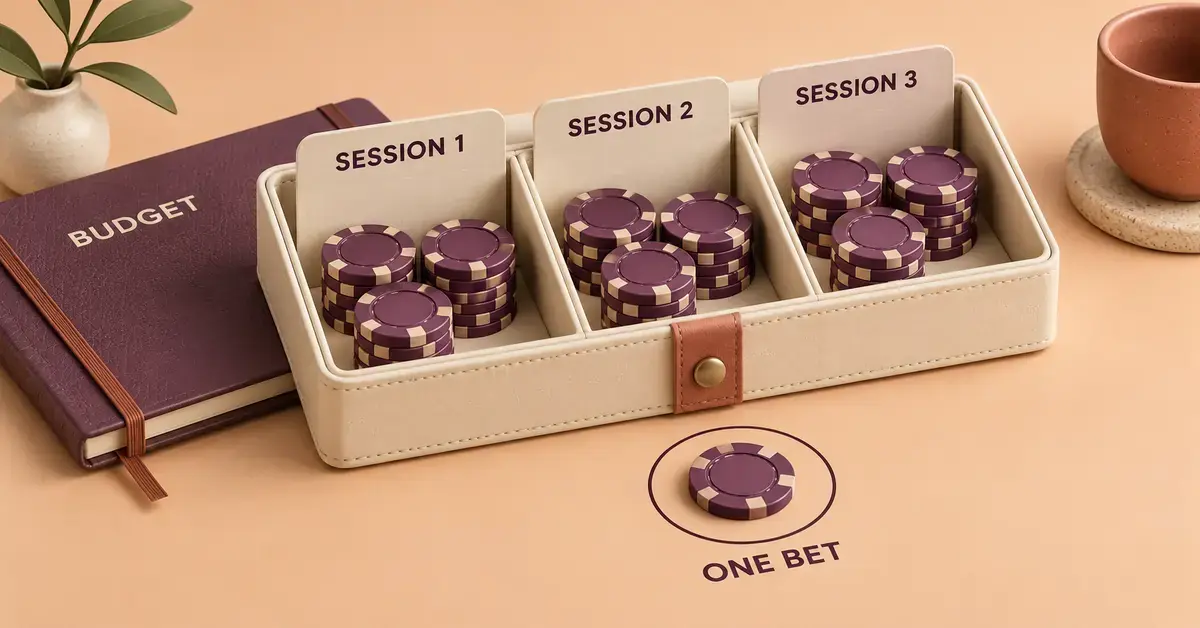
Casino bankroll management is the practice of deciding, in advance, how much money you are willing to risk, how you divide it across sessions, and how large each bet should be. It will not change the odds of any game — the built-in house advantage stays the same whether you bet carefully or recklessly — but it decides how long your money lasts, how much swing you feel along the way, and whether a session ends on your terms or with an empty balance. This guide explains how to set a casino budget, choose a sensible bet size, and keep both under control.
Key Takeaways
- Management controls exposure, not odds. It never removes the house edge or improves your chance of winning.
- Set a budget first. Only ever use money you can afford to lose, decided before you play and split into session bankrolls.
- Keep bets small. A common guideline is 1–5% of your session bankroll per bet (many stay at 1–2%).
- Use hard limits. Fix a loss limit, a win limit and a time limit — and never move them mid-session.
- Expected loss ≈ amount wagered × house edge. Lower-edge games and smaller stakes make a bankroll last longer.
- Avoid chasing losses and “systems.” No staking pattern beats the maths over time.
What is a casino bankroll?
Your bankroll is the pool of money you have set aside specifically for gambling and nothing else. It is a core term in any casino glossary: the amount you have genuinely decided you can afford to lose for entertainment, kept separate from rent, bills, groceries, savings and any money you need for everyday life.
Thinking in terms of a defined bankroll changes how you play. Instead of reaching for whatever is in your account in the moment, you work from a fixed, pre-committed figure. That single habit — drawing a hard line before you start — is the foundation that every other part of bankroll management is built on.
What bankroll management can and cannot do
Bankroll management controls your exposure, not your odds. Every casino game is built with a mathematical edge for the house, so over enough bets the expected result is a loss regardless of how you stake. No budgeting method, staking pattern or betting system removes that edge or turns a losing game into a winning one.
What careful management does do is real and worthwhile:
- It caps your losses. You can only lose what you bring, so the amount at risk is a decision you make in advance rather than one made for you in the heat of a session.
- It extends your playing time. Smaller bets relative to your bankroll mean more rounds of entertainment for the same money.
- It smooths the ride. Sensible stakes reduce the chance that normal short-term swings wipe you out in a few unlucky minutes.
- It keeps decisions rational. Pre-set limits are far easier to follow than willpower once a session is under way.
If you want to understand why the edge is unavoidable, see our explainer on how casino games work and the detailed breakdown of the house edge. Treat anyone who claims a staking system can beat the house as mistaken.
How to set a casino budget
Set your casino budget from money you can comfortably afford to lose, and decide the figure before you play — never during a session. The number should be one that, if it disappeared entirely, would not affect your rent, your bills or your peace of mind. A common approach is to treat gambling spend like any other entertainment line in your monthly budget: a fixed amount, no more.
A simple step-by-step
- Pick a total gambling budget. Decide what you can lose over a set period — a week or a month — without any real-world impact.
- Divide it into sessions. Split that total into individual session bankrolls. If your monthly budget is $100 and you play four times a month, each session bankroll is $25.
- Never top up mid-session. When a session bankroll is gone, the session is over. Reloading to chase losses is the fastest way to blow a budget.
- Keep winnings honest. Decide in advance whether winnings return to your bankroll or are banked and withdrawn. Writing it down beforehand stops a good night from turning into a bad one.
Keep gambling money separate
Hold your bankroll in a separate account or payment method so it is physically distinct from everyday funds. A dedicated card, e-wallet or account makes the budget visible and makes it harder to spend money you did not plan to. It also makes tracking far simpler, because every deposit and withdrawal lives in one place.
How to choose your bet size
Your bet size should be small relative to your session bankroll so that a normal losing streak cannot end the session in minutes. Betting too large is the single most common reason a bankroll disappears quickly: the bigger each stake is as a share of your money, the greater the chance that short-term variance ruins you before luck has any chance to even out.
The 1–5% guideline
A widely used convention is to keep each bet between 1% and 5% of your session bankroll, and many cautious players stay at 1–2%. These figures are rules of thumb, not laws — they do not improve your odds — but they are a practical way to size bets so your money lasts:
- On a $100 session bankroll, a 1–2% stake is roughly $1–$2 per bet.
- At 5%, the same bankroll means $5 per bet and a much shorter session if the cards or reels run cold.
- Lower percentages buy more rounds and a gentler ride; higher percentages mean bigger swings in both directions.
Flat betting versus percentage betting
Flat betting and percentage betting are the two main staking approaches. With flat betting you wager the same fixed amount every round regardless of results — simple, predictable and easy to track. With percentage betting you recalculate each stake as a share of your current bankroll, so bets shrink automatically as you lose and grow as you win.
Flat betting is the easier choice for most beginners because it removes in-the-moment maths and makes a session trivial to budget. Avoid any staking pattern that tells you to increase bets after losses — so-called negative-progression systems such as the Martingale — because they raise your exposure exactly when you can least afford it and run straight into table limits and finite bankrolls.
Match the stake to volatility
Higher-volatility games need smaller bets and a larger bankroll to survive their swings. Volatility (also called variance) describes how results are distributed: low-volatility games pay small amounts often, while high-volatility games pay rarely but larger. Two games with the same long-run return can feel completely different session to session — our guide to volatility and variance explains why.
In practice, a high-volatility slot or a long-shot bet can empty a bankroll far faster than a low-volatility game, even when the average result is identical. If you are playing something swingy, size down.
How long will your bankroll last?
Over the long run, your expected loss is simply the total you wager multiplied by the house edge — not the amount you deposit. The formula is: expected loss ≈ bet size × number of bets × house edge. Because you bet the same money over and over as you win some back and stake it again, the amount that passes through the game (your “total wagered” or “turnover”) is usually many times your starting bankroll.
An example makes it concrete. Betting $2 a spin on European roulette (a 2.7% edge) for about 40 spins means $80 wagered and a long-run expected loss of roughly $2.16 that hour. The same $2 on American roulette, with its 5.26% edge, nearly doubles that. Choosing lower-edge games stretches a bankroll further, which is the core idea behind our comparison of the casino games with the lowest house edge.
The table below shows typical long-run expected losses per hour on a modest stake. These are averages the maths points to, not predictions — real sessions swing well above and below them because of variance, and plenty of individual sessions end in a win.
Session Budget Examples
Illustrative long-run figures for a $100 session bankroll with a $1–$2 bet. Expected loss = bet × bets-per-hour × house edge; real sessions vary widely around these averages.
| Game | Typical house edge | Example bet | Approx. bets/hour | Est. expected loss/hour |
|---|---|---|---|---|
| Blackjack (basic strategy) | ~0.5% | $2 | 70 | ~$0.70 |
| Baccarat (Banker) | ~1.06% | $2 | 70 | ~$1.48 |
| European roulette | 2.70% | $2 | 40 | ~$2.16 |
| American roulette | 5.26% | $2 | 40 | ~$4.21 |
| Slots (96% RTP) | ~4% | $1 | 300 | ~$12.00 |
Faster games and higher edges drain a bankroll more quickly, which is why slots can cost more per hour than a low-edge table game despite smaller individual bets.
Loss limits, win limits and time limits
Setting hard limits before you play is the most effective bankroll tool there is. Three limits do most of the work:
- Loss limit: the maximum you will lose in a session — usually your whole session bankroll. When you hit it, you stop, full stop.
- Win limit: a point at which you bank some or all of your winnings and walk away, so a good run does not get handed back.
- Time limit: a fixed length of play, say an hour or two. Fatigue leads to looser decisions, and the longer you play, the more the house edge applies.
Treat these figures as fixed once set. The moment you start adjusting a limit mid-session — “just one more deposit” — the limit has stopped doing its job. Most regulated Canadian online casinos also let you set deposit, loss and time limits directly in your account, which enforces the plan for you; our responsible gambling guide covers these tools in detail.
Tracking your play and reviewing results
Recording each session turns vague impressions into clear facts. Keeping a simple log — date, game, starting bankroll, time played, and the net win or loss — shows you how much you are really spending and which habits cost you most. People routinely overestimate wins and forget losses; a written record removes the guesswork.
Reviewing that log every few weeks helps you spot patterns: sessions that ran long and lost, games with swings you did not enjoy, or stakes that were too high for your bankroll. It also makes it obvious if spending is creeping upward over time, which is an early warning worth acting on.
Common bankroll management mistakes
Most bankroll disasters come from a short list of avoidable errors:
- Chasing losses. Increasing bets to “win it back” is the classic mistake. The odds do not change because you are behind; bigger bets just lose faster on average.
- Betting too large for the bankroll. Staking 20% or 50% of your money on a single bet means a couple of bad rounds can end everything before variance has any chance to even out.
- Playing with money you need. Using rent, bills or savings turns entertainment into a genuine financial risk.
- Topping up after hitting a limit. Reloading a busted session bankroll quietly doubles or triples your real budget.
- Treating winnings as free money. Winnings are part of your bankroll the instant they land; staking them recklessly is no different from staking a deposit.
- Trusting a “system.” Progressive staking and pattern-spotting do not overcome the house edge. Any claim otherwise is false.
Who should use bankroll management?
Everyone who gambles benefits from bankroll management, from the once-a-month casual player to the regular. For casual players it keeps a night out affordable and predictable; for frequent players it is the difference between controlled entertainment and spending that drifts out of hand. It is not a strategy for profit — no honest guide will promise that — but it is the single most practical way to keep gambling fun, affordable and firmly within limits you chose yourself.
A note on responsible gambling
This article is educational and is not financial, legal or gambling advice. Bankroll management helps you control spending; it does not improve your chances of winning, and every casino game is expected to lose money over time. Gambling should only ever involve money you can afford to lose, and it is restricted to adults (18+ or 19+ depending on your province).
If gambling is causing you or someone you know harm, free, confidential help is available in Canada. ConnexOntario offers 24/7 support at 1-866-531-2600, or text CONNEX to 247247. You can also learn the signs of problem gambling and how to get help and read about the self-exclusion and limit tools described in our responsible gambling resources.
Sources
Frequently Asked Questions (FAQ)
What is a good bankroll for a casino?
A good bankroll is any amount you can afford to lose entirely without affecting your bills, savings or daily life. There is no universal dollar figure — it depends on your finances. The right approach is to set a fixed total you treat as entertainment spending, then divide it into smaller session bankrolls.
What percentage of my bankroll should I bet?
A common guideline is 1% to 5% of your session bankroll per bet, with many cautious players staying at 1–2%. Smaller percentages make your money last longer and reduce swings. These are rules of thumb for controlling exposure, not a way to improve your odds.
Does bankroll management improve my odds of winning?
No. Bankroll management does not change the house edge or your probability of winning any bet. It only controls how much you risk, how long your money lasts and how large your swings are. Every game still favours the house over the long run.
What is the 1% rule in gambling?
The 1% rule means risking only about 1% of your bankroll on a single bet — for example, $1 on a $100 bankroll. It is a conservative version of the common 1–5% staking guideline, chosen to stretch play and limit the damage from losing streaks.
Should I use a separate account for gambling?
Yes, keeping gambling money in a separate account or payment method is a simple, effective habit. It makes your budget visible, stops you from dipping into everyday funds, and makes it far easier to track exactly what you deposit, win and lose.
